21
Various versions of disk brakes are
available for racing and cyclo-cross
bikes. Always read the enclosed in-
structions from the component manufacturer
before the rst ride. Make sure you practice
and get used to operating the brakes on safe
terrain before going on your rst bike ride!
Your bicycle is supplied with the
corresponding operating manual for
your specic braking model. You
can get more information about the brakes
on your bicycle in the operating manual pro-
vided by your manufacturer or on the manu-
facturer’s website.
Brakes are vital to your safety on
the bike. You should therefore
maintain them on a regular basis.
This requires specialist knowledge and
tools. Allow your specialist retailer to do this
type of work on your bicycle! Work that is
improperly carried out endangers your safe-
ty on the bicycle!
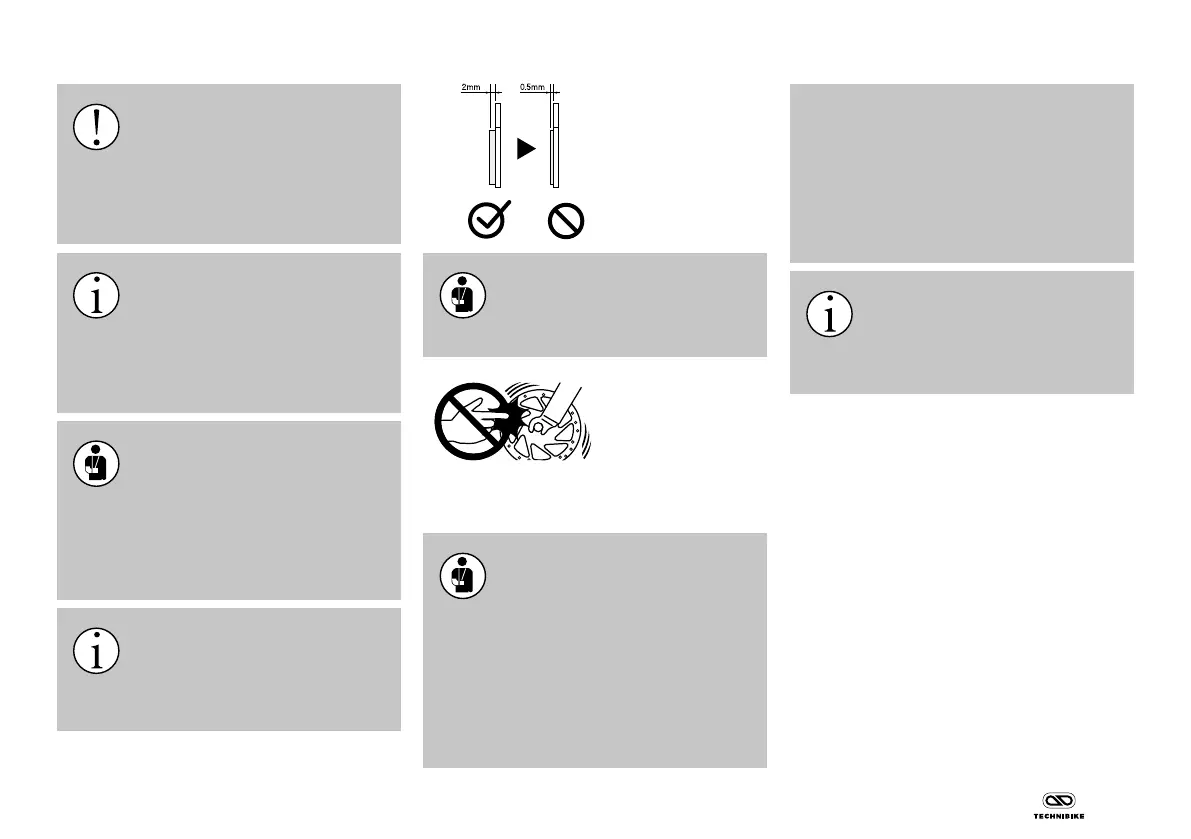
In particular, brake disks and brake
pads are subject to wear. Please al-
low a specialist retailer to check
these key parts on a regular basis and re-
place any worn parts if necessary.
Source: Shimano
®
techdocs
Please do not touch the brake disk
while it is rotating or directly after
braking. This could result in injury
or burns.
Source: Shimano
®
techdocs
Vapour bubbles in the disc brakes
Avoid permanently braking for
longer periods, as can be the case
during long, steep descents. Other-
wise this can allow vapour bubbles to form
and cause a complete failure in the braking
system. This could result in serious falls and
injury.
The brake lever may not be applied if the
bicycle is on its side or upside down. Oth-
erwise air bubbles can enter the hydraulic
system which could cause the brakes to fail.
After transporting the bicycle, check if the
pressure point of the brakes seems softer
than it was before. Then apply the brakes
slowly several times. This allows the brak-
ing system to discharge any bubbles. If the
pressure point remains soft, please refrain
from riding. A specialist retailer has to then
discharge the air from the brake system.
You can avoid this problem by ap-
plying the brake lever before trans-
port and then xing it in this position
using a strap. This prevents any air from
entering the hydraulic system.
When you come to cleaning the braking system,
please rst read the instructions provided by the
component manufacturer.
Gears
Use the shifter to change gears. Changing the
gears will increase or decrease the force or speed
of the bike as needed. In lower, easier gears, you
can easily ride uphill and lower physical strain. In
higher gears, which are harder to peddle in, you
can reach higher speeds and pedal at a lower
cadence. You should generally aim at riding the
bike at a higher cadence and in lower gears.



 To Next Page