27
How to use carbon components
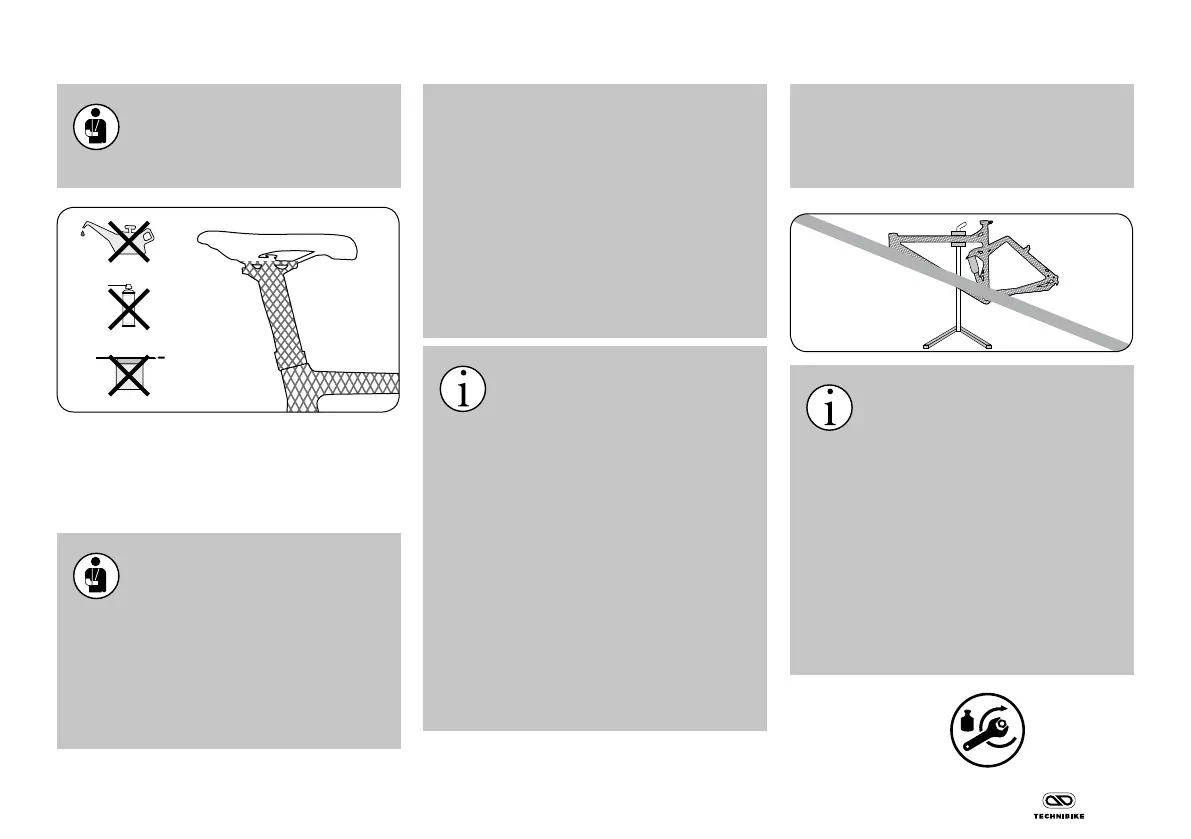
If you have a carbon frame or parts,
these should not be applied with
grease or oil. Please use special as-
sembly paste for carbon parts.
Carbon is a material which requires special han-
dling and care during construction, servicing, rid-
ing, transport and storage.
Properties of carbon
Carbon parts cannot be bent, dent-
ed or misshapen after an accident/
fall. If this is the case, it is possible
that the bres have been destroyed or have
broken off, e. g. within the part, which is not
visible from the exterior!
Therefore, it is vital to regularly check car-
bon frames and other carbon components
very carefully, especially after a fall or an
accident.
• Look for splinters, tears, deep scratches,
holes or other changes in the carbon surface.
• Check if the parts have got softer or less
stiff than usual.
• Check if individual layers (paint, nish or
bres) come off.
• Listen for any cracking or other usual
sounds.
If you are not completely certain that your
bicycle is in perfect condition, please allow a
specialist retailer to check the affected car-
bon parts!
Some carbon components require
lower torques than metal parts. Ex-
cessive torques can lead to hidden
damage, which is possibly not visible from
the outside. Frames or components can
break or warp to such an extent that you
could fall. Therefore please always adhere
to the instructions supplied by the manufac-
turer or ask for advice from a specialist. Use
a torque spanner to ensure that you get the
required torque. Carbon parts may not be
applied with grease or oil. Special assembly
paste is available for assembling and safely
securing carbon components with a low
mounting torque.
Never expose carbon parts to high temper-
atures! Even in the back of cars, the sun’s
rays can generate such a heat that it can put
the safety of carbon parts at risk.
Do not clamp a carbon frame directly into a
work stand, instead you should secure it by
the seat post. If the seat post is also made
of carbon, use another tube made of metal.
The following components and sec-
tions of carbon parts should be
checked regularly (at least every
100 km or 62 miles) for irregularities such as
cracks, breaks or surface changes, as well
as after any accident or fall involving the bi-
cycle: Transition area of the threaded bush-
ing of the drink holder, slot of the dropouts,
bearing areas in full-suspension frame, sus-
pension mounting elements on the main
frame and rear suspension, seat clamp, de-
railleur hanger, derailleur clamp area, disc
brake mounting or brake boss, press-t area
of the headset as well as the threads of the
bottom bracket cups.
Carbon =



 To Next Page