RiverRay Deployment Guide P/N 95B-6131-00 (April 2022)
EAR-Controlled Technology Subject to Restrictions Contained on the Cover Page.
Page 13
If the RiverRay was left in the hot sun, its temperature can quickly rise to 35⁰ C before use.
When initially placed in the water, the thermal mass of the RiverRay housing near the
temperature sensor initially affects the temperature measurement. Within five minutes it
reaches equilibrium and the temperature is accurate within ± 1⁰C. If the temperature sensor
is not allowed to sufficiently equilibrate within the body of water to be measured, it can
impact Speed Of Sound, velocity, and discharge-measurement accuracy.
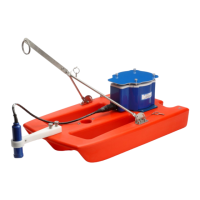
Tethered boat – The RiverRay is moved to the center of the river, and the stationary moving bed test is
started. After five minutes, the moving bed test is stopped and the application displays the apparent mov-
ing bed velocity.
Manned boat – The Hydrologist begins a moving bed loop-test with the boat starting near the river bank.
The boat is maneuvered across to the opposite bank and back again. The user stops the test, and the loop
test results are displayed.
Either type of moving bed test (stationary or loop) can be performed with either deployment
method (tethered boat or manned boat).
Quick Review
Run the Measurement Wizard Read Chapter 7 in the WinRiver II Users
Guide.
Set transducer depth and magnetic
variation.
Run the Built-in tests, compass
calibration, and moving bed tests
Set the clock
Read Chapter 9 in the WinRiver II Users
Guide.
Click the Set Clock button.


 To Next Page