feTElSTAR
MINI-V_I_rev0507US Page 6
4.2. FIRST CONNECTION PRECAUTIONS
Before connecting
to the
mains, carry
out
general cleaning
in
order
to
remove dust particles
accumulated during transport.
To do
this, follow cleaning
and
disinfecting instructions.
Earth suitably according
to the
cabinet plate details.
Before working
for the
first time, start
the
cabinet
and let it run for
about
6
hours
to
purge
out
the
filters.
New filters have
a
characteristic smell, which usually disappears
in a
short time.
4.3. ELECTRIC SUPPLY CONNECTION.
The cabinet
is
supplied with
a
single phase
fan and
connecting cable with European
(or
other
as specified)
plug.
The electronic card includes protection fuses.
The general switch
is at the top of the
cabinet,
on the
right seen from front,
by the
electric
cable.
WARNING
Before connecting
the
cabinet, check that
the
supply source coincides with that shown
on
the
specification plate.
The installation connected must comply with
the
safety requirements
of
the
country
where
it is
found.
4.4. START-UP
Once
the
previous points have been covered, start
the
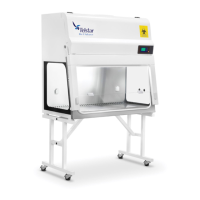
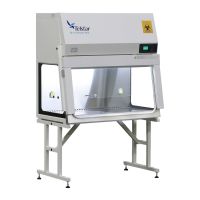
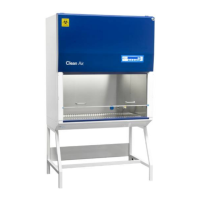
vertical laminar flow cabinet
by
pressing button
(Fig. 2 pos. 1) and
make sure
the
suction area
(Fig. 1.
pos.l)
is
free.
4.5. SWITCHING
OFF
To stop
the
cabinet, turn
the
button (Fig.2 pos.l)
to
stop position,
and
stop
the
general
switch
at the top of the
cabinet.
4.6. LONG STOP.
When
the
cabinet
is
idle
for a
long time, avoid,
as far as
possible, entry
of
dust
and
when
renewing work,
the
procedure should
be as if it
were first connection.
See
paragraphs
4.2 and 4.4
(above).
4.7.
U. V.
STERILIZA TION START-UP
This
is
started
by
pressing button
(Fig. 2 pos. 3),
which turns
on the red
alarm
(Fig. 2
pos.7).
To
change preset sterilization time,
see 5.2
Control
and
alarm panel (below).
WARNING
If this accessory
is
used,
the
usual precautions
for
these lamps must
be
taken.
It is to
be used only
for
sterilizing material outside before
it
enters
the
cabinet
or, all the
material used during
the
previous
PCR
to be
re-used.
In
this
way,
the
lamp
is a
supplement
for
work before
it is
done
in the
cabinet,
and
must
be off
when
the
operator
is
facing
the
table
or
working
at it.
Direct
UV
radiated rays
are
reflected
on
the polished metal parts
and can
seriously affect
the
operator's eyes.



 To Next Page