Section 1 - Introduction
Temp-Cast 2000 Installation Manual February 2010
5
COMBUSTION AIR SUPPLY:
The Temp-Cast heater requires an unrestricted air
supply for proper combustion and maximum
performance. (This section refers to the standard
Temp-Cast “arched” door & air-frame installation.
The Temp-Cast “square” door installation is
described in a separate
manual.)
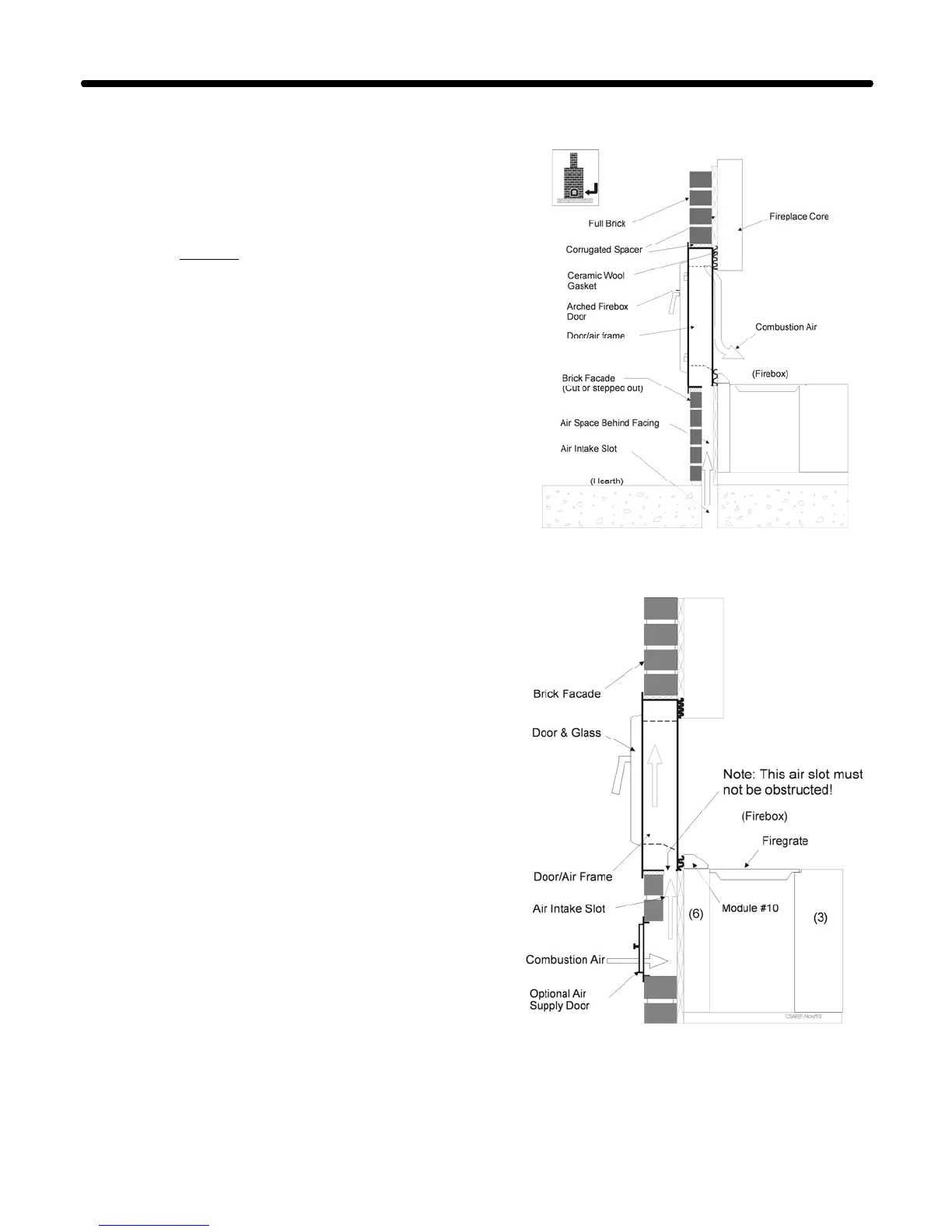
Combustion air can be drawn from outside or inside
the house and delivered by way of a 15" x 2"
(380mm x 50mm) air intake formed in front of the
heater during construction of the concrete floor pad.
Air is then directed up behind the facing masonry,
and into the hollow door frame through slots on the
bottom. The air travels up inside the door frame and
feeds the fire from above, creating an "air-wash"
across the doors to keep the glass clean. (See Fig. 1a)
If the installation is designed to use inside air from
the same room as the heater, (such as in a basement
installation ), then an optional "air supply door" must
be purchased and installed under the loading doors.
This will allow combustion air to be drawn from the
room, travel up behind the facade and into the hollow
door frame. (Refer to Fig. 1b).
In a basement installation, outside air can still be
brought into the fireplace, if ceiling height permits.
In this case, a raised hearth can be constructed, and
6" (150mm) of fresh air can be fed into this
structure.
(A "false" chimney can be used for this fresh air
supply.) The air is brought to the front of the heater
into a 15" x 2" (380mm x 50mm) masonry slot or
custom-fabricated "boot" and treated as a normal
outside air installation.
In a "See-Through" fireplace, 8” of combustion air
must be supplied and divided equally to both door
frames to provide an "air wash" for each door glass.
(See Fig. 16)
Fig 1a
Fig 1b



 To Next Page