Temp-Cast 2000 Installation Manual February 2010
6
SECTION 2: CHIMNEYS & DAMPERS
GENERAL REQUIREMENTS
Temp-Cast fireplaces require an approved
chimney system for safe and satisfactory
performance. Code-approved masonry and
factory-built chimney systems are both
acceptable.
In addition to building code requirements, every
chimney system should:
extend straight up from the base of the
fireplace
be at least 18 ft (5.5m) in height
have an access at the base, with a tight-
fitting metal door, for chimney cleaning
have a cross-sectional area of at least 50 sq.
inches (320 sq cm)
NOT BE CONNECTED TO ANOTHER
APPLIANCE OR TO ANY AIR DUCTS
FLUE CONNECTIONS
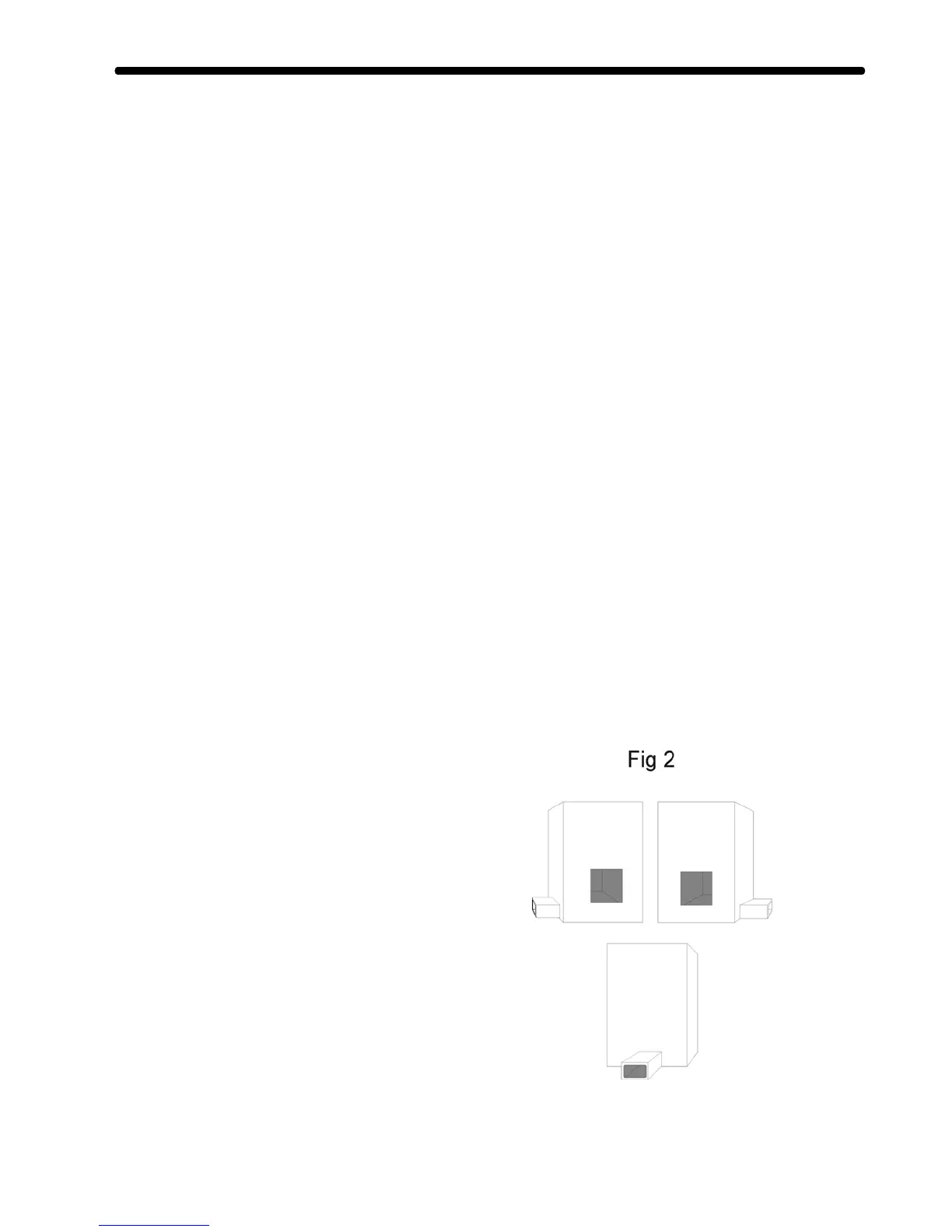
The chimney connection is made at the bottom
of the fireplace, in the first course. The
connection can be made on either side of the
fireplace or through the back wall, into the cross
manifold. (Refer to Fig. # 2). The flue
connection can be up to 5 ft. long, creating
heated benches & allowing additional flexibility
in chimney locations.
For a side connection, the side channel (Part #
30 or 31) is cut to receive the connector. (see
step 18.) Make this cut carefully so that a
smooth transition from the fireplace to the
chimney results, free of
obstructions to the flow
of the escaping smoke. Use joint sealing mortar
to make it completely smoke tight. The
connector piece penetrates the fireplace side
channel about 1" (25mm), but care must be
taken to ensure that it does not protrude past the
inner edge of the side channel. (See Figs. # 3
and 4.)
If the connection is made at the back of the
fireplace, the cross manifold (Part #3) is cut to
receive the flue connector. This joint must
also be smoke-tight. (See also Section 3,
Step #3.)
MASONRY CHIMNEYS
Due to the thermal mass storage capability
of masonry chimneys, we recommend them
over factory-built chimneys, provided they
are completely inside the home & fitted with
a damper.
Masonry chimneys should have carefully
aligned flue liners, with joints that are
smoke-tight and joined with refractory
mortar. The inside surface of the liner
should be smooth, with all excess mortar
removed. Refractory, clay and UL/ULC
listed stainless steel are all acceptable liners.
An access for a chimney cleanout can be cut
in the first vertical flue tile. (See Fig #10)



 To Next Page