8
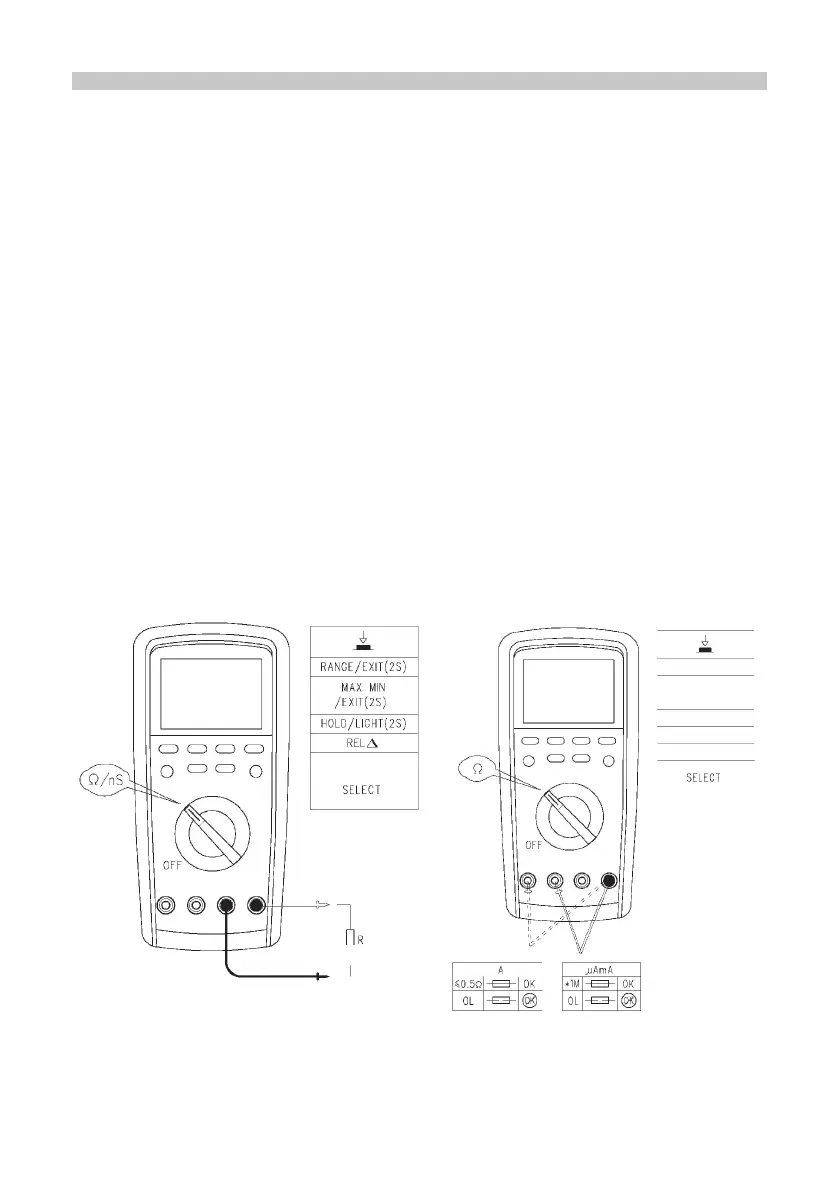
MEASURING RESISTANCE/CONDUCTIVITY
• When measuring ultra-high resistance, higher than 40MΩ, it is advised to use nS
range to measure its conductivity G: G=1/R (Ω). The unit Siemens (S)=10 9/R (Ω).
The unit is (nS).
• By virtue of the function of resistance measuring, it is allowed to make self-checks
on built-in fuses.
• Open circuit voltage is about 1V.
Caution
• If the resistance under test is an open circuit, or the resistance is beyond the
maximum range of the instrument, it will display “OL” on the LCD.
• When measuring in-circuit resistance, turn off all the power to the circuit under test
and discharge the residual electric charge in the capacitor before measuring, in
order to guarantee correct findings.
• In low-resistance measuring, the probe will result in an error of 0.1Ω-0.2Ω.
• In order to acquire an accurate reading, it is necessary to short-circuit the probe
and adopt Relative Measuring mode to ensure measuring precision.
• If probe resistance is higher than 0.5Ω in short circuit, it’s necessary to check
whether the probe is loose or if there is any other reason.
• When measuring high resistance, it is likely to take a couple of measurements
before the reading is stable. This is normal for measuring high resistance.
• It is not allowed to input voltage higher than DC 30V or AC 30V in order to prevent
personal injury.


 To Next Page