69
CHECKING PISTON PACKING FOR THE STEERING CYLINDER
1. Apply the parking brake and lower the loader
bucket to the floor.
2. Turn the steering wheel all the way to the right
and stop the engine.
3.Depressurize the hydraulic system.
4. Disconnect the hose at the left side of the
steering cylinder.
5. Install a plug in the hose. The thread size 3/4-16.
6. Start the engine and run the engine at full
throttle.
7. Turn the steering wheel all the way to the right
and continue to turn the steering wheel to the
right while another person checks for leakage at
the open fitting.
8. If there is constant leakage, the piston packing is
damaged and must be repaired.
NOTE:
Carry out the same procedure for the rear
axle steering cylinder.
ORBITROL STEERING UNIT RELIEF VALVE TEST
1. Work the machine until the temperature of the
hydraulic oil is at least 60
°
C (140
°
F).
2. Park the machine on firm, flat ground.
3. Dump the bucket, raise the loader beam and
install the safety strut.
4. Stop the engine and release the pressure from
the hydraulic system.
5. Open the hood.
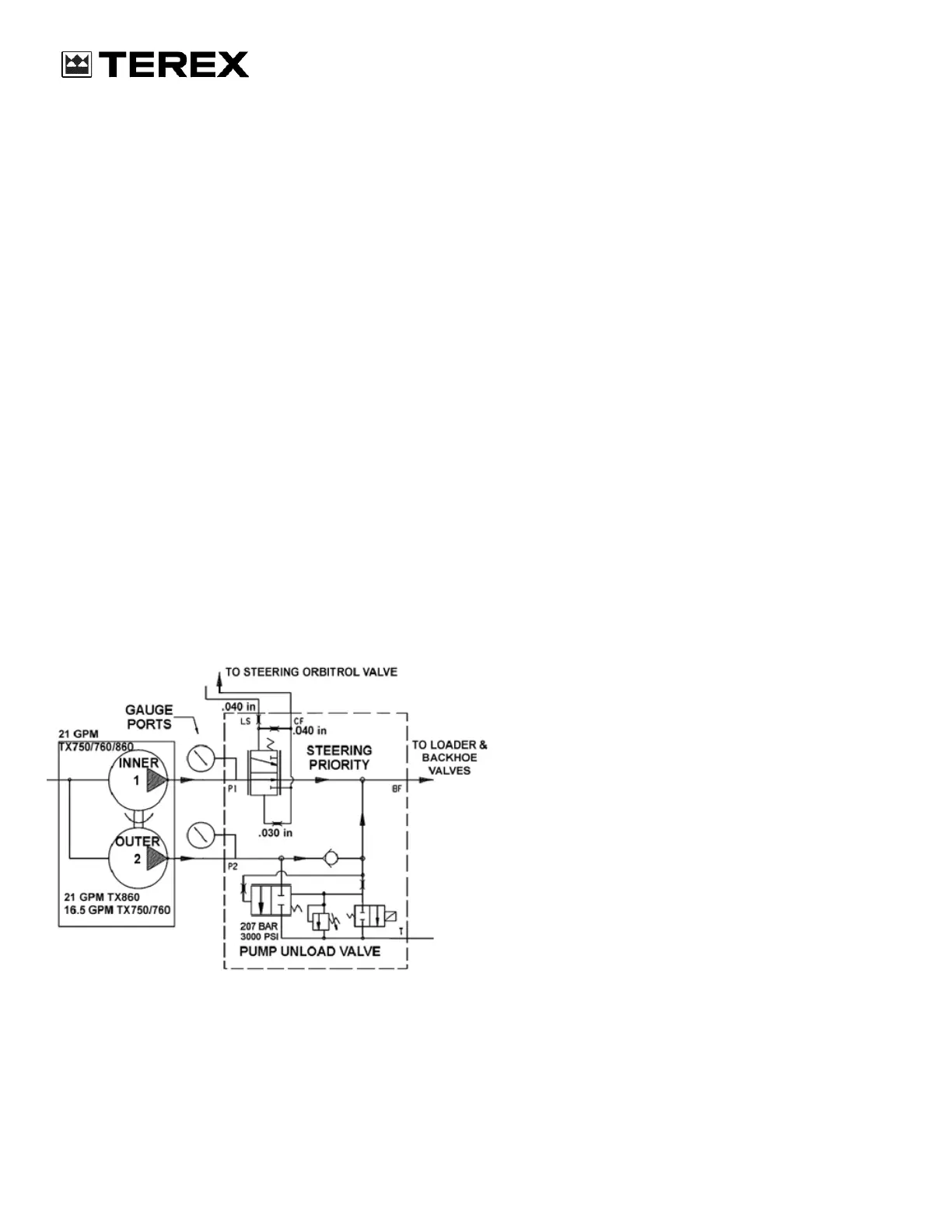
6. Connect the pressure gauge to test point (P1)
Connect the pressure gauge
to the test ports
7. Start and run the engine at 1800 rpm.
8. Turn the steering to full lock and check the relief
valve pressure setting.
This should be 2500 to 2575 psi (170 to 175 bar).
9. Adjust the relief valve in the orbitrol steering unit
if the pressure is not correct.
Adjustment
NOTE:
The relief valve will not normally require
adjustment unless the steering system pressure is
not correct on test. The valve can be adjusted on the
machine or on a test bench. This instruction
describes setting on the machine, but the method of
adjustment is the same when using a test bench.
Adjust the relief valve as follows :
1. Park the machine on firm, level ground.
2. Fully crowd the bucket, raise the loader beam
and fit the safety strut.
3. Lower the backhoe stabilizers to the ground. Do
not raise the machine.
4. Stop the engine and depressurize the hydraulic
system.
5. Fit the test equipment.


 To Next Page