6 Using the product
22
Pos: 62 /TD/Übersc hriften/6. Produkt verwenden @ 0\mod_11737749 28554_79.docx @ 328 @ 1 @ 1
6 Using the product
Pos: 63 /TD/Produk t verwenden/testo 275/A llgemeine Messhin weise (testo 275) @ 15\ mod_1407491032301_79.d ocx @ 194774 @ 25555 @ 1
6.1. General measurement information
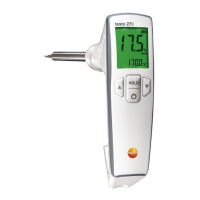
The testo 270 enables several measurements to be carried out one
immediately after the other without any waiting times.
Which oils/cooking fats can be measured?
In principle, all oils and fats intended for deep fat frying can be
measured.
This includes, for example, rapeseed, soya bean, sesame, palm,
olive, cotton seed or groundnut oil. Fats from animal sources can
also be measured. There may be a variation of several percentage
points in the % TPM value for fresh cooking oils, depending on the
type.
The maximum service life for the cooking oil cannot be derived
from this.
Example: Fresh palm oil has a higher % TPM value than other
cooking oils, but ages considerably more slowly.
Use of additives
The testo 270 is designed for the use of pure fats/oils. If additives
are used, deviations may occur.
Comparison of laboratory methods / testo 270
Cooking oil is a mixture of substances with a wide variety of
polarities. During ageing, the proportion of more highly polar
components increases. The laboratory method of column
chromatography separates the fat into a polar and a non-polar
group. The proportion of the polar group compared to the total
amount of cooking oil being investigated is described as the
% TPM value (total polar materials).
The % TPM value established by column chromatography may
vary slightly depending on the setting of the separation limit
between the polar and the non-polar group.
Depending on the type of fat, slight variations of the polarity in both
groups (polar/non-polar) may occur which are not however
identified by the chromatography.
On the other hand, the testo 270 records the entire polarity of the
cooking oil and thus the actual polarity of both groups (polar/non-
polar). This means the reading of the testo 270 may be higher or
lower than that of the column chromatography in individual cases.
An example of this is coconut oil, for which the testo 270 shows
higher TPM values than column chromatography. However, this fat


 To Next Page