9 / 19
Description of the signal inputs and output
L Connect the signal inputs “Stop“, “IN" with volt-free contacts only !
Stop external analysis stop
Function Type of contact Test time Action
Stop
S external analysis stop
(e. g. via flow controller or from the
process controller)
programmable
normally
closed/normally
open volt-free!
none
S So long as the contact at the input is
‘open‘ or ‘closed‘, no analyses are
carried out.
IN
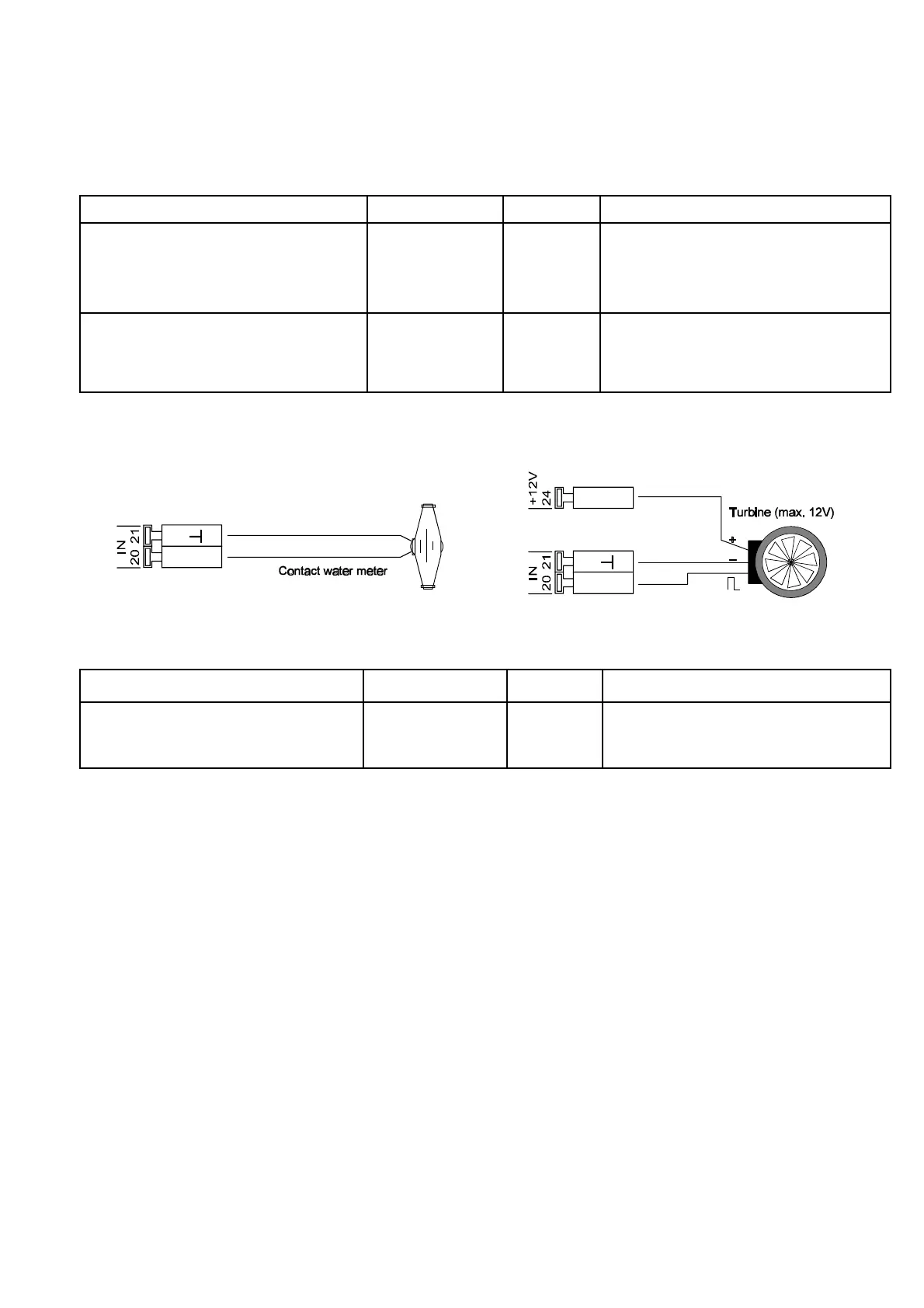
S Water meter input
normally closed/
normally open
volt-free!
or turbine
none
S Quantity recording to start an analysis
"M" º BASIC PROGRAM º PROGRAM VALUES º INPUT STOP
"M" º BASIC PROGRAM º PROGRAM VALUES º WATER METER
Installation example for the water meter
OUT Interface output
Function Terminal Test time Action
power interface 0/4-20mA max. load
350 Ohm
- programmable
S 0 - 20 mA
S 4 - 20 mA
"M" º BASIC PROGRAM º PROGRAM VALUES º 0/4-20mA
Function characteristics
Mode of operation (Analysis controller)
1. Time control: Internal triggering by a timer. The shortest interval = 0 minutes between analyses, longest interval
= 99 minutes.
(see page 10, interval periods)
L The analysis interval is determined by the duration of the set flush times the programmed (interval) and the
duration of the analysis. The analysis duration is a direct function of the value to be measured.
2. Quantity control: Triggered by the water meter.
Minimum interval = 1 litre, maximum interval = 9999 litres.
After the programmed water quantity is measured, the analysis is carried out. Prior to the analysis, the capillary
and the measuring chamber are flushed (observe the programmed flush times).
L The current analysis interval can be interrupted by making contact at the "Stop" input.


 To Next Page