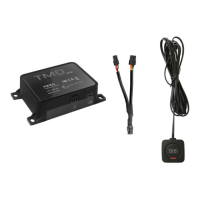
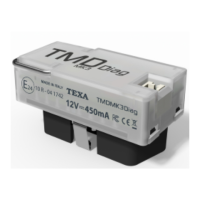
11.2 Positioning
Once you have located the connection points to the power supply lines, you must find the
most suitable place to fasten the device.
When positioning the device, you must respect the following general rules:
•
It must be far from sources of heat
•
It must be in a dry place and away from moisture and water
•
It must be close enough to enable the connection to diagnostic devices
•
It must be in a place where the internal antennas are not shielded
•
The device must maintain the direction selected when the vehicle is in motion
•
The device must be secured to a rigid support to prevent it from being subject to
excessive vibrations.
The device must be placed in a position in which it is not
covered by metallic sides or by other materials that may
screen the radio waves.
Do not fasten the device near antennas or other radio
devices (ex.: CBs, radars, mobile phones, etc.).
The device can be installed in any direction inside the
vehicle; however, position it with the upper part facing
upwards and sky-facing, where possible.
In order to use the inertial sensors, the device automatically calculates its positioning inside
the vehicle.
The automatic calculation takes place during the first trip after the installation.
The trip must last between 2 and 5 minutes based on the type of route.
If the length of the trip or the features of the route (for example the vehicle is stopped for too
long) are not sufficient in order to complete the operation, it will be repeated during the
following trip.
The data of the inertial sensors will not be used by the device until the operation described
above has been completed, in particular the identification of a possible accident will not be
active.
Once this phase is completed, all the functions configured that require the use of the inertial
sensors will be enabled automatically.
en
79


 To Next Page