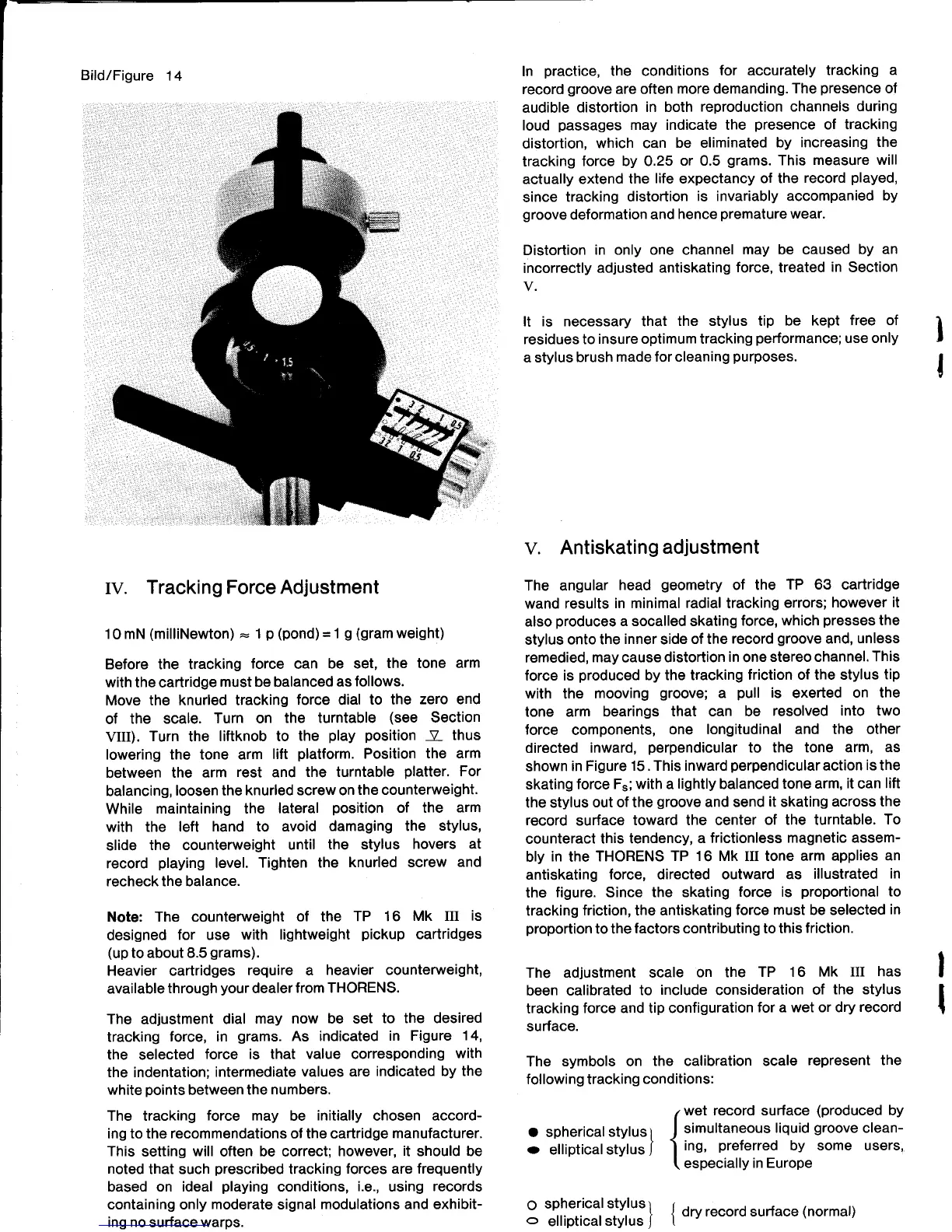
Bif
d/Figure
14
IV.
Tracking Force Adjustment
10mN
(milliNewton)
=
1
p
(pond)=1
g
(gramweight)
Before the tracking
force
can
be set,
the tone
arm
with
the cartridge
must be balanced
as
follows.
Move the
knurled tracking
force dial
to the
zero end
of
the scale.
Turn on
the turntable
(see
Section
VIII).
Turn
the
liftknob to
the
play position
-V-
thus
lowering the tone arm
lift
platform.
Position
the arm
between
the arm
rest
and
the turntable
platter.
For
balancing,
loosen the
knurled screw on
the counterweight.
While
maintaining the
lateral
position
of the
arm
with the
left hand to avoid
damaging the
stylus,
slide
the counterweight
until
the stylus
hovers at
record
playing
level.
Tighten the
knurled screw
and
recheck the balance.
Note:
The counterweight
of the
TP 16
Mk III
is
designed
for use
with lightweight
pickup
cartridges
(up
to about 8.5
grams).
Heavier cartridges
require a
heavier counterweight,
available
through
your
dealer
from THORENS.
The
adjustment
dial
may now be set
to the desired
tracking
force, in
grams.
As indicated
in Figure
14,
the selected
force is that value corresponding
with
the indentation;
intermediate
values are
indicated by the
white
points
between the
numbers.
The tracking
force may
be
initially
chosen
accord-
ing to the recommendations of the cartridge
manufacturer.
This
setting
will
often be correct;
however,
it
should be
noted
that such
prescribed
tracking
forces are frequently
based on ideal
playing
conditions,
i.e.,
using
records
containing only
moderate
signal
modulations and exhibit-
ing no
surface
warps.
In
practice,
the conditions
for
accurately
tracking
a
record
groove
are often
more demanding.
The
presence
of
audible
distortion
in both
reproduction channels
during
loud
passages
may indicate the
presence
of tracking
distortion,
which can
be eliminated
by increasing
the
tracking
force by 0.25
or 0.5
grams.
This
measure will
actually extend
the
life
expectancy
of the
record
played,
since
tracking
distortion
is invariably accompanied
by
groove
deformation
and
hence
premature
wear.
Distortion
in only one channel
may be caused
by an
incorrectly
adjusted antiskating
force,
treated
in
Section
It is necessary that
the stylus tip be
kept
free of
I
residues to
insure optimum tracking
performance;
use only
I
a stylus
brush
made for
cleaning
purposes.
I
v.
Antiskatingadjustment
The angular
head
geometry
of the
TP 63 cartridge
wand results
in minimal radial tracking
errors;
however
it
also
produces
a socalled skating
force,
which
presses
the
stylus onto
the
inner
side
of the
record
groove
and,
unless
remedied,
may
cause
distortion
in
one
stereo channel.
This
force is
produced
by the tracking
friction of the stylus
tip
with
the
mooving
groove;
a
pull
is
exerted
on the
tone arm bearings
that can be
resolved
into two
force
components,
one
longitudinal and
the other
directed
inward,
perpendicular
to the
tone arm,
as
shown
in Figure
15. This inward
perpendicular
action
is the
skating
force Fs; with a
lightly
balanced
tone arm,
it
can
lift
the stylus
out of the
groove
and send
it
skating
across the
record
surface
toward the center
of the turntable.
To
counteract
this tendency,
a frictionless
magnetic assem-
bly
in
the
THORENS
TP 16 Mk III tone arm
applies an
antiskating
force,
directed
outward as
illustrated
in
the
figure.
Since
the skating
force is
proportional
to
tracking
friction, the antiskating
force
must
be selected
in
proportion
to the
factors contributing to this
friction.
The adjustment scale
on the
TP 16 Mk
III has
been calibrated
to
include
consideration
of
the stylus
tracking
force and tip configuration
for a wet or dry
record
surface.
The symbols on
the calibration scale
represent the
following tracking
conditions:
wet record surface
(produced
by
simultaneous
liquid
groove
clean-
ing,
preferred
by some users,
especially
in Europe
I
I
o spherical
stylus
1
o
ellipticalstylus
J
o
spherica.l
stvlusl
I dry record surface
(normar)
o
ellipticalstylus
I
I


 To Next Page
 Loading...