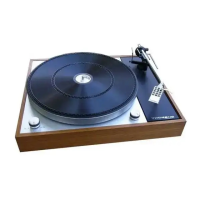
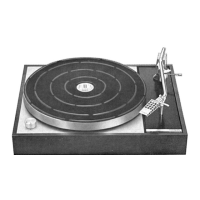
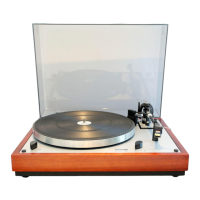
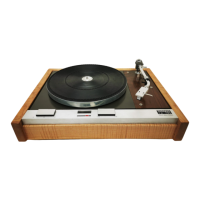
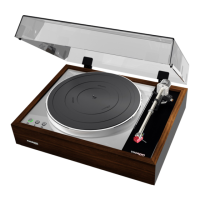
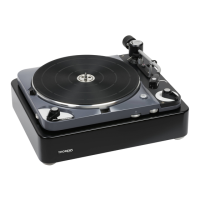
The Thorens TD-150 is a high-performance turntable designed for integration into a music system, offering precise playback of records. It is available in several configurations: the TD-150 AB (with a pick-up arm and wooden base), TD-150 A (with a pick-up arm but without a base), TD-150 B (without a pick-up arm but with a base), and the basic TD-150 (without a pick-up arm or base). This manual primarily focuses on the TD-150 AB model, with specific instructions for other models highlighted where applicable.
Function Description
The core function of the TD-150 turntable is to accurately reproduce audio from vinyl records. It achieves this through a belt-drive system that ensures stable platter rotation and minimizes motor vibrations from reaching the record. The turntable's design emphasizes precision, with components engineered to very close tolerances to deliver high-fidelity sound. The pick-up arm, particularly the TP-13 integrated arm on the AB and A models, is designed for excellent longitudinal and lateral balance, crucial for accurate tracking of record grooves.
Usage Features
The TD-150 offers several features to enhance the user experience and ensure optimal playback:
- Unpacking and Installation: The manual provides detailed instructions for unpacking the turntable, emphasizing the importance of retaining all packing materials for potential re-shipment to prevent damage. For models TD-150 AB and B, specific steps involve removing corrugated spacers and carefully extracting the unit. For TD-150 and TD-150 A, similar steps are outlined, with particular attention to leaving certain spacers in place until installation is complete to protect the main shaft and unit plate.
- Pick-up Arm Mounting (TD-150 and TD-150 B): For users mounting their own pick-up arm, the manual guides through removing the bottom cover, loosening screws on the wooden board, and consulting the arm manufacturer's instructions for drilling and installation. It highlights the importance of using compliant pick-up leads to avoid stiffening the turntable's spring mount, which could degrade performance. A ground lead connection is also specified. For heavy pick-up arms, adjustments to the conical coil springs supporting the metal frame may be necessary.
- Turntable Mounting on a Panel: The TD-150 can be mounted on a plywood board using a provided template (TD-560). Two mounting modes are described: with the unit plate on top of the panel, or slightly recessed. In both cases, the unit plate should be securely fastened to the panel or wooden supports.
- Power Supply Configuration: The turntable motor is configured for different power supplies depending on the region. For USA and Canada, it's set for 60 cycle, 100-120 volt operation. For other countries, it's typically 50 cycle, 200-240 volt. The manual includes diagrams for motor connections and explains how to adapt for different voltages (e.g., 200 to 100 volt) by soldering a wire. Changing between 50 and 60 cycle operation requires replacing the entire motor with its integrated pulley.
- Assembling the Outer Platter: Users are instructed to remove the stylus force calibration plate and carefully center the outer turntable platter on the inner platter, with the rubber mat on top. The central adapter, used for normal or large-hole records, can be installed in two inverse positions. A critical notice warns against shock or strain to the motor, spindle, and pulley during this process to avoid invalidating the warranty.
- Cartridge Installation and Connections: If a cartridge is pre-mounted, this section can be skipped. Otherwise, the aluminum plug-in shell accommodates standard pick-up cartridges. Users should follow the cartridge manufacturer's mounting instructions, but use the screws provided with the TD-150 AB and A turntables. The cartridge height needs to be adjusted to position the stylus tip within a specific distance from the bottom of the shell. The manual details the color-coded leads for cartridge connections (Red for right positive, Green for right negative/shield, White for left positive, Blue for left negative/shield) and explains the factory wiring for pick-up output connections.
- Ground Connection: The unit plate and metal arm parts are connected to the shield of the right channel cable, which acts as a ground lead. The left channel cable's shield is insulated. Spring-mounted parts are grounded to the fixed unit plate. The manual also describes two alternative wiring systems (3-wire and 5-wire) for specific cartridges or amplifiers, allowing for different grounding configurations.
- Cartridge Alignment: The patented plug-in shell allows for adjustment of both vertical tracking angle and stylus overhang for optimum tracking. Users are guided to loosen screws, insert the shell plug, and then adjust the vertical tracking angle by bringing the arm over a record and following cartridge manufacturer instructions. The stylus overhang is adjusted using the central adapter and ensuring the stylus tip just strikes the upper circle of the adapter.
- Pick-up Arm Adjustments: The counterweight, packed separately for transit protection, needs to be mounted on the arm extension. The manual describes how to balance the arm by moving the counterweight until the arm assumes a horizontal position, with a fine adjustment knob for precision.
- Operation: Operating the turntable involves placing a record, pushing the "On-Off" knob down to start, and turning the knob to the desired speed (33⅓ or 45 RPM). A crucial note states that speed can only be changed when the platter is revolving, and the knob cannot be turned when in the "Off" position. To play a record, the pick-up arm control lever is moved to "High," the arm is disengaged from its rest and positioned above the record, then the lever is moved to "Play" for a smooth, damped landing. To stop, the lever is moved back to "High," the arm returned to rest, and the "On-Off" knob pulled to "Off."
Maintenance Features
Proper maintenance ensures the longevity and performance of the TD-150:
- Cleaning the Belt and Pulleys: For optimal drive system function, the belt, motor pulley, and inner turntable periphery must be free of oil or grease. Cleaning with a rag impregnated with denatured alcohol is recommended. The manual includes a diagram illustrating the correct belt position, noting it will center in the control fork only when the outer platter is in place.
- Turntable Spindle: The spindle uses self-lubricating bushings and a nylon thrust plate. Under normal conditions, lubrication is not required for several thousand hours. When needed, only Caltex or Texaco Regal Oil B (ROB), available as an accessory, should be used.
- Motor: The slow-speed double synchronous motor is designed not to require lubrication during its lifetime.
- Important Notice on Packing: The manual strongly advises saving the complete original packing for any re-shipment, as the TD-150 is a delicate instrument and can be severely damaged if forwarded in improvised packing. This is also tied to warranty conditions.

 Need help?
 General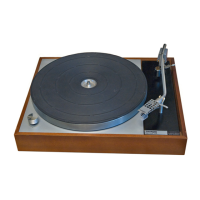

 To Next Page