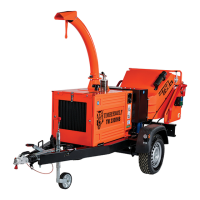
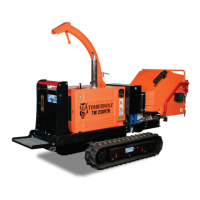
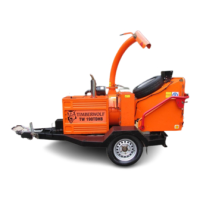
TW 13/75G
10 / 32
OPERATING INSTRUCTIONS
C190-0187 25.01.2019 Rev: 1.0
BLOCKAGES
Always be aware that what you are putting into the chipper must come
out. If the chips stop coming out of the discharge tube but the chipper
is taking material in STOP IMMEDIATELY. Continuing to feed material
into a blocked machine may cause damage and will make it difficult to
clear. If the chipper becomes blocked, proceed as follows:
Stop the engine, as per instructions on page 9. •
Remove the M12 screw that retains the top rotor housing. •
Open the top rotor housing. •
Wearing gloves, reach into the rotor housing and scoop out the •
debris causing the blockage.
It is not necessary to remove all the debris, just the majority. •
Close the rotor housing and clamp down tightly. •
Restart the engine and increase to full speed. •
Allow chipper time to clear the rotor housing. •
Feed a small piece of wood in to ensure complete clearance. •
If this does not clear it, repeat the process and carefully inspect the discharge tube to find any obstruction. •
NOTE
Continuing to feed the chipper with brushwood once it has become blocked will cause the chipper to compact the chips
in the rotor housing and it will be difficult and time consuming to clear.
AVOID THIS SITUATION - WATCH THE DISCHARGE AT ALL TIMES.
BLADE WEAR
The most important part of using a wood chipper is keeping the cutter blades sharp. Timberwolf chipper blades are
hollow ground to an angle of 40 degrees. When performing daily blade checks ensure blade edge is sharp and free from
chips, if there is any evidence of damage, or the edge is “dull” change the blade(s). The TW 13/75G is fitted with one blade
177 mm (7") long. It is 43 mm wide when new. A new blade should chip for up to 25 hours before it requires sharpening.
This figure will be drastically reduced by feeding the machine with stony, sandy or muddy material.
As the blade becomes blunt, performance is reduced, with increased stress and load on the machine the chips will become
more irregular and stringy. At this point the blade should be sent to a reputable blade sharpening company. The blade
can be sharpened several times in its life. A wear mark on the reverse side indicates the safe limit of blade wear. Replace
when this line is exceeded.
The machine is also fitted with a static blade (anvil). It is important that the anvil is in good condition to allow the cutting
blades to function efficiently. Performance will be poor, even with sharp cutter blades, if the anvil is worn.
REFUELLING
When refuelling, follow standard Health & Safety practices:
Stop the engine and allow it to cool before refuelling. •
Never smoke or allow naked flames nearby while refuelling. •
Store fuel away from vapour ignition sources such as fires and people smoking. •
Never refuel at operating location, keep a distance of > 10 m to avoid creating fire hazards. •
Fuel storage containers must be approved for appropriate fuel storage and clearly labelled with securely fitting caps. •
Clean the area around the fuel cap and use a funnel for refuelling. Replace the fuel cap securely. Do not fill the tank •
beyond the maximum fill indicator.
Avoid skin contact with fuel. If it gets into eyes wash out with sterile water immediately and seek medical advice as •
soon as possible.
Always clean spillages quickly and change clothes before re-entering the work area if fuel is spilled onto garments.•
WARNING
DO NOT REACH INTO THE
ROTOR HOUSING WITH
UNPROTECTED HANDS.
THERE ARE SHARP
BLADES AND ANY SMALL
MOVEMENT OF THE
ROTOR MAY CAUSE
SERIOUS INJURY.


 To Next Page