5
GB
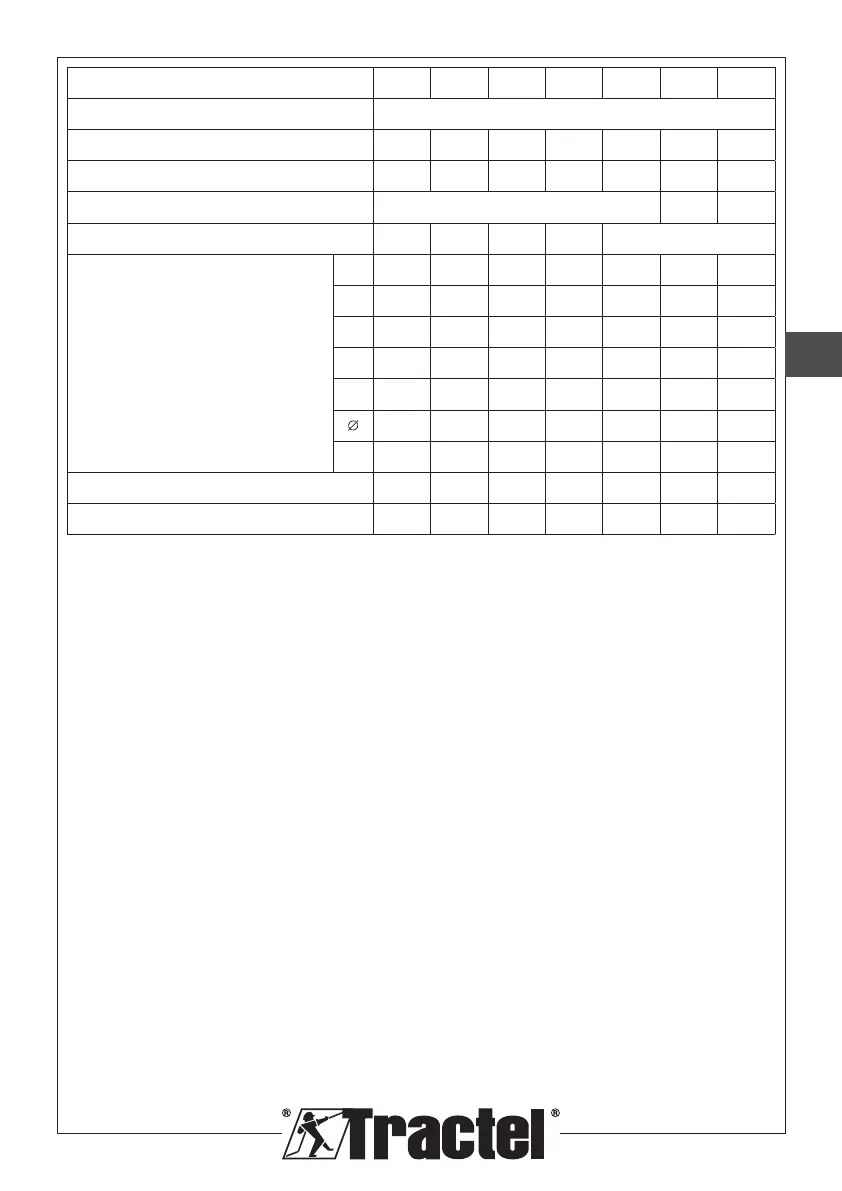
WLL* (t) 0.5 0.75 1 1.5 3 6 9
Standard lifting height** (m)
1.5
Minimum distance between hook H (mm) 260 325 325 380 480 620 700
Maximum force on handle at WLL* (N) 340 140 190 220 320 340 360
Number of strands 1 2 3
Chain dimensions (type T) 5 × 15 6 × 18 6 × 18 8 × 24 10 × 30
Dimensions (mm)
A 105 148 148 172 200 200 200
B 78 90 90 98 115 115 115
C 80 136 136 160 180 235 319
D 300 280 280 410 410 410 410
E 21 25 25 27 37 41 55
34 40 40 44 54 66 83
M 42 47 47 50 67 78 92
Net weight (kg)
4 7 7 11 21 31 44
Additional weight by lifting m. (kg) 0.54 0.8 0.8 1.4 2.2 4.4 6.6
** : other travel distances possible : 3 m; 4.5 m; 6 m.
Optionally, the bravo™ hoists of W.L.L.* 0.75 t / 1 t / 1.5 t / 3 t / 6 t / 9 t an be equipped with a dynamic load limiter adjusted between
1.1 and 1.9 × WLL*. The load limiter mechanism is integrated in the lever and is formed by friction disks and a clamping nut by which
the limiter is adjusted. This adjustment is performed by TRACTEL
®
.
3. INSTALLATION
Before installing the bravo™ hoist make the following
checks:
1. Check that the hoist is in good condition.
2. Check that the correct hoist capacity is to be used.
3. Check that the hooks and safety latches are in good
condition.
4. Check that the low limit stop is in place.
5. When the hoist uses a multiple strand chain, make
sure that the strands are not tangled or twisted.
6. Check that the load chain is correctly tted.
7. Check that the anchor point is sufcient to take the
intended load.
After successfully completing the preliminary checks,
install the bravo™ hoist on its anchoring point and
perform the following checks:
1. Check that the bravo™ hoist is properly suspended
by its suspension hook (item 5, g. 1) and that the
hook safety catch (item 6, g. 1) is properly closed
(see gs. 2 and 3).
2. Check that the load chain has not been subjected to
any torsion when setting up, in particular for the two-
strand version (see g. 4).
3. Without load, check that the up and down functions
operate correctly.
4. When using the hoist with a push suspension trolley,
without load, check that the trolley moves freely. If
using a geared suspension trolley, without load,
check the direction of movement by pulling on the
trolley hand chain. The movement should be carried
out on a strictly horizontal plane.
After successfully completing these checks, place the
load in position and ensure:
1. The anchoring accessory of the load sits fully in the
hook and does not prevent the catch from closing
correctly (see gs. 2 and 3).
2. The load on the hoist is free to align itself with the
machine’s anchoring point.


 To Next Page