Need help?
Do you have a question about the Trotec TTK 53 E and is the answer not in the manual?
Explains warning symbols used in the manual.
Covers manual reading, warnings for shock/fire/injury, child safety, placement, water exposure, and handling.
Safe handling of R290, avoiding ignition sources, proper storage, and maintenance.
Precautions regarding device as a toy, cable damage, power connections, and extension cords.
Guidelines on device positioning, distances, and keeping air inlets/outlets clear.
Defines allowed uses and lists foreseeable misuse of the device.
Specifies user requirements for safety awareness and instruction understanding.
Importance of label integrity and referring to manuals for safety.
Details dangers of R290 gas, electric shock, and water exposure.
Covers device as non-toy, child suffocation risk, and air filter necessity.
Outlines steps to take in an emergency: switch off, disconnect, do not reconnect defective device.
Explains the condensation principle, fan operation, and water collection.
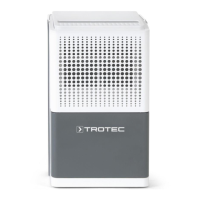
Illustrates the dehumidifier with numbered components.
Details steps for safely transporting the dehumidifier, including switching off and draining.
Provides guidelines for proper storage, including room size, ignition sources, and protection.
Lists package contents and guides on how to unpack the device.
Instructions on positioning, airflow, filter, tank, and power connection.
Advises on usage, and identifies/explains control panel buttons and indicators.
Explains selection of Dehumidification, Continuous, Automatic, Ventilation, and Laundry Drying modes.
How to adjust desired humidity levels in dehumidification mode.
Explains the meaning of the color LED for current room humidity.
Details how to set the automatic switch-off timer for the device.
Describes how the device remembers settings and automatically stops when the tank is full.
Instructions for connecting a drain hose for continuous dehumidification.
Explains automatic defrost and how to use the laundry drying mode.
Emphasizes electrical safety during device shutdown.
Checks for device not starting or no condensate formation issues.
Covers compressor not starting, overheating, loss of performance, and noise.
Advises contacting customer service if issues persist after troubleshooting.
Details the schedule and specific tasks for routine maintenance and cleaning.
A section for recording maintenance activities performed on the device.
Emphasizes disconnecting power and handling plugs safely before any maintenance.
Guidance on inspecting interior dirt and cleaning the device housing.
Detailed steps on how to remove, clean, and reinsert the air filter.
Explains how to empty the condensation tank when it is full or incorrectly inserted.
Instructions for refitting the tank and actions after maintenance, like reconnecting power.
Provides specifications like performance, airflow, operating ranges, power, and dimensions.
Illustrates the electrical connections and components of the device.
Lists and illustrates all available spare parts for the dehumidifier.
Provides instructions for environmentally friendly disposal of packing and the device itself.
 General
| Operating temperature range | 5 - 35 °C |
|---|---|
| Refrigerant | R290 |
| GWP factor | 3 |
| Power consumption | 300 W |
| Dimensions (H x W x D) | 520 x 340 x 240 mm |
| Operating range humidity | 30 to 80 % RH |
| Input voltage | 220 - 240 V |
| Refrigerant amount | 55 g |
| CO2 equivalent | 0.165 t |


 To Next Page