Opposite Side
Unstrap patient's thigh from the stabilizer, as well as his/her ankle.
Slide the chair away from the dynamometer.
Remove the seat attachments and place them the other way around, the angle should face the
other side.
Adjust the chair and the dynamometer.
Follow the steps 6 -9 as described above.
Considerations
Normal Range of Motion for dorsiflexion is considered to be 25°, while for plantarflexion up to 50°.
The angle of peak torque has been found to be around 25° of plantarflexion.
When the exercise is performed in prone sure, ensure full support of the knee. Otherwise pain can
occur due to hyperextension.
The angular velocity of choice is 30°/sec.
Gait cycle simulation is possible and particularly useful for neurological rehabilitation.
Design a program that comprises of the following sequence:
Eccentric dorsiflexion (heelstrike) and eccentric plantarflexion (midstance)
Concentric dorsiflexion (toe off) and concentric plantarflexion (swing phase)
Attention! The ankle is known to be unstable in a plantarflexed position. Please keep that in mind when
testing or exercising a subject.
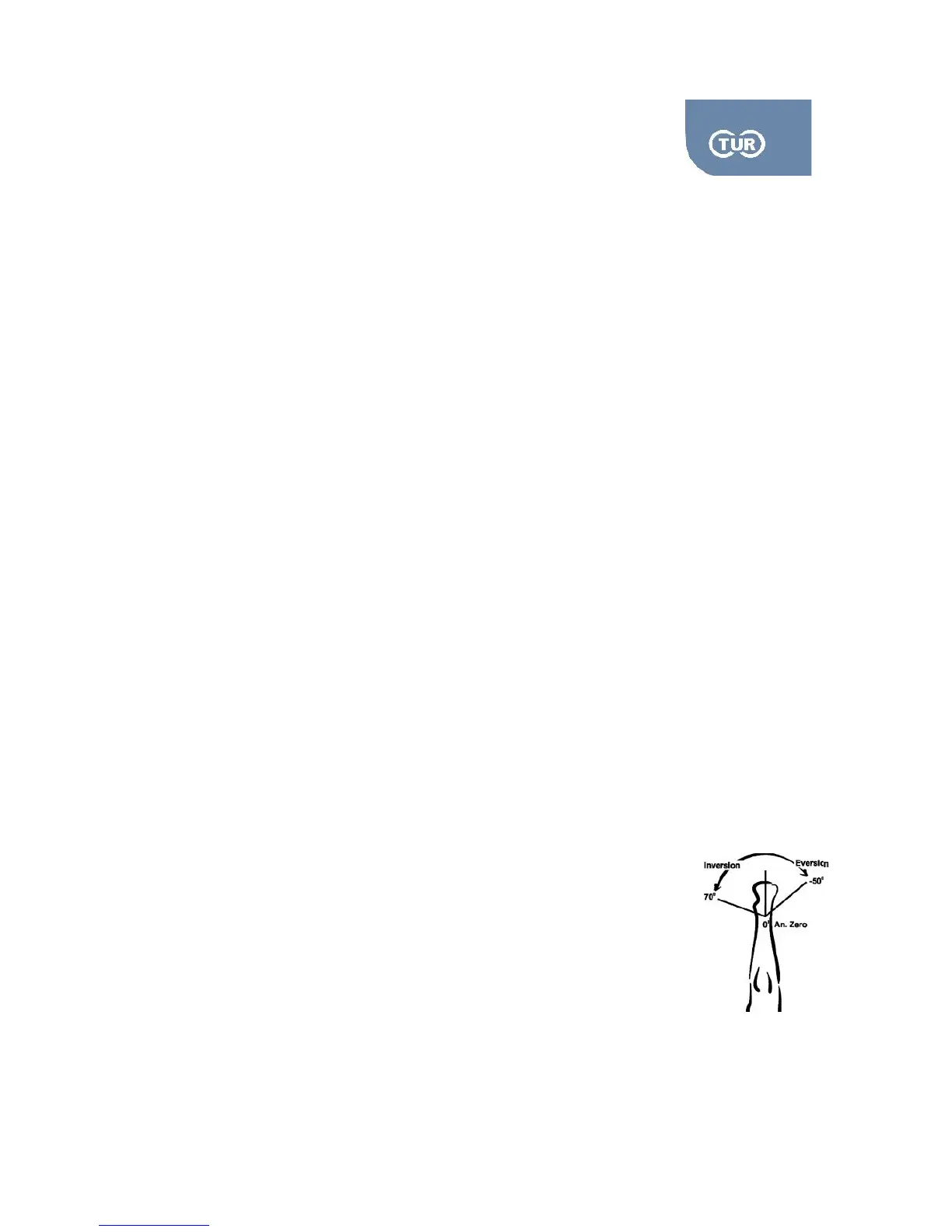
3.1.2 Inversion/Eversion
Rotation Axis: The rotation axis of the dynamometer extends through the center of
the calcaneus
Anatomical Zero: In neutral position. To be sure that you set it correctly ask your
subject to stand without wearing shoes and make a measurement with goniometer
defining the angle the tibia forms to the foot taking the malleoli as the center of the
angle. Reproduce the angle after the subject is positioned and stabilizes on isoforce.
A tip is that in neutral position at this pattern the foot should point to the roof.
Range of Motion: Up to 40 degrees for inversion and up to 25 degrees for eversion,


 To Next Page