Remove the shoulder attachment from the dynamometer input arm and put it back turning it
around.
Adjust the chair and the dynamometer in accordance to the quick reference above.
Follow the steps 5-7 as described above.
Considerations
Flexion/Extension of the shoulder is usually used in the early stages of rehabilitation. However,
the therapist should be careful not to cause impingement. To avoid this limit the flexion ROM.
Generally it is accepted that speeds of 60 degrees/second and multiples of this should be used.
Speeds over 300 degrees/second have been found to be difficult to achieve by even baseball
pitchers.
The axis of rotation may superior move during this exercise. To avoid this you can divide the
ROM in two, and perform two tests instead of one. One test could be the external ROM and
one the internal.
Flexion beyond 90
0
produces high variability in results.
Gravity Correction is necessary for reliable test results as the movement is performed in the
vertical plane.
In the anterior impingement syndrome a rapid drop in torque at the start of the range of motion
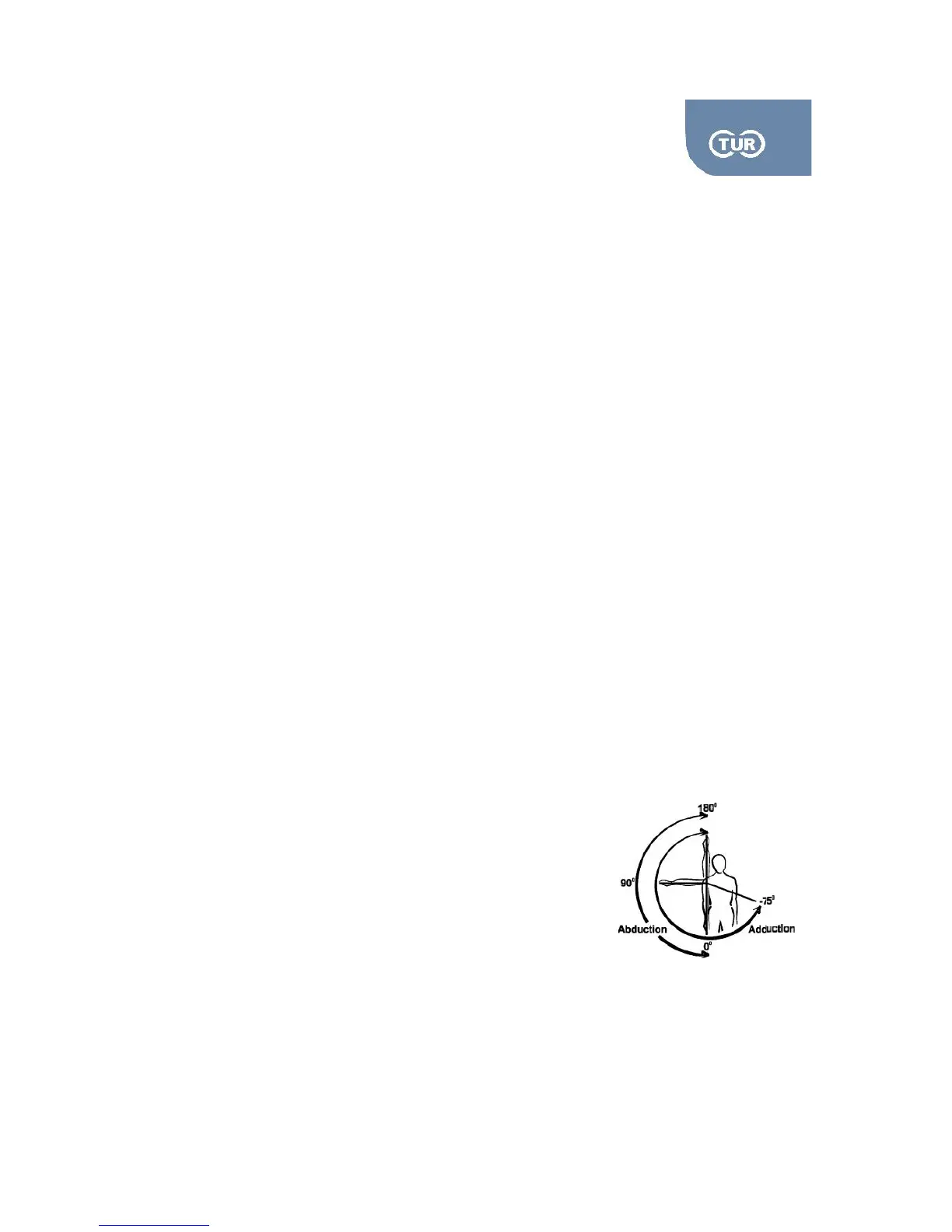
3.4.2 Adduction – Abduction (Laying)
Rotation Axis: a point roughly 2-3 cms below the inferior lip of the acromial arch. However, one should
keep in mind the gleno-humeral joint as a whole moves by an average of 8cm throughout a
movement, therefore the need for accuracy is seriously questioned.
Anatomical Zero: In neutral position with arms at the side of the body
Range of Motion: The normal ROM is between up to 180 degrees
adduction and 75 degrees abduction
Isoforce offers one positioning possibility, in supine position.
Muscles Involved: Teres major, latissimus dorsi, Pectoralis major, Middle, Anterior and posterior deltoid


 To Next Page