3.4 Shoulder
The shoulder is a complex joint made up of many articulations capable of a wide variety of motions. The
shoulder complex is made up of the clavicle, the humerus, the sternum, the scapula, the ribs, and the
vertebral column (Rybski, 2004). The distinctive feature about the shoulder is that it is tied and
connected to the whole body and interacts with back and chest muscles. The shoulder joint consists of
a combined and coordinated movement of four distinct articulations - glenhumeral, arcomioclavicular,
sternoclavicular, and scapulothoracic - which allow the arm to be positioned in space for efficient
function (Nordin & Frankel, 1989). The four articulations of the shoulder joint complex acting together to
provide the nearly full range of motion found in the shoulder, the sum of which is greater than the
motion available at any single articulation. Of the four articulations, the glenhumeral joint bears the
greatest load (Nordin & Frankel, 1989). The mobility of the shoulder joint is a result of motion in both
glenhumeral joint and scapulothoracic-gliding plane (Veeger & Van der Helm, 2007).
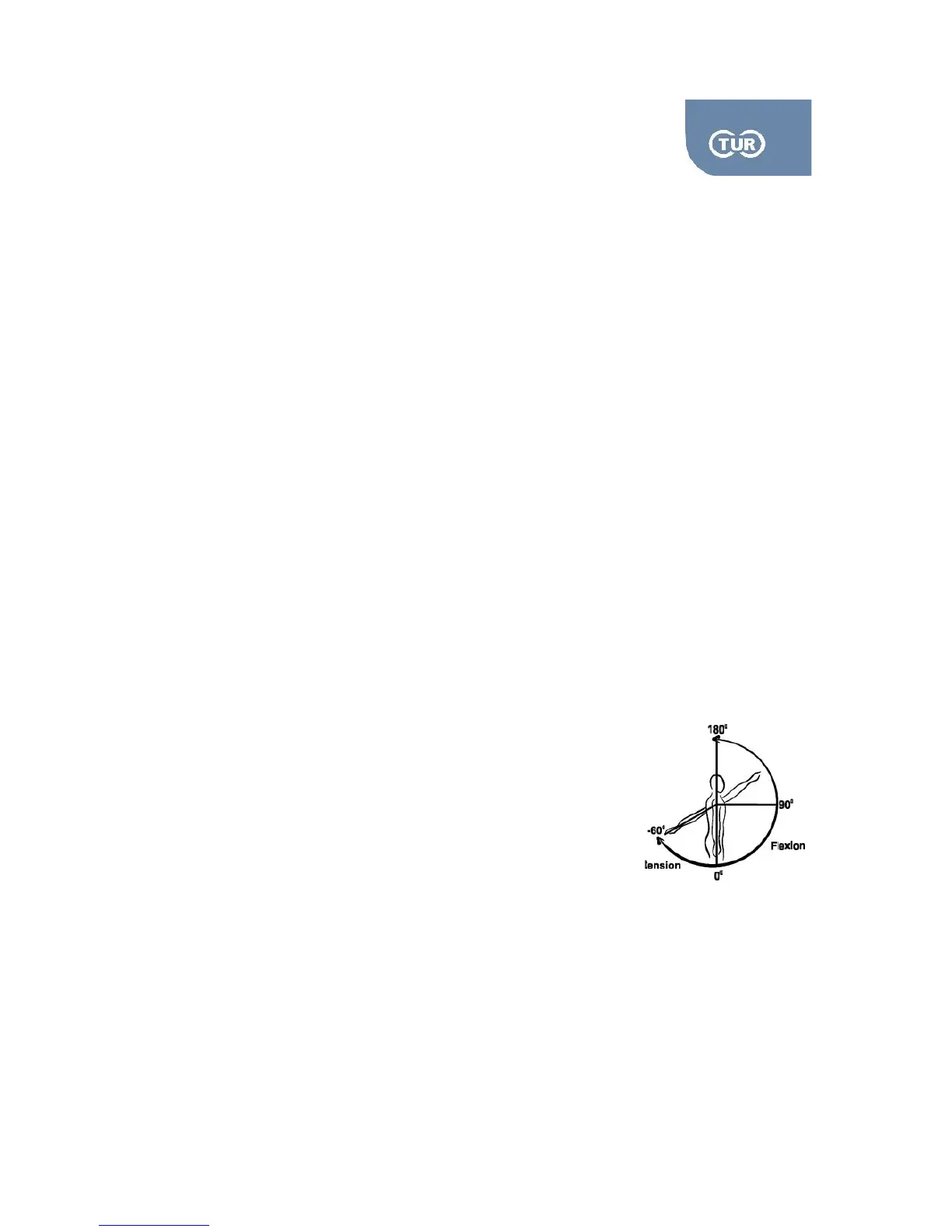
3.4.1 Flexion – Extension (Supine)
Rotation Axis: a point roughly 2-3 cms below the inferior lip of the acromial arch. However, one should
keep in mind the gleno-humeral joint as a whole moves by an average of 8cm throughout a
movement, therefore the need for accuracy is seriously questioned.
Anatomical Zero: In neutral position with arms at the side of the body
Range of Motion: The normal ROM is between up to 180 degrees extension
And 60 degrees flexion
Isoforce offers one positioning possibility, in supine position.
Muscles Involved: Pectoralis major, Deltoid, biceps, coracobrachialis, latissimus dorsi, teres major


 To Next Page