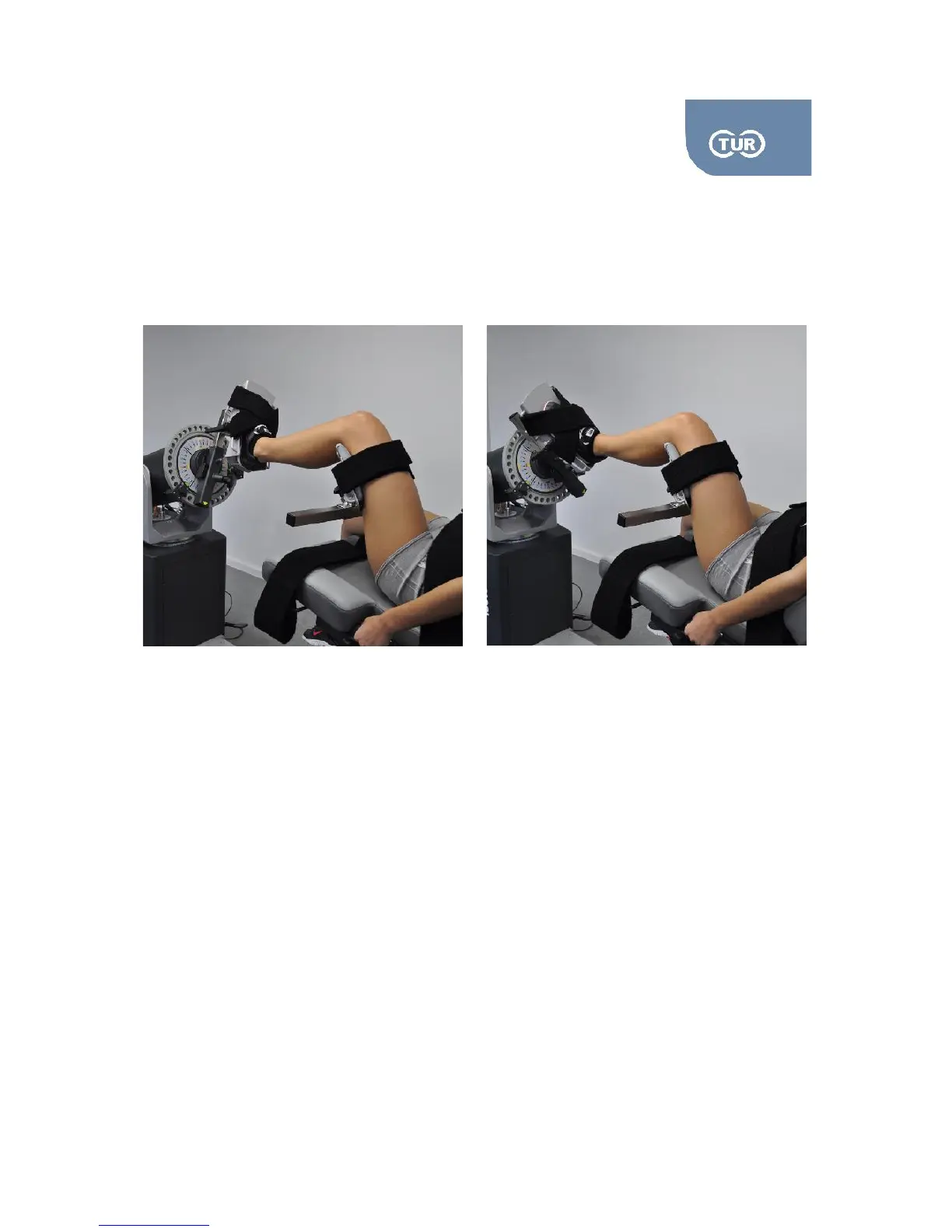
Isoforce offers one positioning possibility, in supine position. This position looks like the ankle
inversion/eversion. However, during the tibial rotation the knee should be flexed to 90 degrees. Make
sure that the foot of your subject is not lifted from the ankle plate during the movement.
Muscles Involved: Semimembranosus, semitendinosus, and popliteus do internal rotation, and biceps
femoris does external rotation.
Attachments Needed
Dynamometer: Ankle attachment (ADA1),
Seat: Angle Attachment (ADS1), Thigh Pad (ADS4)
Set up & positioning
Put the mechanical stops to “B” red and “B” red.
Attach the ankle (ADA1) to the dynamometer by sliding it in the input arm from the top, short side.
Tighten it firmly by turning the knob placed in the input arm clock wise.
For the seated position combine the ADS1 with the ADS4 and place it in the receiving tube of the
seat by sliding it from the top. Tighten it firmly by turning the knob placed in the input arm clock
wise. The attachment should be facing the leg to be tested. Set it low as it is much easier to adjust
it higher if needed. Insert the thigh pad stabilizer in the vertical angle with its vertical section
towards the inside. Secure firmly.
Ask the subject to lay on the chair facing the dynamometer.
Place the subject's ankle in the ankle adapter and secure it firmly by tightening the straps.


 To Next Page