EasyManua.ls Logo

Uniden 2020 - User Manual

Uniden 2020
26 pages
Print Icon
To Next Page IconTo Next Page
Loading...
UNIDEN 2020
Sid 1 (26)
ACCESSORY CIRCUITS ALIGNMENT
1. NOISE BLANKER Adjustment
1-1. Test Equipment Required
(1) DC Voltage Meter
1-2. Adjustment Procedures.
(1) Set MODE SWITCH to USB, and recive 14.200 Mhz.
(2) Activate MARKER OSCILLATOR by pulling out RF ATT knob.
(3) Set NOISE BLANKER SWITCH to OFF.
(4) Tune the main dial to generate about 1,000 Hz beat from a speaker.
(5) Put the meter to the COLLECTOR of Q119.
(6) Adjust L139 and L140 to obtain minimum meter readings.
2. MARKER OSCILLATOR ADJUSTMENT
2-1. Test Equipment Required
(1) Frequency Counter.
2-2. Adjustment Procedures
(1) Connect Frequency Counter to the Pin 1 (Marker output) of J751 on the
operation unit.
(2) Activate MARKER OSCILLATOR by pulling out RF ATT knob.
(3) Tune trimmer capacitor C753, so that the counter indicates 25.000 KHz
± 2 Hz..
2-3 Adjustment by Standard Radio Signals
(1) Connect antenna-to-antenna jack.
(2) Set BAND SWITCH to 15.0 SEGMENT SWITCH at 0/500, and recive 15
MHz Standard Signal (JJY, WWV, etc.)
(3) Pull out RF ATT knob to activate MARKER OSCILLATOR.
(4) Set MODE SWITCH to AM.
(5) Adjust trimmer C753 to make zero beat of calibration signal. It is easlily
adjustable Standard Radio Signal (A2), because double beat is generated.
(6) Adjust attenuator control to make the calibration easy against excessive
incoming signal.

Other manuals for Uniden 2020

Question and Answer IconNeed help?

Do you have a question about the Uniden 2020 and is the answer not in the manual?

Summary

ACCESSORY CIRCUITS ALIGNMENT

NOISE BLANKER Adjustment

Procedure for adjusting the noise blanker circuit.

MARKER OSCILLATOR ADJUSTMENT

Procedure for adjusting the marker oscillator.

R.I.T CIRCUIT ALIGNMENT

S-METER ADJUSTMENT

ALC METER ADJUSTMENT

Adjustment Procedures

Step-by-step guide for ALC meter adjustment.

RX RF UNIT ALIGNMENT

Tuning Coil Alignment

Procedure for tuning receiver RF coils.

IF Tuning Coil Alignment

Procedure for aligning IF tuning coils.

IF UNIT ALIGNMENT

Coil Adjustment.

Procedure for adjusting coils in the IF unit.

Carrier Balance Adjustment.

Procedure for adjusting carrier balance in the IF unit.

TRANSMITTER ALIGNMENT

PA IDLING CURRENT ADJUSTMENT

GENERATOR UNIT ALIGNMENT

Modulator Output Coil Adjustment

TRANSMITTER RF CIRCUITS ALIGNMENT

RF output meter adjustment

Adjustment Procedure.

Procedure for adjusting the RF output meter.

FEEDBACK NEUTRALIZING.

POWER SUPPLY ALIGNMENT

LOCAL OSCILLATOR CIRCUITS ALIGNMENT

PLL UNIT ALIGNMENT.

LOCAL OSCILLATOR UNIT ALIGNMENT.

Summary

ACCESSORY CIRCUITS ALIGNMENT

NOISE BLANKER Adjustment

Procedure for adjusting the noise blanker circuit.

MARKER OSCILLATOR ADJUSTMENT

Procedure for adjusting the marker oscillator.

R.I.T CIRCUIT ALIGNMENT

S-METER ADJUSTMENT

ALC METER ADJUSTMENT

Adjustment Procedures

Step-by-step guide for ALC meter adjustment.

RX RF UNIT ALIGNMENT

Tuning Coil Alignment

Procedure for tuning receiver RF coils.

IF Tuning Coil Alignment

Procedure for aligning IF tuning coils.

IF UNIT ALIGNMENT

Coil Adjustment.

Procedure for adjusting coils in the IF unit.

Carrier Balance Adjustment.

Procedure for adjusting carrier balance in the IF unit.

TRANSMITTER ALIGNMENT

PA IDLING CURRENT ADJUSTMENT

GENERATOR UNIT ALIGNMENT

Modulator Output Coil Adjustment

TRANSMITTER RF CIRCUITS ALIGNMENT

RF output meter adjustment

Adjustment Procedure.

Procedure for adjusting the RF output meter.

FEEDBACK NEUTRALIZING.

POWER SUPPLY ALIGNMENT

LOCAL OSCILLATOR CIRCUITS ALIGNMENT

PLL UNIT ALIGNMENT.

LOCAL OSCILLATOR UNIT ALIGNMENT.

Overview

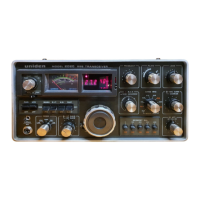
This document outlines the alignment procedures and technical specifications for the Uniden 2020, a device that appears to be a transceiver or a similar radio communication unit, given the references to RF, IF, transmitter, receiver, and various frequency bands. The manual provides detailed instructions for adjusting different circuits and measuring voltages, indicating a focus on precise calibration and maintenance.

Function Description:

The Uniden 2020 is a radio communication device that includes both receiver and transmitter functionalities, along with various auxiliary circuits for signal processing and control. Key functional blocks include:

  • Noise Blanker: A circuit designed to reduce impulse noise, which is common in radio communication. Its adjustment ensures optimal noise suppression.
  • Marker Oscillator: This generates a precise frequency signal, likely for calibration or frequency reference purposes. Its alignment ensures accuracy.
  • R.I.T. (Receiver Incremental Tuning) Circuit: Allows for fine-tuning of the receiver frequency independently of the transmitter, useful for adjusting to slightly off-frequency signals without affecting the transmit frequency.
  • S-Meter: An indicator that displays the strength of the received signal. Its calibration ensures accurate signal strength readings.
  • ALC (Automatic Level Control) Meter: Monitors and controls the output power of the transmitter, preventing overmodulation and ensuring a clean signal.
  • Receiver RF Unit: Handles the initial stages of signal reception, including tuning and filtering.
  • IF (Intermediate Frequency) Unit: Processes the received signal at a fixed intermediate frequency, where most of the signal amplification and filtering occur.
  • Transmitter RF Circuits: Generate and amplify the radio frequency signal for transmission.
  • PA (Power Amplifier) Idling Current Adjustment: Sets the quiescent current for the power amplifier, crucial for efficient operation and minimizing distortion.
  • Generator Unit: Likely responsible for generating various internal signals or frequencies required for the transceiver's operation.
  • Modulator Output Coil: Adjusts the output of the modulator, which impresses the audio signal onto the RF carrier.
  • Balanced Modulator: A key component in SSB (Single Sideband) transmission, responsible for suppressing the carrier frequency.
  • AM Modulation: Handles Amplitude Modulation for voice or data transmission.
  • Power Supply (AVR Unit): Provides stable DC voltages to various parts of the transceiver.
  • Local Oscillator Circuits (VFO Unit, PLL Unit, Local Oscillator Unit): Generate the necessary frequencies for mixing with incoming or outgoing signals, enabling tuning across different bands. These units include a Variable Frequency Oscillator (VFO) and Phase-Locked Loop (PLL) circuits for frequency stability and synthesis.

Important Technical Specifications:

While specific numerical specifications like power output or sensitivity are not explicitly listed in the provided excerpts, the document details various frequencies and voltage levels that are critical for the device's operation and alignment.

  • Frequencies:
    • Noise Blanker/Marker Oscillator: 14.200 MHz, 25.000 KHz.
    • R.I.T. Circuit: 1,000 Hz beat frequency.
    • S-Meter: 14.200 MHz signal for calibration.
    • ALC Meter: 14.2 MHz for transmitter tuning, audio frequencies of 1,900 Hz and 2,300 Hz for two-tone signal generation.
    • Receiver IF Trap Coil: 6.187 MHz.
    • Receiver Tuning Coils: Covers bands like 3.5 MHz, 7.0 MHz, 14.0 MHz, 21.0 MHz, 28.5 MHz, and 15.0 MHz.
    • IF Tuning Coils: 14.200 MHz.
    • Generator Unit: 6,187.000 kHz (USB), 6,187.750 kHz (TUNE).
    • Modulator Output Coil: 14.2 MHz.
    • Balanced Modulator/AM Modulation: 14.2 MHz output, 1,500 Hz audio input.
    • Transmitter RF Circuits: Covers bands like 3.600 MHz, 7.100 MHz, 14.200 MHz, 21.200 MHz, 28.500 MHz.
    • Feedback Neutralizing: 21.2 MHz.
    • VFO Unit: 9,038 kHz and 9,138 kHz.
    • PLL Unit: 16.000 MHz (VCO unlocked-oscillation).
    • Local Oscillator Unit (PC-092): Xtal Oscillator Output Adjustment frequencies range from 25.525 MHz to 51.525 MHz, covering bands from 3.5 MHz to 29.5 MHz.
  • Voltages:
    • Noise Blanker: Minimum meter readings at Q119 collector.
    • Modulator Output Coil: 0.2V r.m.s. (max VFVM indication), 0.3V r.m.s. (max meter indication).
    • Power Supply (AVR Unit): 8.2V DC, 6V DC (5.5-6.5V), 5V DC (5.0+0.2/-0.1V), R.I.T. Power Source (1.3V ±0.1V).
    • Local Oscillator Unit (PC-092): 1.5V r.m.s. (Xtal Oscillator Output), 0.7 – 1.3V r.m.s. (Bandpass Filter Output), 0.4 – 0.5V r.m.s. (VFO Output).
    • PLL Unit: 0.5V r.m.s. (Bandpass Amplifier).
    • Voltage Measurements (Tubes): Various DC and AC voltages are specified for different pins of tubes like V251 (12BY7A), V1001/V1002 (6146B), including values like -3.2V, -16.5V, 0.29V, -50V, 280V, 325V, 750V, 900V, 430V, 460V.
    • Voltage Measurements (Transistors & FETs): Detailed DC voltages (E/S, C/D, B/G1, G2) are provided for numerous transistors (e.g., 2SC735Y, 2SC784R, 2SC372Y, 2SK35BL, 2SK19GR, 2SC380Y, 2SA495Y, 2SC11730, 2SC1682) and FETs across different units (L.O., RX-RF, TX-RF, IF, AF, GE, AVR, VFO, OPR, RF-PA, PLL). These values range from 0V to 12.0V.
    • Voltage Measurements (ICs): DC voltages are specified for various pins of ICs like MC1496 and TA7063P, ranging from 0V to 12.0V.
    • RF Voltage Measurements (PLL Unit): Peak-to-peak voltages are specified for different points, e.g., 2.2V P-P, 0.8V P-P, 240mV P-P, 1.6V P-P, 7.5V P-P, 1.4V P-P, 5.0V P-P.
  • Current: PA Idling Current: 200 mA (IK reading).

Usage Features:

The manual primarily focuses on alignment and maintenance, but it implicitly reveals several usage features:

  • Mode Selection: Supports USB (Upper Sideband), LSB (Lower Sideband), AM (Amplitude Modulation), and TUNE modes.
  • Frequency Tuning: Features a main dial, BAND SWITCH, and SEGMENT SWITCH for selecting and fine-tuning frequencies across various bands (e.g., 3.5 MHz to 28.5 MHz, 15.0 MHz).
  • RF Gain Control: Allows adjustment of the receiver's sensitivity.
  • RF ATT (Attenuator) Knob: Likely reduces the strength of strong incoming signals to prevent receiver overload, and also activates the marker oscillator when pulled out.
  • PRESELECT Knob: Used for pre-selection filtering, enhancing receiver performance by reducing out-of-band interference.
  • MIC GAIN CONTROL: Adjusts the microphone input level for the transmitter.
  • CARRIER CONTROL: Adjusts the carrier level, especially important for AM and SSB modes.
  • PLATE and LOAD Controls: Used for tuning the final amplifier stage of the transmitter to match the antenna impedance for maximum power transfer.
  • STANDBY SWITCH: Controls the operational state of the transceiver (e.g., MANU, PTT).
  • METER SWITCH: Selects what the meter displays (e.g., ALC, PWR, IK).
  • FUNCTION SWITCH: Controls overall operational modes (e.g., INT, R. EXT).
  • R.I.T. SWITCH: Activates or deactivates the Receiver Incremental Tuning.
  • N.B. SWITCH: Activates or deactivates the Noise Blanker.
  • AGC SWITCH: Controls Automatic Gain Control for the receiver (e.g., FAST).
  • External Speaker Jack: Allows connection of an external speaker or dummy load.
  • RF POWER AMP SWITCH: Controls the RF power amplifier.

Maintenance Features:

The document is essentially a maintenance guide, detailing precise steps for alignment and troubleshooting. Key maintenance aspects include:

  • Test Equipment Requirements: Specifies the need for a DC Voltage Meter, Frequency Counter, Standard Signal Generator (SSG), RF Power Meter, AF Milli-volt Meter (mV), Audio Generator (AG), Oscilloscope, RF Voltage Meter (RF VTVM), and Sweep Generator. This indicates that specialized tools are necessary for proper servicing.
  • Circuit Alignment Procedures: Comprehensive step-by-step instructions are provided for aligning various circuits, including:
    • Noise Blanker Adjustment (L139, L140).
    • Marker Oscillator Adjustment (C753).
    • R.I.T. Circuit Alignment (R665, R664).
    • S-Meter Adjustment (R387, R389, R392).
    • ALC Meter Adjustment (R388).
    • Receiver IF Trap Coil Alignment (L01, L207).
    • Receiver Tuning Coil Alignment (L201-L213).
    • Receiver IF Tuning Coil Alignment (L214-L218).
    • IF Unit Coil Adjustment (L351-L354).
    • Carrier Balance Adjustment (R374, C370).
    • Transmitter RF Tuning Coil Adjustment (L251-L263).
    • RF Output Meter Adjustment (R08).
    • Feedback Neutralizing (C1037).
    • Generator Unit Alignment (L510, C541, C542).
    • Modulator Output Coil Adjustment (L501, L504).
    • Balanced Modulator Alignment (R530).
    • AM Modulation Adjustment (R509).
    • VFO Unit Oscillator Frequency Adjustment (L702, C707).
    • VFO Unit Output Voltage Adjustment (L706, L707).
    • PLL Unit VCO Unlocked-oscillation Frequency Adjustment (L801).
    • PLL Unit Bandpass Amplifier Alignment (L804-L807).
    • Local Oscillator Unit Xtal Oscillator Output Adjustment (L101-L110).
    • Local Oscillator Unit Xtal Oscillator Frequency Adjustment (C116-C125).
    • Local Oscillator Unit VCO Buffer Amplifier Adjustment (L121, L122).
    • Local Oscillator Unit Bandpass Filter Adjustment (L123-L136).
  • Voltage Measurements: Detailed tables for voltage measurements on tubes, transistors, FETs, and ICs serve as a crucial diagnostic tool for identifying faulty components or incorrect operating conditions.
  • Waveform Diagrams: The inclusion of waveform diagrams for various points in the PLL and Marker circuits (e.g., OB15, OB13, OB12, OB11, OB10, Q752, Q753, J751) is invaluable for verifying correct signal shapes and timing during troubleshooting.
  • Service Extension Boards: The manual mentions using "SERVICE EXTENSION BOARD" for IF UNIT and GENERATOR UNIT, indicating a design that facilitates modular testing and repair.
  • Safety Precautions: Explicit warnings about high voltage and the need for quick adjustments during transmitter tuning highlight safety considerations for technicians. The caution about using insulated screwdrivers for specific adjustments further emphasizes safe practices.
  • Component Identification: References to specific component numbers (e.g., L139, C753, R665, Q119, J751) allow technicians to locate and adjust the correct parts on the circuit boards.

In summary, the Uniden 2020 is a sophisticated radio transceiver requiring meticulous alignment and maintenance. The provided manual serves as a comprehensive guide for technicians, ensuring the device operates within its specified parameters for optimal performance.

Uniden 2020 Specifications

General IconGeneral
BrandUniden
Model2020
CategoryTransceiver
LanguageEnglish

Related product manuals