EasyManua.ls Logo

Valor 203 - User Manual

Valor 203
13 pages
Print Icon
To Next Page IconTo Next Page
Loading...
INSTALLATION GUIDE – 203 DISPLAY
1-800-568-9188
www.valortpms.com
4320 Harvester Rd., Floor 2
Burlington, ON, L7L 5S4, Canada
Vehicle Types: Straight Trucks, Tractor/Trailers, RVs and Buses
Max Sensing Pressure Standard Cold Ination Pressure Low Pressure Warning Limit High Pressure Warning Limit
188 PSI 72 PSI – 145 PSI 20% Below Set Pressure 30% Above Set Pressure
-203 Tire Pressure Monitoring System
1
2
3
4
5
6
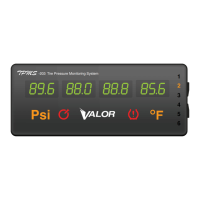
89.6 88.0 88.8
Question and Answer IconNeed help?

Do you have a question about the Valor 203 and is the answer not in the manual?

Summary

Quick Use Notice

Please Read Before Installation

Emphasizes the importance of reading the installation guide carefully before proceeding with installation.

System Installation

Straight Truck;Tractor Installation

Guides the installation process specifically for straight trucks and tractors.

Mounting Integrated Display

Provides instructions on how and where to mount the central display unit.

Installing ID Modules

Explains how to install the sensor ID modules into the display unit for tire identification.

Installing TPMS Sensors

Details the procedure for attaching the TPMS sensors to the vehicle's wheel rims.

Installing Antennas

Covers the placement and connection of antennas for signal reception.

Trailer Installation

Outlines the steps for installing the TPMS system on trailers.

Installing Tractor ID Box

Describes the installation of the ID box on a tractor for trailer communication.

Installing Gen II Trailer Box

Details the installation of the Gen II trailer box.

Programming Gen II Trailer Box

Refers to separate instructions for programming the Gen II trailer box.

Installing Antennas (Trailer)

Provides specific guidance for installing antennas on the trailer.

System Programming

Turning Integrated Display On;Off

Explains how to power the integrated display unit on and off.

Programming Tire Pressure Baseline

Details the process of setting the baseline tire pressure for accurate monitoring.

Programming Time & Date

Guides the user on how to set the internal time and date for the display.

Reading The Display

Reading the Integrated Display

Describes how to read tire pressure and temperature values shown on the display.

Switching between Pressure and Temperature

Details how to toggle between viewing tire pressure and temperature readings.

Switching between Axles

Explains how to navigate through different axles displayed on the unit.

Overview

The VALOR TPMS-203 is a tire pressure monitoring system designed to enhance safety and efficiency for various vehicle types, including straight trucks, tractor/trailers, RVs, and buses. Its primary function is to continuously monitor tire pressure and temperature, providing real-time data to the driver and alerting them to potential issues.

Function Description:

The core function of the TPMS-203 is to provide constant surveillance of tire conditions. It utilizes wireless sensors installed on each tire's rim to collect pressure and temperature data. This data is then transmitted to an integrated display located in the vehicle's cab. The system is designed to detect deviations from predefined baseline pressures and temperatures, as well as rapid air loss, and alert the driver accordingly.

The system's monitoring capabilities are comprehensive. It tracks the Standard Cold Inflation Pressure (SCIP), which is typically found on the tire sidewall. Users can set a Baseline Pressure according to the SCIP. The system then establishes warning thresholds: a Low Pressure Warning is triggered at a 20% deviation below the baseline pressure, and a High Pressure Warning is activated at a 30% deviation above the baseline pressure. Additionally, a High Temperature Warning is set to 80°C (176°F), and a Leakage Warning is issued if air loss exceeds 4.8 PSI within 16 seconds. These predefined thresholds ensure that drivers are promptly informed of critical tire conditions, allowing for timely intervention and preventing potential hazards.

For tractor/trailer configurations, the system includes an ID box for the tractor and a Gen II Trailer Box for the trailer, enabling communication and monitoring across the entire vehicle combination. This ensures that all tires, regardless of their position on the tractor or trailer, are under constant surveillance.

Usage Features:

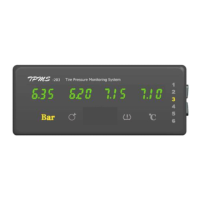
The TPMS-203 is designed for ease of use and clear information display. The integrated display unit, typically mounted on the windshield, presents tire pressure and temperature values in an intuitive format. The display shows values for up to six axles, with tire pressure or temperature values arranged from left to right according to their location on the vehicle.

Key usage features include:

  • Integrated Display: The display provides a clear, real-time overview of tire conditions. It features indicators for PSI (pressure) and °F (temperature), illuminating the relevant unit depending on what is currently being displayed.
  • Toggle Buttons: Located on the right side of the display, toggle buttons allow the driver to switch between viewing pressure and temperature values. A bottom toggle switches between pressure and temperature, while a top toggle allows the driver to cycle through different axles being monitored.
  • Warning Indicators: The display includes distinct indicators for "SLOW LEAK WARNING" and "MAJOR ISSUE WARNING," ensuring that critical alerts are easily identifiable.
  • ON/OFF Switch: An ON/OFF switch is conveniently located on the back of the display for easy power management.
  • Programming Baseline Pressure: Drivers can program the tire pressure baseline by pressing and holding the "Set Key" on the back of the display. This feature allows the system to adapt to the recommended pressure for the specific tires, ensuring accurate monitoring. The display will beep and show "00.0" before recording the next pressure from the sensors as the new baseline.
  • Programming Date & Time: The integrated display has an internal time and date function. This can be programmed using the toggle buttons, allowing for data storage that can be retrieved using Valor's SmarTool (for truck fleets).
  • ID Modules: Prior to sensor installation, ID modules, taped to each sensor, are inserted into the back of the display. These modules help the system identify and track individual tire sensors.
  • Sensor Installation: Sensors are attached to the rim near the air valve using a steel band, ensuring a secure and stable connection. The installation process is straightforward, requiring the area to be cleaned and the adhesive protector removed before placement.
  • Antenna Installation: Antennas are strategically placed on the vehicle to ensure optimal signal reception from the sensors. For straight trucks/tractors, antennas are typically located between the rear drive wheels and between the steer wheels. For trailers, antennas are placed between the trailer wheels. Care is taken to avoid heat sources and moving parts, and cables are secured with wire ties.

Maintenance Features:

While the manual primarily focuses on installation and usage, certain aspects touch upon maintenance or considerations for system longevity:

  • Careful Installation: The installation guide emphasizes careful handling and placement of components, such as ensuring the display location does not impair the driver's view and securely attaching sensors and antennas. This attention to detail during installation contributes to the system's reliable operation and reduces the need for frequent maintenance.
  • Cable Management: Instructions for running and securing cables with wire ties, and avoiding over-tightening connections, are crucial for preventing damage and ensuring consistent signal transmission. Wrapping splitter connections with electrical tape is also recommended for protection.
  • Tire Condition Awareness: The manual explicitly states that the TPMS-203 is not designed to warn of sudden critical tire damage or blowouts caused by external effects. It advises drivers to remain vigilant for other tire problems, such as unusual noises, vibrations, uneven tread wear, or bulges, and to have tires checked by a professional if these symptoms occur. This highlights that the TPMS is a valuable tool but not a substitute for regular physical tire inspections.
  • Cool Tire Baseline Setting: The instruction to set the pressure baseline when tires are cool is a maintenance-related tip, as tire pressure fluctuates with temperature. Setting the baseline under consistent conditions ensures the accuracy of the warning thresholds.
  • Data Retrieval (for fleets): The internal time and date function, coupled with the ability to retrieve data using Valor's SmarTool, offers a maintenance-related benefit for truck fleets. This data can be used for record-keeping, performance analysis, and proactive maintenance planning.

In summary, the VALOR TPMS-203 is a robust and user-friendly system designed to provide critical tire monitoring for heavy-duty vehicles. Its comprehensive monitoring capabilities, intuitive display, and straightforward installation process make it an essential tool for enhancing road safety and operational efficiency. While primarily a monitoring device, its design and installation guidelines implicitly support the longevity and reliable performance of the system.

Valor 203 Specifications

General IconGeneral
Capacity200 g
Readability0.001 g
DisplayLCD
PowerAC Adapter (Included)
Unitsg
Measurement Range0 - 200 g
Dimensions196 x 223 x 73 mm
Weight0.9 kg

Related product manuals