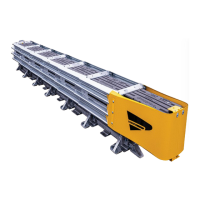
The QuadGuard® Crash Cushion is a potentially reusable, re-directive, non-gating crash cushion designed for roadside obstacles. It consists of energy-absorbing cartridges surrounded by a framework of Quad-Beam Panels. The system is modular, allowing its length to be tailored to the design speed and appropriate number of bays for a specific site.
Function Description:
The QuadGuard® system is designed to absorb impact energy and redirect vehicles away from roadside obstacles. It utilizes two types of cartridges in a staged configuration to address impacts from both lighter cars and heavier, high center-of-gravity vehicles. In head-on impacts within NCHRP Report 350 criteria, the QuadGuard® is designed to telescope rearward to absorb energy. When impacted from the side, within applicable NCHRP Report 350 criteria, it is designed to redirect the vehicle back toward its original travel path.
Important Technical Specifications:
- Width Range: The QuadGuard® is available in five nominal widths, ranging from 24" [610 mm] to 126" [3200 mm]. Specific nominal widths include 24" [610 mm], 30" [760 mm], 36" [915 mm], 48" [1219 mm], 69" [1755 mm], 90" [2285 mm], and 126" [3200 mm]. The outside width of the system is approximately 6” [150 mm] to 9” [230 mm] wider than the nominal width.
- Test Levels: The QuadGuard® system is certified to Test Level 2 (43 mph [70 kph]) and Test Level 3 (62 mph [100 kph]) as per NCHRP Report 350 specifications.
- Foundation Requirements:
- Concrete Installations: Requires an existing or freshly placed and cured concrete base (28 MPa [4000 psi] minimum).
- Foundation A (Concrete Pad or Roadway): 150 mm [6"] minimum depth P.C.C. with approved adhesive and 180 mm [7"] studs (140 mm [5 1/2"] embedment).
- Asphalt Installations:
- Foundation B (Asphalt over P.C.C.): 76 mm [3"] minimum A.C. over 76 mm [3"] minimum P.C.C. Anchor length required is 460 mm [18"] (420 mm [16 1/2"] embedment).
- Foundation C (Asphalt over Compacted Subbase): 150 mm [6"] minimum A.C. over 150 mm [6"] minimum C.S. Anchor length required is 460 mm [18"] (420 mm [16 1/2"] embedment).
- Foundation D (Asphalt Only): 200 mm [8"] minimum A.C. Approved adhesive with 460 mm [18"] studs (420 mm [16 1/2"] embedment).
- Anchoring: Only 460 mm [18"] threaded rods with Valtir approved adhesive can be used with asphalt foundations. Anchor bolts (studs) must be high strength steel (Grade B7 or SAE-J429 Grade 5) and set in minimum 4000 psi [28 MPa] concrete.
- Cross-Slope: Deployment cross-slope shall not exceed 8% (5° or 12:1) and should not twist more than 2% over the length of the system. The foundation surface should have a light broom finish.
- Clearance: The Backup must be positioned so that the rear ends of the last Fender Panels are a minimum of 30” [760 mm] forward of objects that would otherwise interfere with movement of the rearmost Fender Panels during impact.
- Cartridge Types: The system uses Type I and Type II cartridges. Type I cartridges are placed toward the front (Nose) of the system, and Type II cartridges are placed toward the rear (Backup).
- Bay Count: One Bay consists of one Cartridge, one Diaphragm, and two Fender Panels. The Nose section is not considered a Bay, but includes a cartridge. The system will always have one more cartridge than the number of bays.
Usage Features:
- Modular Design: Allows for customization of system length based on design speed and site requirements.
- Backup and Transition Types: Available with Tension Strut Backup or Concrete Backup. Various Transition Panels (Quad-Beam™ to W-Beam, Thrie-Beam, Safety Shape Barrier, End Shoe, or 4" Offset Panel) or Side Panels can be used depending on traffic direction and roadside obstacle type.
- Assembly Instructions: Detailed steps are provided for marking system location, anchoring the backup and monorail, attaching side/transition panels, monorail guides, diaphragms, and the nose assembly.
- Adhesive Anchoring System: Valtir-approved adhesive anchoring systems are required for secure installation, with specific instructions for vertical and horizontal assemblies, borehole preparation, and torque specifications.
- Tools: A comprehensive list of recommended tools is provided, including documentation, personal protective equipment, cutting equipment, hammers, wrenches, and miscellaneous items like traffic control equipment, lifting devices, air compressor, and measuring tools.
Maintenance Features:
- Inspection Frequency:
- Visual Drive-By Inspections: Recommended at least once a month to check for impact evidence, cartridge displacement, and nose presence.
- Walk-Up Inspections: Recommended every six months for systems on asphalt and once a year for concrete. These include clearing debris, removing dirt from monorail and diaphragm feet, checking bolt tightness and rust, verifying anchor bolt security, ensuring straight diaphragm legs, proper seating of mushroom washer assemblies, tight nesting of fender panels, and undamaged/properly seated cartridges.
- Post-Impact Instructions:
- Asphalt Anchoring: If more than 10% of anchors are damaged, the system must be relocated to fresh, undisturbed asphalt. If 10% or fewer are damaged, only replace the damaged anchors. Anchor bolts on asphalt systems must be inspected every six months.
- System Restoration: Deploy traffic control, check anchor bolts, clear debris, verify mushroom washer assembly integrity, ensure diaphragm support legs are attached, and use chains to pull the system forward to its original length.
- Component Replacement: Replace all crushed cartridges, bowed or bent diaphragms, and damaged nose assembly parts.
- Fender Panel Gaps: Check gaps between fender panels (maximum 0.78” [20 mm] for narrow systems, 1.00” [25 mm] for wide systems). Replace bent parts if gaps are too large after torquing mushroom washer assemblies.
- Final Checks: Confirm torque of all bolts, ensure the site is clear of debris, and verify the system is ready for use.
- Parts Ordering Procedure: A chart is provided to assist in identifying and ordering replacement parts, requiring information on system width, number of bays, backup type, and transition panel type.

 Need help?
 General

 To Next Page