80
*
Ϩ
*
ϩ
*
Ϫ
ϫ
DIFFERENTIAL FEED APPLICATIONS
Refer to pages 63 - 64 DIFFERENTIAL FEED.
Dierential feed is designed to minimize
puckering and wavering. It is also very eective
for gathering.
1. Puckering
Puckering tends to occur on woven or sheer
fabrics. To obtain pucker-free seams, set the
Dierential feed control lever at less than 1.
2. Wavering
Wavering tends to occur on knitted or
stretchable fabrics. To obtain waver-free
seams, set the Dierential feed control lever at
more than 1.
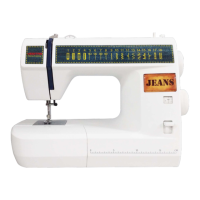
3. Gathering
Dierential feed makes gathering easier on
lightweight fabric. Use it on waistlines, sleeve
heads, sleeve bottoms and rues, etc.
Set the Dierential feed control lever between
1.5 and 2 to obtain the best gathering eect for
your use.
IMPORTANT
The exact adjustment depends on the thickness
and elasticity of fabric. Even the stitch length can
inuence the setting. The longer the stitches, the
more the fabric is contracted.
Always do a test run with a piece of actual fabrics
you use and nd the best settings.
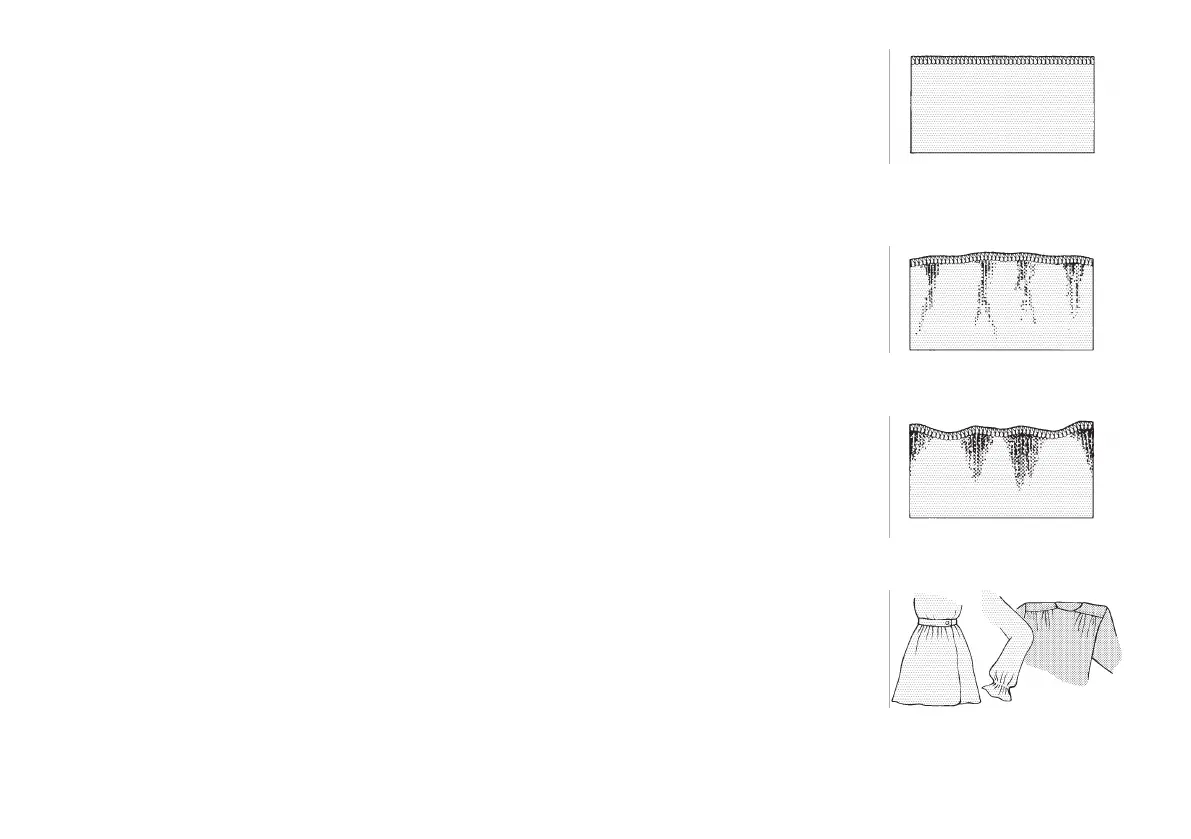
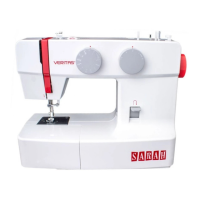
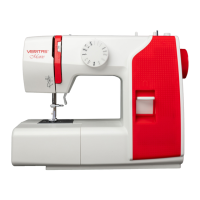
Illustration *
I
: Pucker or waver-free seams
*
II
: Puckering
*
III
: Wavering
*
IV
: Gathering
UTILISATIONS DU DIFFERENTIEL
Veuillez consulter la page 63 - 64 ENTRAINEMENT
DIFFERENTIEL. Le diérentiel est conçu pour
minimiser les eets de vague ou de fronçes.
Il est aussi ecace pour le fronçage.
1. PLISSEMENTS (ou fronçes)
Ils ont tendance à apparaître sur les tissus
tissés légers ou très souples. Pour obtenir des
coutures plates et nettes, règler le bouton du
diérentiel à moins de 1.
2. ONDULATIONS (ou vagues)
Elles ont tendance, à apparaître sur les
matières tricotées ou élastiques. Pour obtenir
des coutures plates et nettes, il faut règler le
bouton du diérentiel au-delà de 1.
3. FRONCAGE
Le diérentiel permet de fronçer facilement
des matières légères. On peut l’utiliser sur
des volants, bas de jupes, hauts de manches,
rideaux, etc ...
Règler le bouton du diérentiel entre 1.5 et
2 pour obtenir le fronçage idéal pour votre
couture.
IMPORTANT
Le réglage idéal dépend de l’épaisseur et de
l’élasticité du tissu. Plus les points sont longs,
plus le tissu à tendance à froncer. Il faut faire un
essai sur un morceau du tissu à coudre an de
déterminer les meilleurs réglages.
Illustration *
I
: Coutures sans ondulations/plissements
*
II
: Plissements (ou fronces)
*
III
: Ondulations (ou embu)
*
IV
: Assemblage


 To Next Page