1 Principles of burning wood for heat generation
3
1.1Principles of burning logs for heat generation
Units of measurements for wood
as fuel
The units of measurement commonly
used in forestry and the timber industry for
wood as fuel are solid measure of timber
(smt) and stacked cubic metre (stcm).
The solid measure of timber (smt)
describes 1m
3
of solid timber mass in the
form of assorted round timbers.
The stacked cubic metre of timber (stcm)
is a measure for stacked or tipped wood,
measuring a total volume of 1m
3
,
including air gaps.
On average, 1 solid measure of timber
equals 0.7stacked cubic metres.
Energy content and emission
values
Timber is a renewable fuel. In
combustion, on average approx.
4.0kWh/kg energy is released.
The table shows the calorific value of
various types of firewood with a water
content of 20%.
Type of
timber
Density Calorific value
(approx. with 20%
water content)
kg/m
3
kWh/
smt
*1
kWh/
stcm
*2
kWh/
kg
Pine
Common
spruce
Norwe−
gian
spruce
Scots
pine
Larch
430
420
510
545
2100
2200
2600
2700
1500
1550
1800
1900
4.0
4.2
4.1
4.0
Deciduous
Birch
Elm
Beech
Ash
Oak
Common
beech
580
620
650
650
630
720
2900
3000
3100
3100
3100
3300
2000
2100
2200
2200
2200
2300
4.1
3.9
3.8
3.8
4.0
3.7
*1
Solid measure of timber
*2
Stacked cubic metre
1litre fuel oil can be replaced by 3kg
firewood, given the usual efficiencies.
A stacked cubic metre (stcm) of beech
firewood corresponds to the energy of
approx. 200litres fuel oil or 200m
3
natural gas. Therefore, burning wood
contributes to the preservation of finite
reserves of oil and gas.
Firewood has a generally neutral
CO
2
balance, as the CO
2
created during
combustion is immediately reabsorbed
into the photosynthetic circle and
therefore, contributes to the formation of
new biomass.
Another aspect relevant to environmental
considerations is the fact that firewood
contains hardly any sulphur and therefore
almost no sulphur dioxide is created
during combustion.
Influence of moisture on the
calorific value
The water content of firewood
substantially influences its calorific value.
The more water firewood contains, the
lower its calorific value, since the water
evaporates during combustion and
consumes energy in the process.
Two measures are used to state the water
content.
H Water content
The water content of firewood is its
water mass as a percentage of the total
firewood mass.
H Firewood moisture
The firewood moisture (in the following
referred to as moisture) is the water
mass expressed as percentage of the
total firewood mass excluding water.
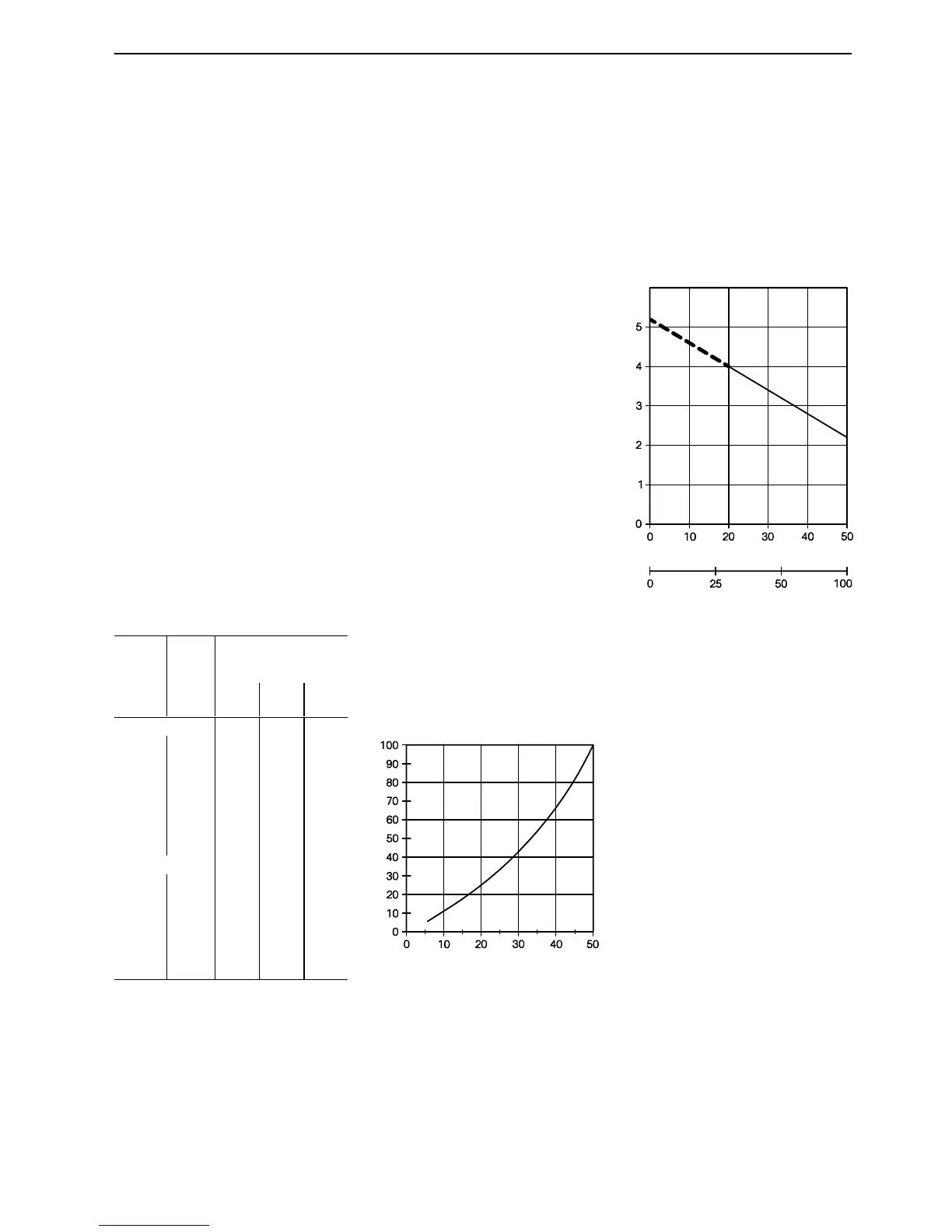
The diagram shows the relationship
between the water content and moisture.
Freshly cut firewood has a moisture
content of 100%. During storage over
one summer, this moisture level reduces
to approx. 40%. During storage over
several years, this moisture level reduces
to approx. 25%.
The following diagram shows the
dependency of the calorific value on the
water content using common spruce as
an example.
With a water content of 20% (moisture
25%), the calorific value is 4.0kWh/kg.
The calorific value of firewood stored
over several years is approximately twice
that of freshly cut firewood.
Storage
Not only is the burning of wet firewood
uneconomical, but it also leads to low
combustion temperatures and high
emissions plus tar deposits inside the
chimney stack.
Tips on storing firewood
H Split round timbers from a diameter of
10cm upwards.
H Stack the split firewood in a ventilated
and preferably sunny spot underneath a
rain canopy.
H Stack the split firewood with generous
air gaps to enable the air flow to carry
off the dissipating moisture.
H A hollow should be created underneath
the woodpile, e.g. in the form of storage
beams, to allow moist air to escape
downwards.
H Never store freshly cut firewood in a
cellar, since air and sunshine are
required to dry out firewood. However,
dried firewood can be stored in a
well−ventilated cellar.
5822241 GB
Water content in %
Moisture in %
Water content in %
Moisture in %
Calorific value in kWh/kg







 To Next Page