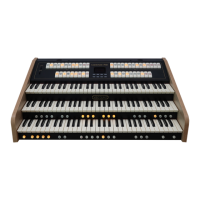
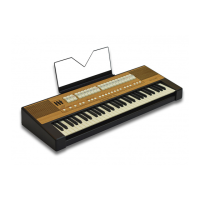
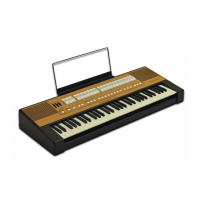
Cantorum Trio – Duo Plus
Reference Manual
21. [MIDI] connectors: connectors for connecting MIDI devices.
- [IN]: input connector for receiving data from an external MIDI unit to the instrument. Connect to the MIDI output
of the transmitting device (e. g. a MIDI pedalboard).
- [OUT]: this connector transmits the MIDI data generated by the instrument. Connect to the MIDI input of the
receiving device (e. g. an expander).
22. [USB] connectors: two USB ports. The [TO HOST] port links the organ to a computer, in order to use the
“Physis Plus The Editor” Windows / Mac OS / iOs application. The [TO DEVICE] port is dedicated to USB
flash drive (not included with the organ) to save and load configuration files and songs recorded using the
internal sequencer.
23. [MAINS AC-IN] socket: connector for the power cable supplied with the instrument.
24. [POWER] switch: switches the instrument on and off.
- When a headphone jack is inserted, the organ’s internal speakers are automatically muted.
-
When switching on, the instrument automatically detects the polarity of the switch pedal connected to
the [SUSTAIN] connector. Do not hold down the pedal when turning the power on, to avoid reversing the
operation of the pedal.
-
Expression and Crescendo can also be controlled via MIDI. It is necessary to set the type and operation
mode of the respective pedals using the SHOES / PEDALBOARD function (page 38
). In addition to this,
please note that when using the MIDI controls, Expression and Crescendo cannot be controlled with
pedals connected to the [EXPR.] and [CRESC.] connectors. Likewise, by selecting the use of these
pedals, control via MIDI is not possible.
-
The [CRESC.] pedal can control also the volume of Pedal and Manual II or Manual I (Cantorum Trio
Plus) or Pedal and Manual I (Cantorum Duo Plus). For further information about this function see page
26.
- For further information about the MIDI interface, see page 54.
- For further information about the use of a USB flash drive, see page 13, 33 and 40.


 To Next Page