2 Stability and Safety Enhancement Systems
7
WABCO Maintenance Manual MM-0112 (Revised 07-18)
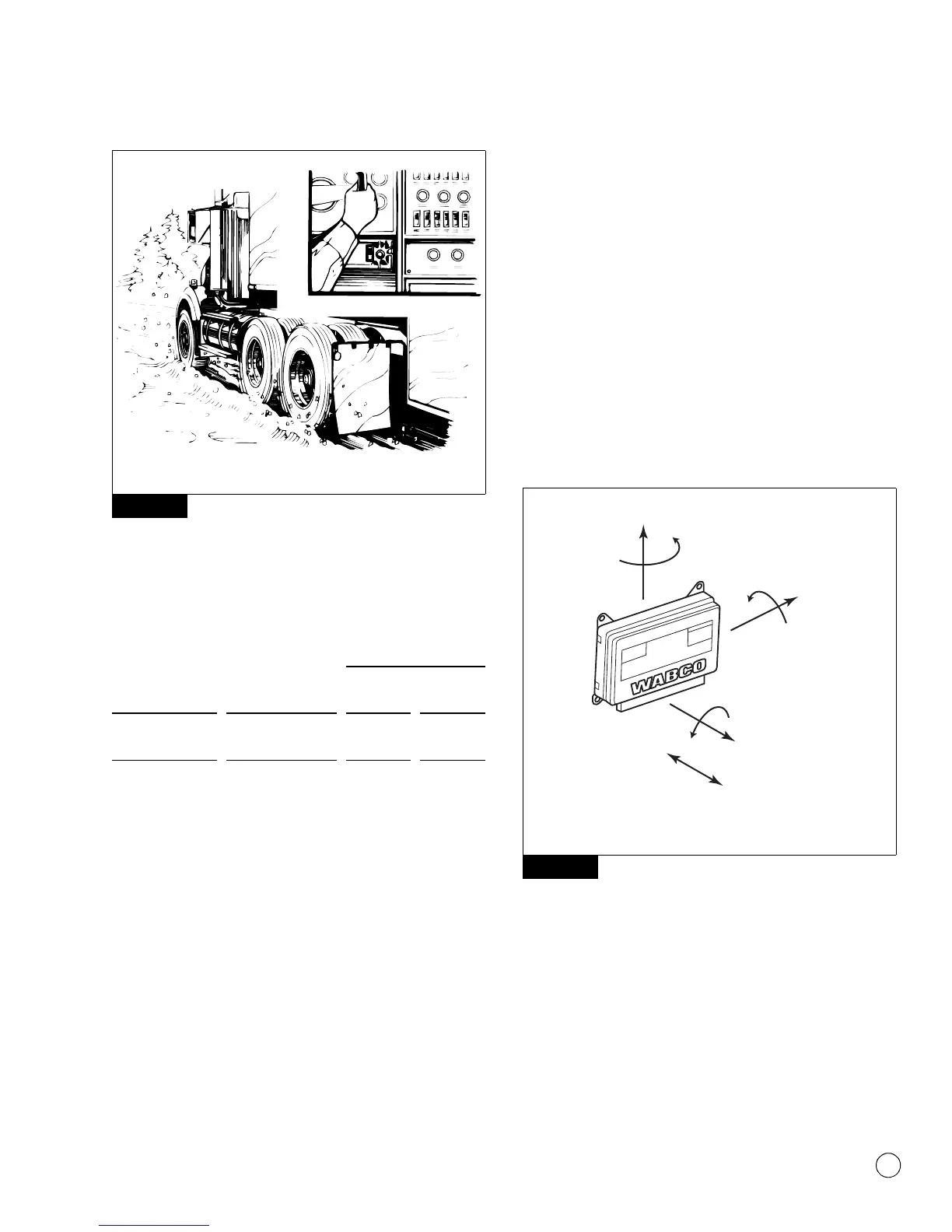
Figure 2.3
Switch and lamp locations as well as ATC switch configuration will
vary depending on the vehicle make and model. Please check with
the vehicle manufacturer for correct information.
Here’s how the ATC switch works.
NOTE: Turning off the ignition will also deactivate either ATC
function.
Roll Stability Control (RSC)
Roll stability control is an option designed to assist drivers in
managing the conditions that may result in vehicle rollovers. When
RSC senses conditions that may result in a rollover, it may reduce
engine torque, engage the engine retarder, apply pressure to the
drive axle brakes and may modulate the trailer brakes to slow the
vehicle down. Depending on the application and vehicle
configuration, the steer axle brakes may be applied as well.
Similar to ATC, RSC works automatically. The driver does not have to
select this feature. Unlike ATC, RSC cannot be turned off by the
driver.
RSC Components
RSC uses many of the same components used by ABS/ATC
including modulator valves, active braking valves and wheel speed
sensors. RSC ECUs are different from ABS ECUs as they contain an
internal accelerometer that measures and updates the lateral
acceleration of the vehicle and compares it to a critical threshold at
which rollover may occur.
Depending on the vehicle manufacturer, RSC ECUs have orientation
on the XX/YY or ZZ axis. For correct operation and the best
performance, verify the ECU is correctly leveled and securely
mounted. Figure 2.4, Figure 2.5 and Figure 2.6.
Figure 2.4
Figure 2.3
Driver Action
System
Response
Function
Active
Not
Active
Press ATC switch ATC lamp blinks
continuously
X
Press ATC switch
again
ATC lamp stops
blinking
X
Figure 2.4
4010606a
Z ± 2°
X ± 2°
DRIVING
DIRECTION
+92°
-2°
Y
XX Orientation



 To Next Page