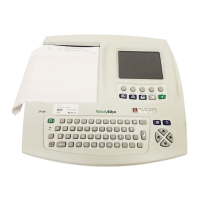
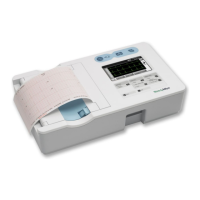
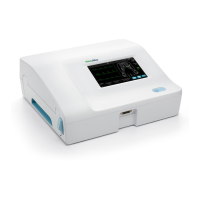
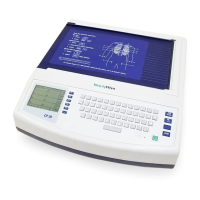
CP 20 ____________________________________________________________________Appendix B
Inspection and Cleaning
If the hospital or institution fails to implement a satisfactory cleaning and inspection schedule for this equipment, it
may result in equipment failure and health hazards.
NOTE: Only qualified service personnel should repair or replace CP 20 parts.
Inspecting the CP 20
Inspect the equipment for the following conditions on a regular basis:
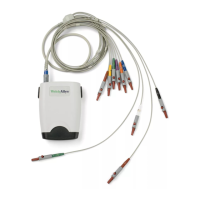
• Examine patient cable, power cable and other accessory cables for obvious damage (e.g. torn insulation,
broken connectors, etc.). Replace cables as necessary.
• No bent prongs or pins on the plugs and connectors. Check the fit of cables with connectors on the CP 20
to ensure proper fit.
• All cords and connectors are securely seated in their corresponding connections.
• Examine the equipment for missing screws, cracks or broken areas that might allow unintended access to
internal electronics areas.
Cleaning the CP 20
Disconnect the power source. Clean the exterior surface of the unit with a damp cloth using a solution of mild
dishwashing detergent diluted in water. After washing, thoroughly dry off the unit with a clean, soft cloth or paper
towel.
NOTE: Do not let soap or water come into contact with the writer, plugs, jacks or vents.
Test Operation
After cleaning and inspecting the CP 20 proper operation of the unit may be confirmed by using an ECG simulator
to acquire and print a standard 12-lead ECG of known amplitude. Printing should be dark and even across the page.
There should be no evidence of print-head dot failure (e.g. breaks in printing forming horizontal streaks). Paper
motion should be smooth and consistent during printing. Waveforms should appear normal, with proper amplitude,
and without distortion or excessive noise. Paper should stop with perforations near the tear-bar (indicating proper
cue sensor operation).
Recommendations to Biomedical Staff
Following any service to the CP 20 or when non-compliant operation is suspected, Welch Allyn, Inc. recommends
the following procedures:
• Confirm proper operation.
• Perform testing to ensure continued electrical safety of the device (use IEC 60601-1 or ANSI/AAMI ES1
methods and limits).
• Patient leakage current.
• Chassis leakage current.
• Earth leakage current.
• Dielectric strength (mains and patient circuits).
B-2


 To Next Page
 Loading...