How Welch Allyn MicroTymp Works
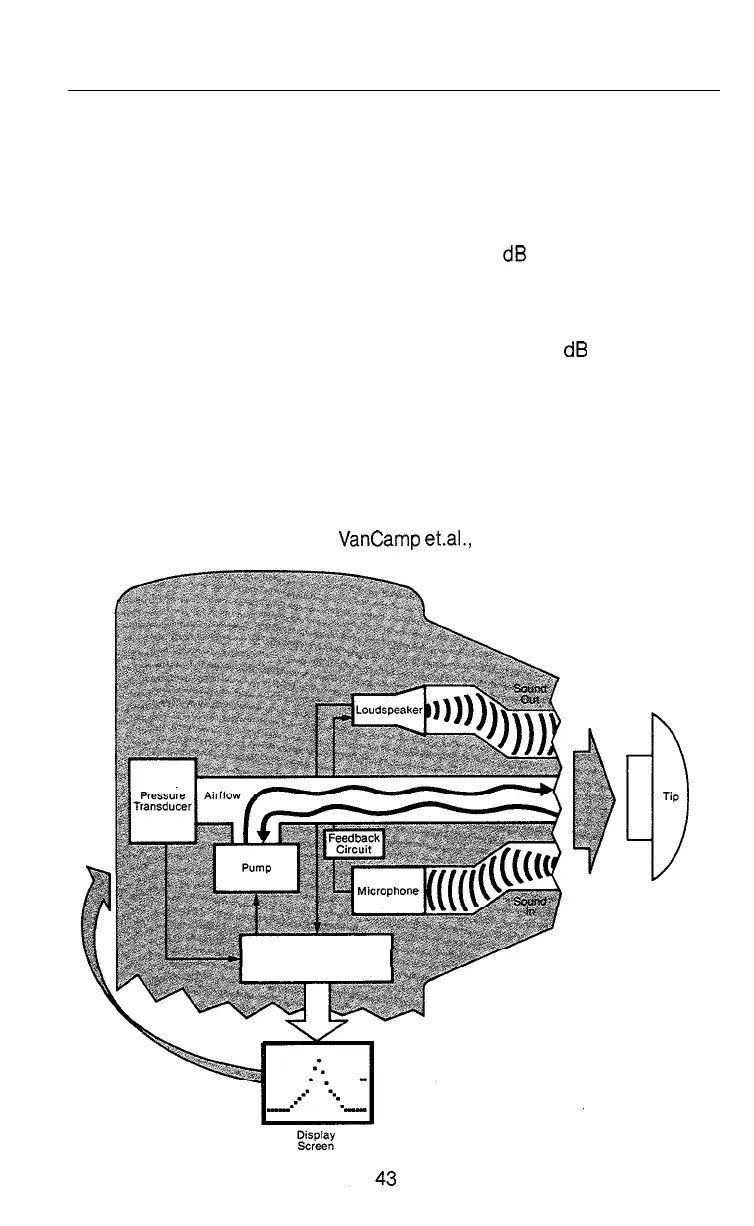
A block diagram of the Welch Allyn MicroTymp is shown below.
A 226-Hz probe tone is introduced in the sealed ear canal by a
miniature loudspeaker. A miniature microphone records and monitors
the sound pressure produced in the ear canal.
The sound level is maintained at a constant 85
dB
SPL throughout a
test via the feedback circuit. Therefore, when the amount of sound
absorbed by the middle ear increases, the speaker must be driven
harder by increasing voltage to maintain the correct SPL.
The voltage required to maintain the probe tone at 85
dB
SPL is
proportional to the acoustic admittance of the ear. As pressure in
the ear canal is changed throughout a test, the microprocessor
computes acoustic admittance and plots it out.
Pressure in the ear canal is changed with a miniature pump. The
pressure transducer monitors pressure, feeding this information to
the microprocessor so that it can control the pump.
For a more thorough discussion of design principles of acoustic
immittance instruments, see
VanCamp
et.al.,
1986, Chapter 4.
Microprocessor
0
Tip






 To Next Page