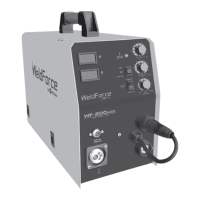
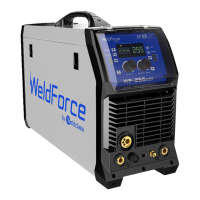
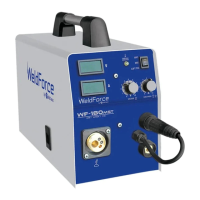
Table 17
14.4.6 Fumes And Gases
WARNING! Welding produces fumes and gases. Breathing these fumes and
gases can be hazardous to your health.
1. Keep your head out of the fumes. Do not breathe the fumes.
2. If inside, ventilate the area and/or use an exhaust at the arc to remove welding fumes and gases.
3. If ventilation is poor, use an approved supplied-air respirator (PAPR).
4. Read the Safety Data Sheets (SDS) and the manufacturer’s instruction for the metals,
consumables, coatings, and cleaners.
5. Work in a confined space only if it is well ventilated, or while wearing an air-supplied respirator.
Shielding gases used for welding can displace air causing injury or death. Be sure the breathing air
is safe.
6. Do not weld in locations near degreasing, cleaning, or spraying operations. The heat and rays of
the arc can react with vapours to form highly toxic and irritating gases.
7. Do not weld on coated metals, such as galvanized, lead, or cadmium plated steel, unless the
coating is removed from the weld area, the area is well ventilated, and if necessary, while
wearing an air- supplied respirator. The coatings and any metals containing these elements can
give off toxic fumes if welded.
14.4.7 Fire & Explosive Risks
WARNING! Sparks and spatter fly off from the welding arc. The flying sparks
and hot metal, weld spatter, work piece, and hot equipment can cause fires and
burns.
Accidental contact of electrode or welding wire to metal objects can cause sparks, overheating, or fire.
1. Protect yourself and others from flying sparks and hot metal.
2. Do not weld where flying sparks can strike flammable material.
3. Remove all flammables within 10m of the welding site.
4. Be alert that welding sparks and hot materials from welding can easily go through small cracks
and openings to adjacent areas.
5. Watch for fire, and keep a fire extinguisher nearby.
6. Be aware that welding on a ceiling, floor, bulkhead, or partition can cause fire on the hidden side.
7. Do not weld on closed containers such as tanks or drums.


 To Next Page