GENERATOR
INFORMATION
USE
OF
ELECTRIC
MOTORS
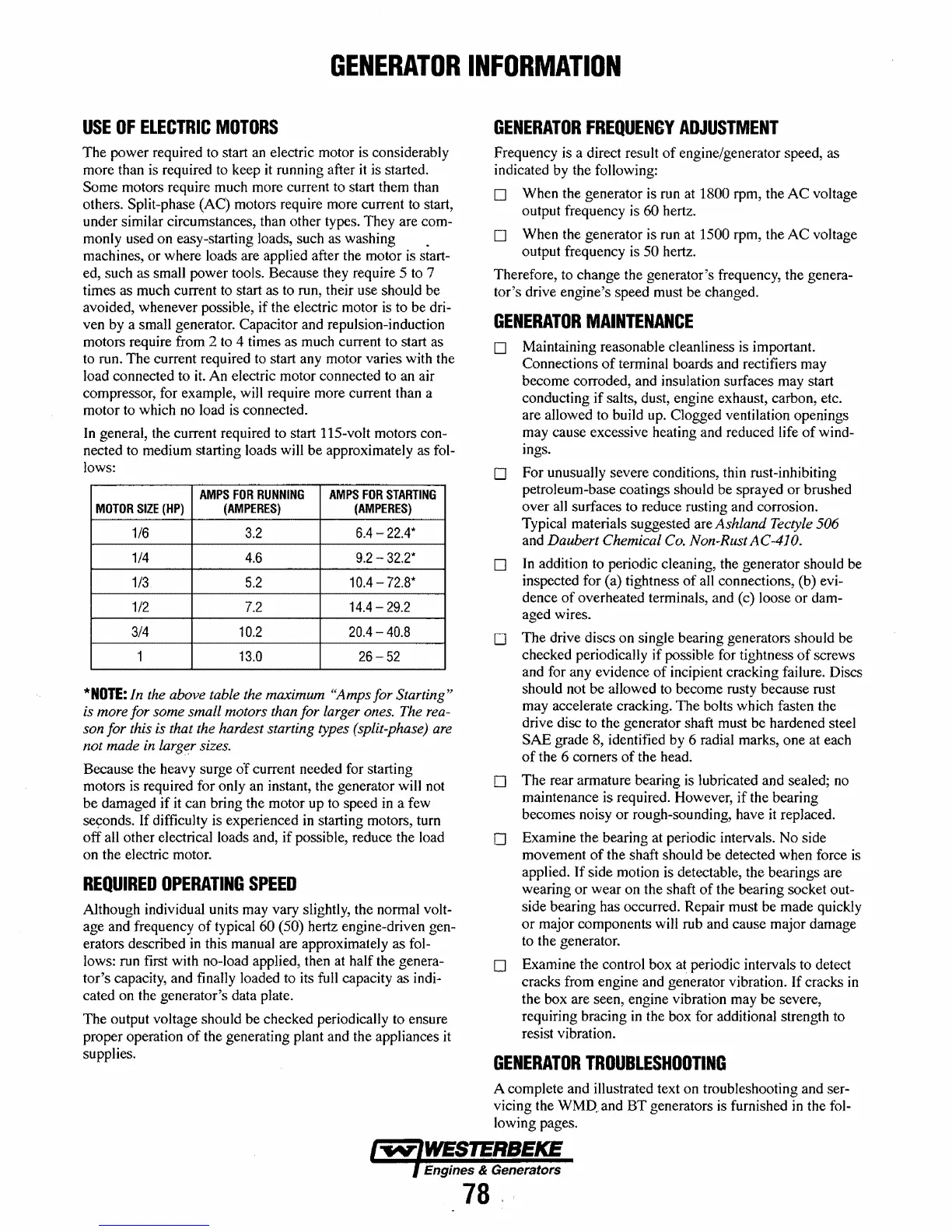
The power required to start
an
electric motor is considerably
more than is required to keep
it
running after
it
is started.
Some motors require much more current to start them than
others. Split-phase (AC) motors require more current to start,
under similar circumstances, than other types. They are com-
monly used on easy-starting loads, such as washing .
machines, or where loads are applied after the motor is start-
ed, such as small power tools. Because they require 5 to 7
times as much current to start as to run, their use should be
avoided, whenever possible, if the electric motor
is
to be dri-
ven by a small generator. Capacitor and repulsion-induction
motors require from 2 to 4 times as much current to start as
to run. The current required to start any motor varies with the
load connected to it. An electric motor connected to an air
compressor, for example, will require more current than a
motor to which no load is connected.
In
general, the current required to start lIS-volt motors con-
nected to medium starting loads will be approximately as fol-
lows:
AMPS
FOR
RUNNING
AMPS
FOR
STARTING
MOTOR
SIZE
(HP)
(AMPERES)
(AMPERES)
1/6
3.2
6.4
-
22.4*
1/4
4.6
9.2
-
32.2*
1/3
5.2
10.4
-72.8*
1/2
7.2
14.4
29.2
3/4
10.2
20.4
-
40.8
1
13.0
26
52
*NOTE:
In the above table the maximum "Amps for Starting"
is more for some small motors than for larger ones. The rea-
son for this is that the hardest starting types (split-phase) are
not made
in
larger sizes.
Because the heavy surge
ot
current needed for starting
motors is required for only an instant, the generator will not
be damaged
if
it
can bring the motor up to speed
in
a few
se90nds. If difficulty is experienced
in
starting motors, turn
off
all other electrical loads and,
if
possible, reduce the load
on the electric motor.
REQUIRED
OPERATING
SPEED
Although individual units may vary slightly, the normal volt-
age and frequency
of
typical 60 (50) hertz engine-driven gen-
erators described
in
this manual are approximately as fol-
lows: run first with no-load applied, then at half the genera-
tor's capacity, and finally loaded to its full capacity as indi-
cated on the generator's data plate.
The output voltage should be checked periodically to ensure
proper operation
of
the generating plant and the appliances
it
supplies.
GENERATOR
FREQUENGY
ADJUSTMENT
Frequency is a direct result
of
engine/generator speed, as
indicated by the following:
D When the generator is run
at
1800 rpm, the
AC
voltage
output frequency is
60 hertz.
D When the generator is run at
1500
rpm, the
AC
voltage
output frequency is
50 hertz.
Therefore, to change the generator's frequency, the genera-
tor's drive engine's speed must be changed.
GENERATOR
MAINTENANCE
D Maintaining reasonable cleanliness
is
important.
Connections
of
terminal boards and rectifiers may
become corroded, and insulation surfaces may start
conducting
if
salts, dust, engine exhaust, carbon, etc.
are allowed to build up. Clogged ventilation openings
may cause excessive heating and reduced life
of
wind-
ings.
D For unusually severe conditions, thin rust-inhibiting
petroleum-base coatings should be sprayed or brushed
over all surfaces to reduce rusting and corrosion.
Typical materials suggested are
Ashland Tectyle 506
and Daubert Chemical
Co.
Non-RustAC-410.
D
In
addition to periodic cleaning, the generator should be
inspected for (a) tightness
of
all connections, (b) evi-
dence
of
overheated terminals, and (c) loose or dam-
aged wires.
D The drive discs on single bearing generators should be
checked periodically if possible for tightness
of
screws
and for any evidence
of
incipient cracking failure. Discs
should not be allowed to become rusty because rust
may accelerate cracking. The bolts which fasten the
drive disc to the generator shaft must be hardened steel
SAE
grade 8, identified by 6 radial marks, one at each
of
the 6 corners
of
the head.
D The rear armature bearing is lubricated and sealed; no
maintenance is required. However,
if
the bearing
becomes noisy
or
rough-sounding, have
it
replaced.
D Examine the bearing at periodic intervals. No side
movement
of
the shaft should be detected when force
is
applied. If side motion is detectable, the bearings are
wearing or wear on the shaft
of
the bearing socket out-
side bearing has occurred. Repair must be made quickly
or
major components will rub and cause major damage
to the generator.
D Examine the control box at periodic intervals to detect
cracks from engine and generator vibration. If cracks
in
the box are seen, engine vibration may be severe,
requiring bracing
in
the box for additional strength to
resist vibration.
GENERATOR
TROUBLESHOOTING
A complete and illustrated text on troubleshooting and ser-
vicing the WMD. and BT generators is furnished
in
the fol-
lowing pages.
Engines & Generators
78
'



 To Next Page