Operator Manual for Gasoline Generators 5 Maintenance
page 31
5.4.7 Battery Charging Circuit
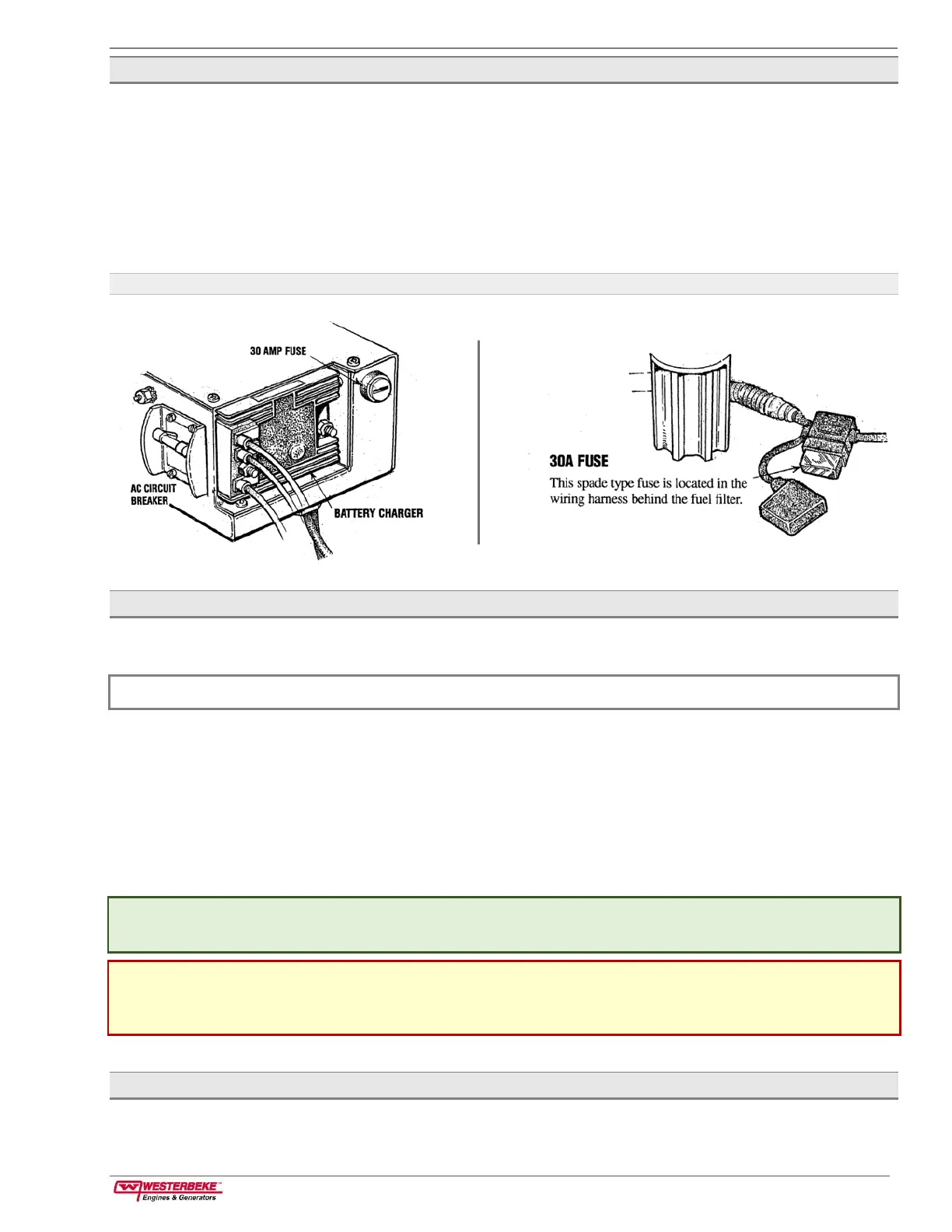
The battery charger is an encapsulated, solid-state unit that supplies a DC charging voltage to the generator
starting battery while the generator is operating. The battery charging circuit is separate from the AC output of
the generator.
A separate group of stator windings supplies AC voltage to a bridge rectifier which converts the AC current to
supply the charging unit. The unit senses the needs of the starting battery and supplies a DC charge when one
is needed. A 30-amp blade type fuse is in the wiring harness behind the fuel filter.
When the generator is first started, the charger produces a low-charging rate. This charging rate rises as the
generator runs.
Figure 25: Battery Charger and 30A Fuse
5.4.8 How to Check the Battery
The minimum recommended capacity of the battery used in the 12-volt DC control circuit in the engine is 800-
1,000 CCA.
NOTE: You must use a dedicated battery.
1.
Review the manufacturer recommendations and then establish a systematic maintenance schedule for your
engine starting batteries and house batteries.
2.
Monitor your voltmeter for proper charging during engine operation.
3.
Check the electrolyte level and specific gravity with a hydrometer (except on sealed type batteries)
4.
Use only distilled water to bring electrolytes to a proper level.
5.
Make certain that battery cable connections are clean and tight to the battery posts (and to your engine).
6.
Keep your batteries clean and free of corrosion.
TIP: There is a small DC amperage drain from the starting battery when the generator is not in use. To prevent this draw,
turn OFF the DC breaker on the generator control panel (or turn OFF the DC battery switch to the generator).
CAUTION: To avoid electrical shorts when working on the engine electrical circuit, shut OFF the engine battery switch;
however, to avoid damage to the battery charging circuit, never shut OFF the engine battery switch while the engine is
still running.
5.4.9 Exhaust System Maintenance
The catalyst is critical to minimizing engine CO exhaust emissions. Any water intrusion into the exhaust system
can quickly compromise the proper operation of the catalyst. Inspection of the catalyst at the prescribed
intervals is critically important.



 To Next Page