16 | English
OPERATION
USING FUEL STABILIZER
Adding a fuel stabilizer (not included) extends the usable
life of fuel and helps prevent deposits from forming that can
clog the fuel system. Follow the manufacturer’s instructions
for use.
Always mix the correct amount of fuel stabilizer to gasoline in
an approved gasoline container before fueling the generator.
Run the generator for ve minutes to allow the stabilizer to
treat the entire fuel system.
LP GAS CYLINDER REQUIREMENTS
NOTICE
Propane cylinders that use liquid with-
drawal system can not be used on these models.
LP gas is extremely ammable and could ignite sponta-
neously when mixed with air. The LP gas cylinder used
with this generator must meet the following requirements:
l The cylinder must be manufactured and labeled in accor-
dance with the Specications for LP Gas Cylinders of the
U.S. Department of Transportation (D.O.T.) or the National
Standard of Canada, CAN/CSA-B339, Cylinders, Spheres,
and Tubes for Transportation of Dangerous Goods; and
Commission.
l The cylinder must have a safety relief valve.
l The cylinder must include a UL list-
ed Overll Protection Device (OPD).
Cylinders with this safety feature will have
a unique triangular handwheel. Only use
LP gas cylinders with this type of hand-
wheel.
l The cylinder must be periodically certied for use by the
authority having local jurisdiction (AHJ). Before use, verify
that the certication date on the cylinder has not expired.
l All new cylinders must be purged of air and moisture prior
to lling. Used cylinders that have not been plugged or
kept closed must also be purged. The purging process
should be done by a propane supplier (Cylinders from an
exchange supplier should have been purged and lled
properly).
CONNECTING AN LP GAS CYLINDER TO
THE GENERATOR
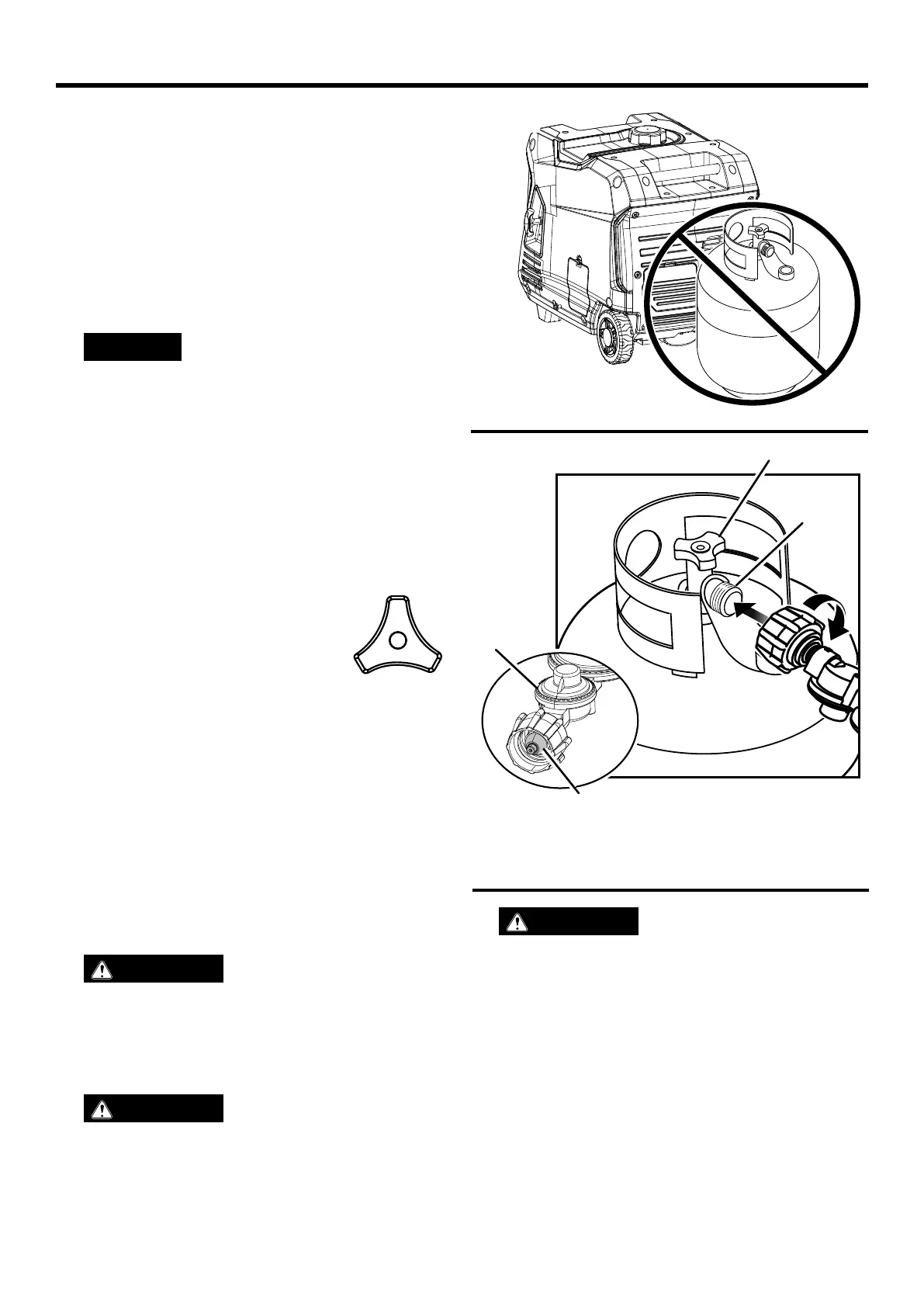
See Figures 10 - 11.
DANGER
Fire and explosion hazard. Nev-
er connect or disconnect the LPG/propane hose while
the engine is running. Do not smoke or create sparks
while handling LPG/propane. Always turn the engine
off and allow the generator to cool for at least ve min-
utes before connecting the propane cylinder.
WARNING
Never use a gas container, LPG/
propane hose, propane cylinder or any other fuel item
that appears to be damaged.
FIG. 10
FIG. 11
A - Handwheel
B - Cylinder valve
C - LPG/propane hose
D - Nipple
A
C
D
B
WARNING
To reduce the risk of injury, per-
form a leak test any time the LP gas cylinder is discon-
nected and reconnected.
l Turn the generator off and allow the engine to cool for at
least ve minutes.
l Place the generator on a level surface in a well-ventilat-
ed area. DO NOT connect or disconnect the LP gas
cylinder indoors.
l Place the LP gas cylinder near the generator, but do not
placeitinthepathofthemuferexhaust.
NOTE: The propane cylinder can be of any capacity but
it must conform to the LP Gas Cylinder Requirements
listed earlier in this section.


 To Next Page