Keeping the arising steam in a closed vessel will produce a very high
pressure, which can even lead to an explosion of the boiler.
Therefore the steam engines have safety valves which open with high
pressure so the steam can escape.
One uses the pressure of the steam by moving a piston in a cylinder, which
produces mechanical energy.
When the steam cools down a contrary process is taking place, the steam
condenses. Now the energy which has been used to evaporate is set free.
Water steam condenses f. ex. on colder metals and is then visible in little
water drops.
1.2.2 The boiler
There are different designs of the steam boiler depending on the use and
form of the steam engine. The main intension is to provide constantly
enough steam so that the pistons of the steam engine are moving.
1.2.3 The flywheel
The steam engine transforms the back- and forward movement into a
rotating movement.
The classical steam engine has a heavy flywheel to provide an even
rotation. This helps to overcome the upper and lower dead centres. The
flywheel is an energy storage, which stores the energy of the “power
strokes” and therefore bridges the passive time.
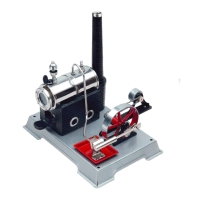
1.2.4 The oscillating steam engine
With the help of the oscillating principle one easily can realize a
functioning steam engine model. The oscillating steam engine regulates the
in and outlet of the steam through the moving cylinders. Constructions of
centred rotatable bearings provide the needed flexibility of the cylinder.
Through a coil spring the cylinder is compressed against the holder. The
sliding surfaces need to be even.


 To Next Page