Maintenance4103−3/A1
RT-flex58T-E
Winterthur Gas & Diesel Ltd.
4/ 5
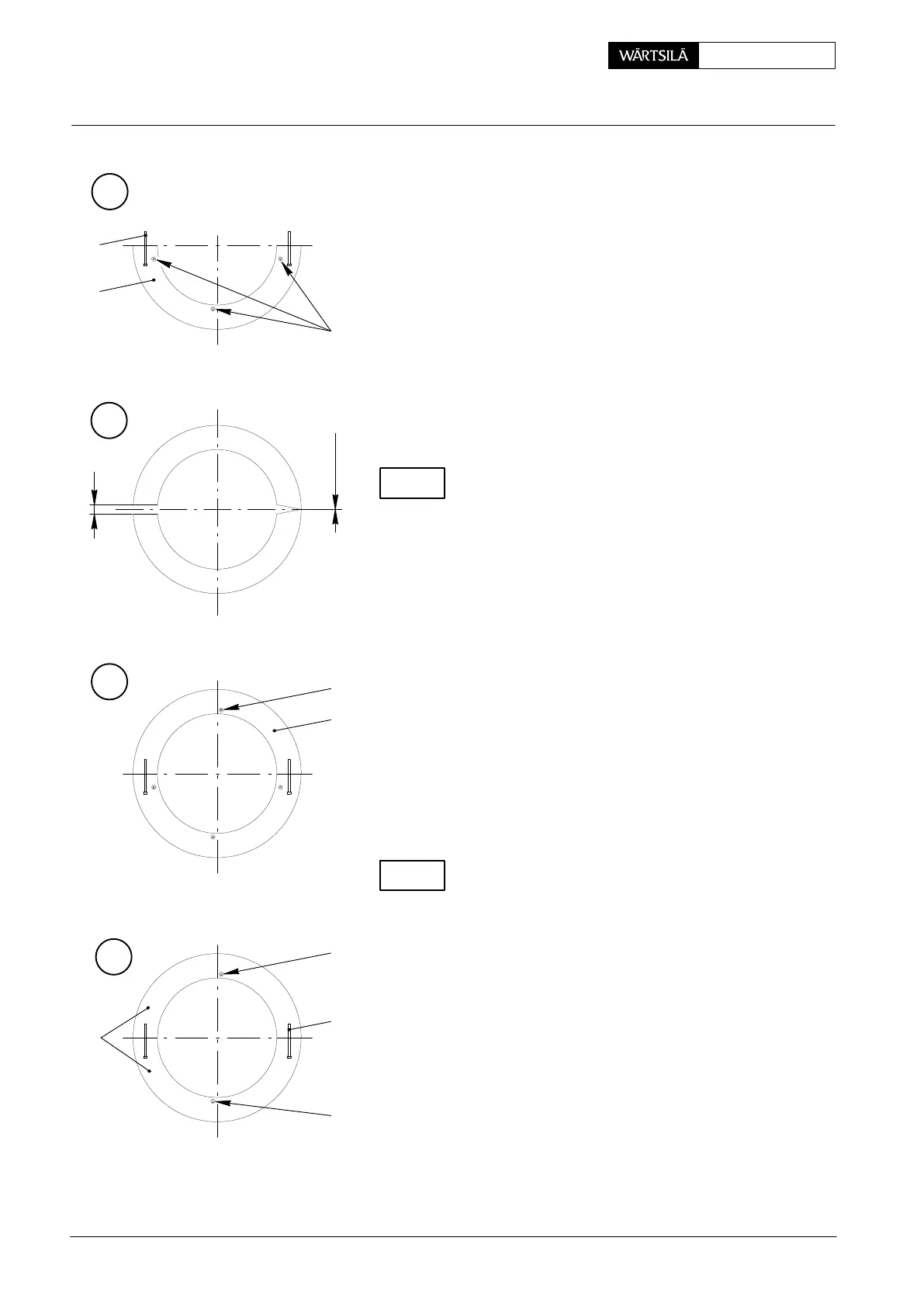
⇒ Turn the gear wheel half to the bottom (Fig. E) and
place the second gear wheel half, which is also pro-
vided with two pre-assembled elastic studs 3, on the
top (Fig. G).
D Check the correct diameter tolerance by measuring
the size of the gap between both gear wheel halves.
For that the gap must be closed on the opposite side
(Fig. F).
Gap ‘j’ must be 0.16 mm ... 0.41 mm. If the dimension is
not within the mentioned tolerance, the gear wheel must
not be assembled, but the center hole has to be given an
appropriate re-machining (see Preparing the assembly
of the gear wheel).
⇒ After measuring, align the gaps between the wheel
halves and slightly tighten castle nuts 4 of elastic
studs 3 (Fig. C).
⇒ Also insert a flange screw 6 in the centre of upper
gear wheel half and tighten it temporarily (Fig. G).
⇒ Remove flange screws 6 from each end of the lower
gear wheel half so that there are now only two flange
screws 6, each of them tightened temporarily in the
centres of the upper and the lower gear wheel half
(Fig. H).
CHECK
There must be no clearance on the seating surfaces be-
tween the gear wheel and the crankshaft flange − check!
⇒ For fitting the four remaining castle nuts 4 belonging
to elastic studs 3 (Fig. C), apply MOLYKOTE paste
to the threads and the seating surfaces. Tighten only
the castle nuts treated with MOLYKOTE paste. Use
fork wrench 94412E (Fig. I) for holding up the castle
nuts opposite which have already been fitted and se-
cured with LOCTITE and a split pin.
⇒ Tighten the four castle nuts of elastic studs 3 cross-
wise by means of ring slugging wrench 94002−46,
measuring and recording the length of the elastic
studs beforehand.
CHECK
E
6
3
1
F
G
j
GAP 0
6
1
H
6
3
6
1
001.167/97
001.166/97
001.166/97
001.166/97
2013 / V2
Replacing the Gear Wheel on the Crankshaft


 To Next Page