32
Wissner-Bosserhoff Carisma Bed, Instruction & Safety Manual
T 08 9351 7500 E info@unicarehealth.com.au W www.unicarehealth.com.au
18) Since the system can be run via battery operation, it is not enough just to pull out the plug in
case of the motors functioning incorrectly. If an incorrect function occurs, please switch off
functions via the control box and contact our Customer Service (battery operation option).
19) For adjustments via the handset, it is recommended that the operator remains in the vicinity
of the control box so that possible incorrect functions can be immediately switched off.
20) Caution! All electrical functions can be faulty – unless they are locked through the control
box.
21) For the power source, a 220 / 230 volt, 50 Hz mains plug in accordance with VDE stipulations
must be used.
22) Do not touch the plug with wet hands. Only hold the mains connection cable on the plug and
pull out from the mains socket.
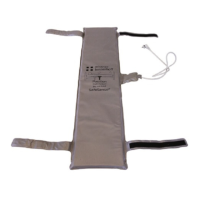
23) Lay the mains connection cable without loops, do not bend or pull around sharp edges.
24) Generally protect connection cable and supply cable from mechanical stress.
25) Position the mains connection cable and supply cable to the handset so that they are safe
from being squashed and do not place any objects on the connection or extension cable.
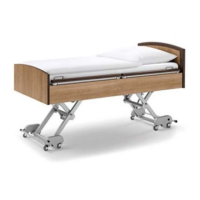
26) When setting up the bed in the room provided for it, safety clearances from the wall,
windowsills and other objects must be maintained. Safety clearances depend on the design
and model of the bed, for which extreme height adjustment and tilting movements are
performed and at least 25 mm space for fi ngers must be maintained.
27) If the bedding and height adjustment functions are performed, it must be ensured that the
safety key is not in the lock or in the vicinity of the handset (in the range of the patient
resident). Through improper release via the safety key, positions can be achieved that may
represent a risk to the patient/resident, such as a wrongly applied Trendelenburg position.
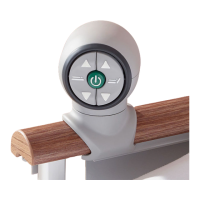
28) Place the handset in the holder provided for this (option) or on the bed so
that the keys can not be pressed through being caught between two objects, e.g. between
side rail and bedside cabinet.


 To Next Page