Cooling
4
700 mm
500 mm
500 mm
150 mm
1000 mm
During installation & maintenance
Ensure that:
1. The units are installed and maintained by qualified personnel only.
2. The electrical supply is isolated and secured from accidental re-connection whilst work is carried out on the equipment.
3. Electrical connections to the unit should be made in accordance with IET regulations as well as local laws and legislation.
Interconnecting pipework
Interconnecting refrigerant lines installed between the condensing unit and evaporator must be purged through with oxygen-free
nitrogen to remove any particles of dirt, debris or moisture, in accordance with good refrigeration practice. Failure to do so could
cause clogging or damage to the solenoid valve and expansion valve during operation.
Care should be taken when completing this to avoid any personal injury. Please note that Nitrogen is an asphyxiant and should
only be used in well-ventilated areas with appropriate procedures and mitigation measures in place to prevent harm.
Refrigerant
The system has been designed and certified when charged with R448a. Charging with R449a is also acceptable. Do not mix these
refrigerants in the same system.
2. Planning the installation
Positioning the condensing unit
To ensure optimum performance, the condensing unit should be situated to give uniform air distribution across the coil.
• Obstructions to airflow should be minimized.
• Coils should ideally be shaded from the sun.
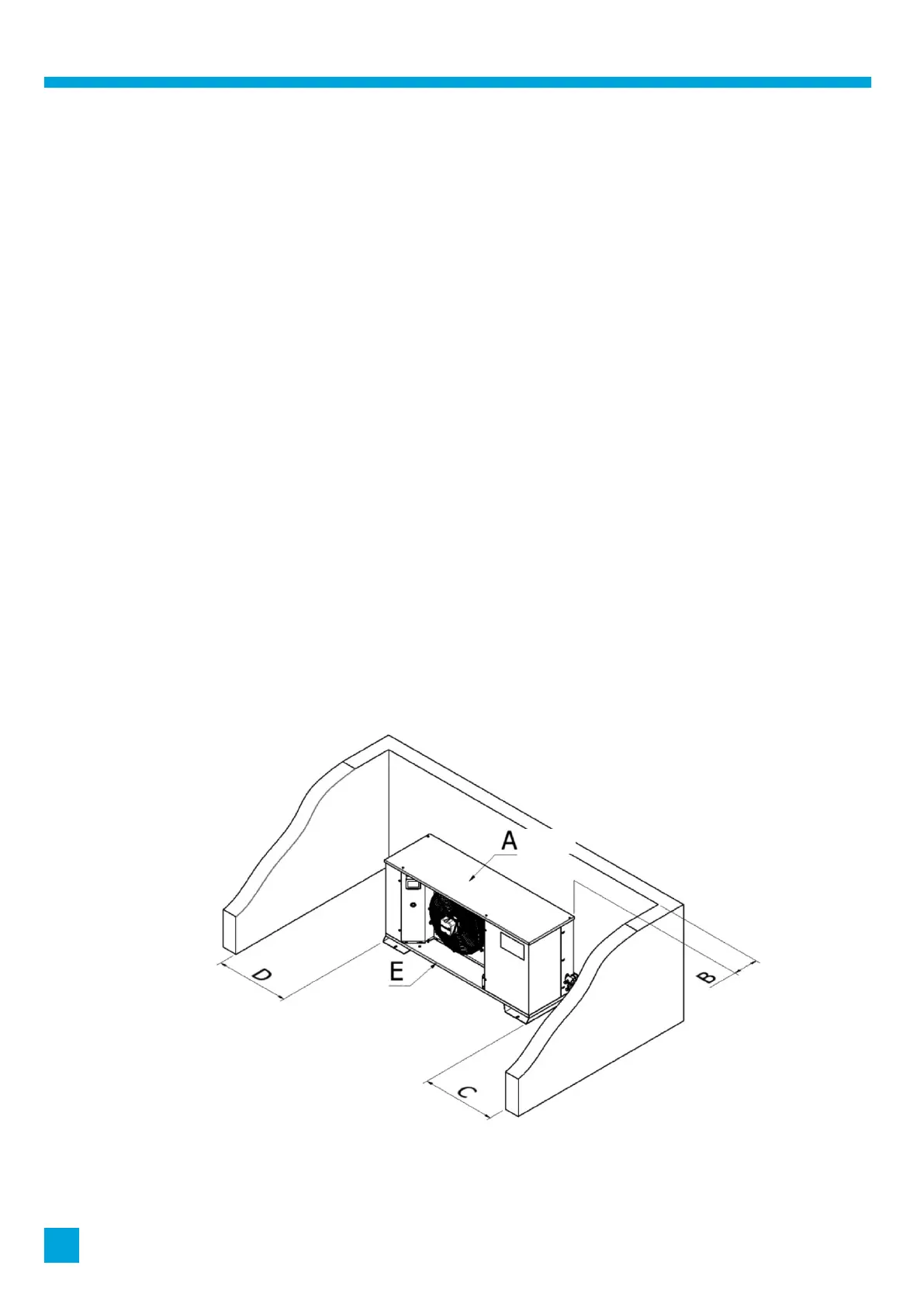
• Consideration should also be given to servicing and airflow. Please see the diagram below.
• If units are roof mounted it is recommended that isolation material is used between the feet of the unit and the roof itself.
The unit should also be installed level and on a firm platform that is able to support the full weight of the unit, including
refrigerant.
• The location of the unit should take into account the minimum clearances, as detailed below.
A Clearance from the top of the unit
B Clearance from the back of the unit to the wall
C Clearance from the RHS of the unit to the wall
D Clearance from the LHS of the unit to the wall
E Clearance from the front of the unit to any other object



 To Next Page