Important points to consider when siting a condensate
drainage pipe:
•
Where a new or replacement boiler is being installed,
access to an internal “gravity discharge” point should
be one of the factors considered in determining
boiler location
•
The condensate pipe must be a minimum of 22mm dia.
plastic pipe
•
The condensate pipework must fall at least 52mm per
metre towards the outlet and should take the shortest
practicable route
•
Ensure there are no blockages in the pipe run.
Internal connections
In order to minimise risk of freezing during prolonged cold
spells, the following methods of installing a condensate
drainage pipe should be adopted, in order of priority.
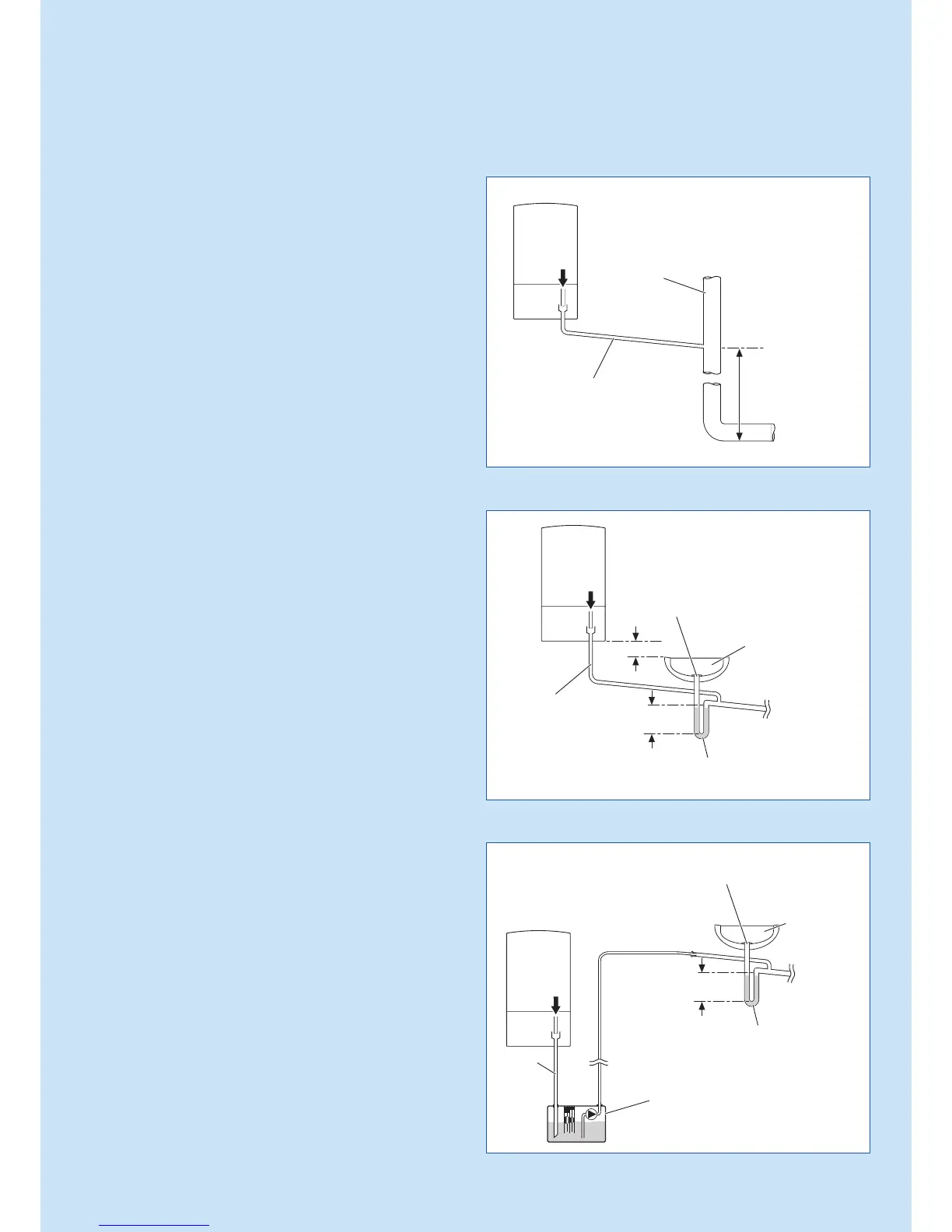
Wherever possible, the condensate drainage pipe should
be routed and terminated so that the condensate drains
away from the boiler, under gravity, to a suitable internal
foul water discharge point, such as an internal soil and vent
stack. A suitable permanent connection to the foul waste
pipe should be used. (see fig. 1)
Alternatively, if the first option is not possible, an internal
kitchen, bathroom or washing machine waste pipe etc. can
be used. (see fig. 2)
Condensate pump
Where “gravity discharge” to an internal termination is not
physically possible, or where very long internal runs would
be required to reach a suitable discharge point, condensate
should be removed using a proprietary condensate pump,
of a specification recommended by the boiler or condensate
pump manufacturer.
The pump outlet pipe should discharge to a suitable internal
foul water discharge point such as an internal soil and vent
stack, internal kitchen, bathroom or washing machine waste
pipe etc. A suitable permanent connection to the foul waste
pipe should be used. (see fig. 3)
Condensate pipework



 To Next Page