Studer Innotec SA
Xtender
User manual V4.6.0 20
Lead batteries are usually available in 2 V, 6 V or 12 V block types. In the majority of cases, in order
to obtain an operating voltage that is correct for Xtender usage, several batteries must be
connected in series or in parallel depending on the circumstances.
The various cabling options are presented in figures 5a-5b (12 V), 5c-5e (24 V) and 6a to 6d (48 V) in
appendix I of this manual.
4.5.1
Battery cable cross-section and DC protective devices
The battery cables must also be as short as possible.
It is always preferable to keep the cable at the negative
pole of the battery as short as possible.
In order to avoid any further loss and protection
redundancy, the XTH does not have an internal fuse.
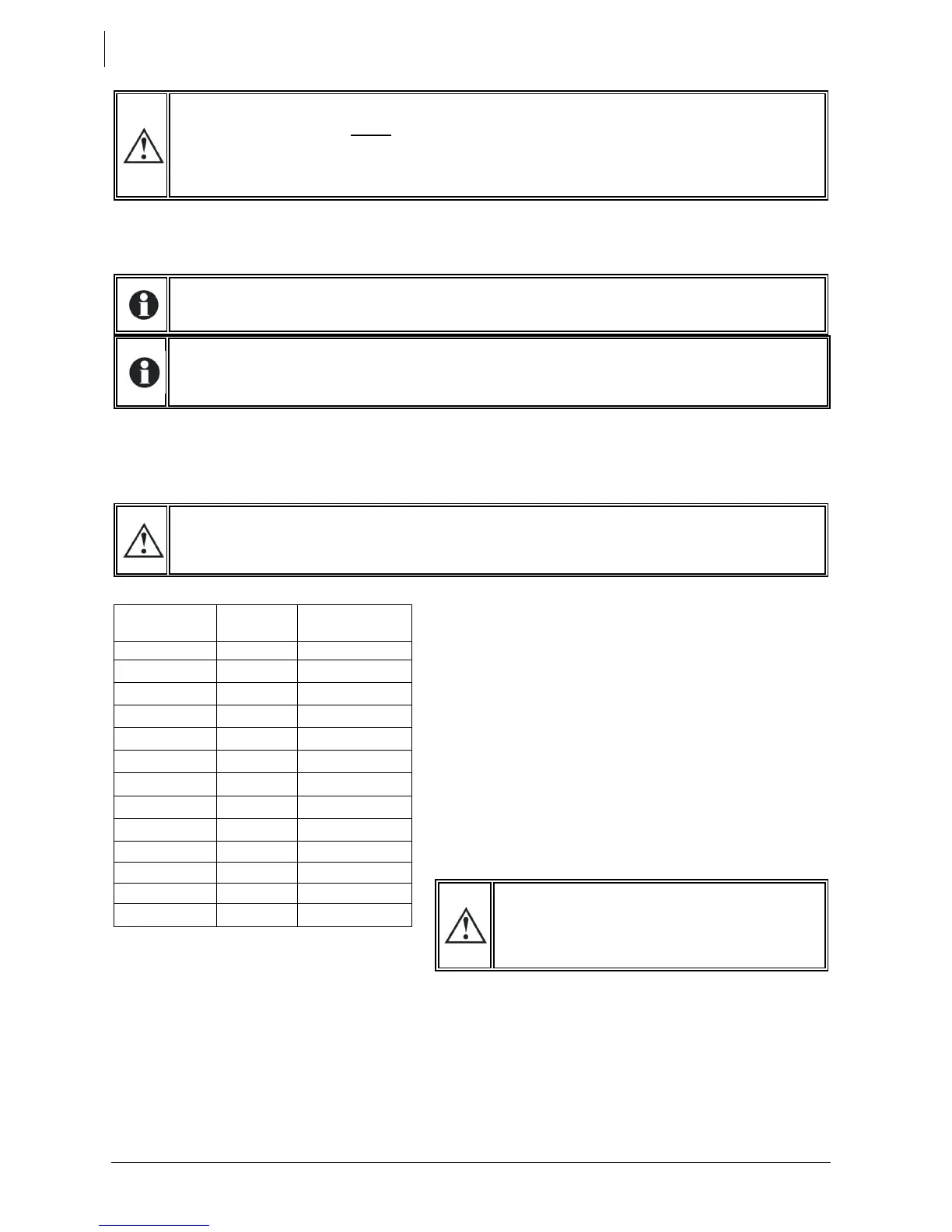
A protective device (f) must be installed as close as
possible to the battery and sized according to the table
on the left.
The recommended cable cross-sections are valid for
lengths less than 3 m. beyond this length it is strongly
recommended to oversize the battery cables.
For safety reasons, we recommend an annual check on
the tightness of all connections.
In mobile installations, the tightness of the connections
should be checked even more frequently.
4.5.2
Connecting the battery (Xtender side)
Insert the cable glands supplied on the battery cable before tightening the cable lugs. Crimp the
cable lugs and fasten the cable gland on the device. Repeat this for the second battery cable. Fix
the battery cables to the appropriate connections "+ Battery" and "- Battery". The M8 screws must be
very well tightened.
On the XTM range, you can insert, if required, a fuse directly on the positive connection to the battery
following the procedure below.


 To Next Page