EasyManua.ls Logo

Yamaha DS55 - MIDI Functions

Yamaha DS55
39 pages
Print Icon
To Next Page IconTo Next Page
To Previous Page IconTo Previous Page
Loading...
MIDI
FUNCTIONS
|
EES
|
i
MIDI,
the
Musical
Instrument
Digital
Interface,
is
a
world-standard
communication
interface
that
allows
MIDl-compatible
musical
instruments
and
equipment
to
share
musical
information
and
control
one
another.
This
makes
it
possible
to
create
“systems”
of
MIDI
instruments
and
equipment
that
offer
far
greater
versatility
and
control
than
are
available
with
isolated
instruments.
For
example,
most
MIDI
key-
|
boards
transmit
note
and
velocity
(touch
response)
information
via
the
MIDI
OUT
i
connector
whenever
a
note
is
played
on
the
keyboard.
If
the
MIDI
OUT
connector
|
is
connected
to
the
MIDI
IN
connector
of
a
second
keyboard
(synthesizer,
etc.)
or
i
a
tone
generator
such
as
the
YAMAHA
TX81Z
FM
Tone
Generator
(essentially
a
synthesizer
with
no
keyboard),
the
second
keyboard
or
tone
generator
will
respond
precisely
to
notes
played
on
the
transmitting
keyboard.
The
result
is
that
you
can
effectively
play
more
than
one
instrument
at
once,
providing
thick
multi-instrument
sounds.
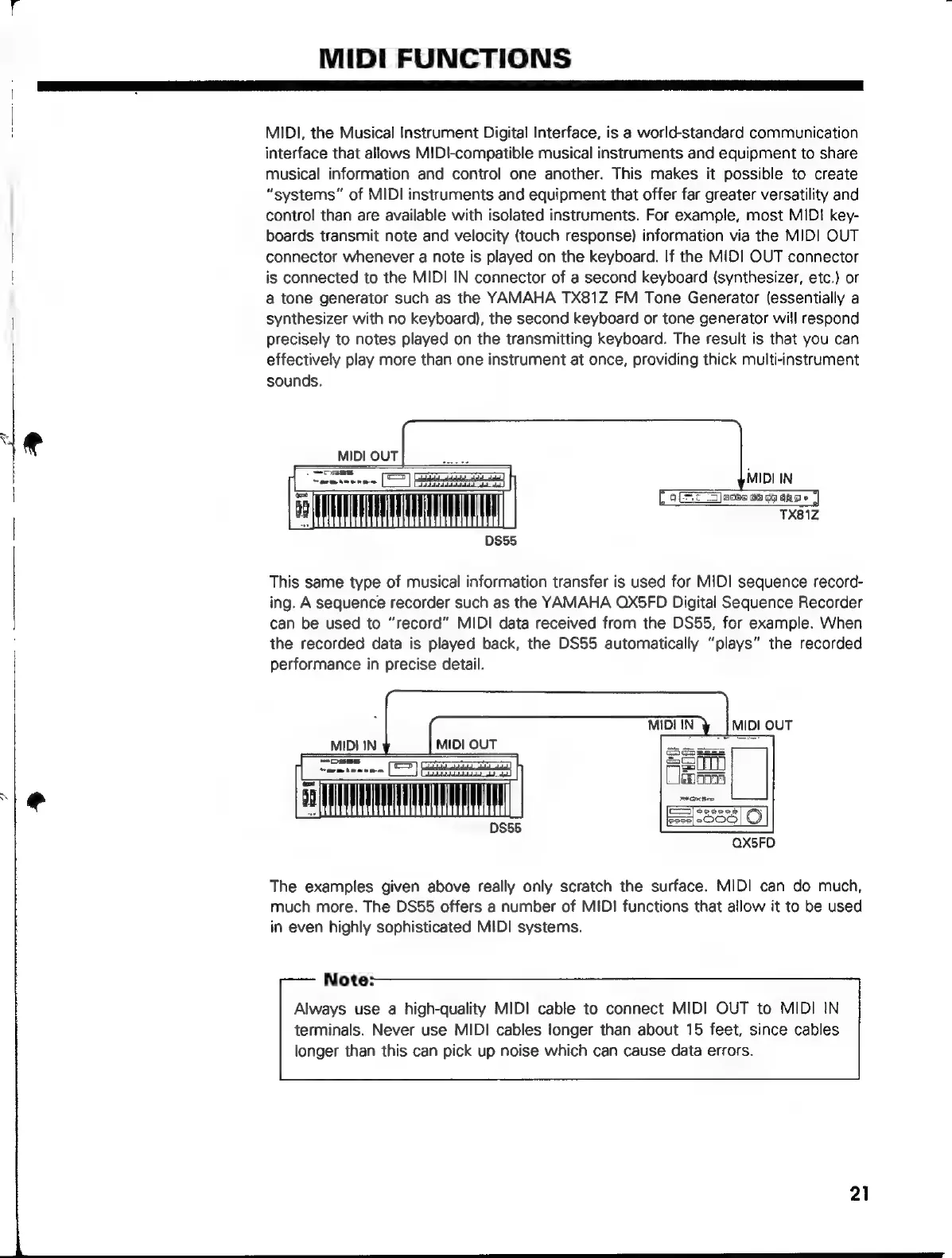
MIDI
IN
2)
ados
88
Ga
gÈ
9
e
TX81Z
This
same
type
of
musical
information
transfer
is
used
for
MIDI
sequence
record-
ing.
A
sequence
recorder
such
as
the
YAMAHA
OX5FD
Digital
Sequence
Recorder
can
be
used
to
“record”
MIDI
data
received
from
the
DS55,
for
example.
When
the
recorded
data
is
played
back,
the
DS55
automatically
“plays”
the
recorded
performance
in
precise
detail.
The
examples
given
above
really
only
scratch
the
surface.
MIDI
can
do
much,
much
more.
The
DS55
offers
a
number
of
MIDI
functions
that
allow
it
to
be
used
in
even
highly
sophisticated
MIDI
systems.
Note:
Always
use
a
high-quality
MIDI
cable
to
connect
MIDI
OUT
to
MIDI
IN
terminals.
Never
use
MIDI
cables
longer
than
about
15
feet,
since
cables
longer
than
this
can
pick
up
noise
which
can
cause
data
errors.