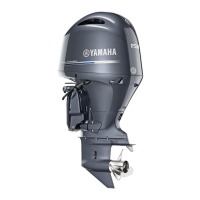
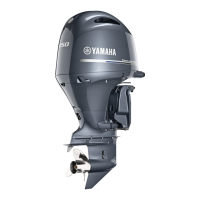
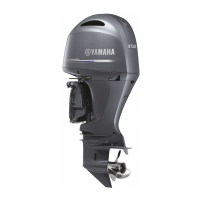
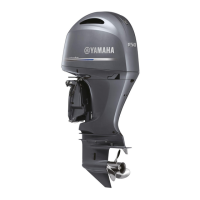
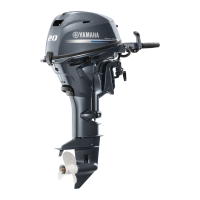
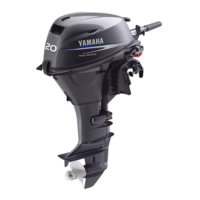
This document is an owner's manual for Yamaha F150, LF150, F150D1, and FL150D1 outboard motors. It provides comprehensive information for proper operation, maintenance, and care.
Function Description
The Yamaha F150 series outboard motors are 4-stroke DOHC L4 16-valve engines designed for marine propulsion. They feature electric starting and fuel injection for efficient operation. The motors are equipped with a power trim and tilt system for adjusting the motor angle relative to the transom, which helps optimize performance, fuel economy, and steering. Some models may include a Yamaha Security System to protect against theft, which requires a remote control transmitter to lock and unlock the engine. The manual covers various operational aspects, including starting the engine, shifting gears, stopping the boat and engine, trimming, and operating in different water conditions.
Important Technical Specifications
- Engine Type: 4-stroke DOHC L4 16 valves
- Total Displacement: 2670 cm³ (162.9 c.i.)
- Bore × Stroke: 94.0 × 96.2 mm (3.70 × 3.79 in)
- Rated Power: 110.3 kW (150 HP)
- Full Throttle Operating Range: 5000–6000 r/min
- Idle Speed (in neutral): 650–750 r/min
- Ignition System: TCI
- Spark Plug (NGK): LFR5A-11
- Spark Plug Gap: 1.0–1.1 mm (0.039–0.043 in)
- Steering System: Remote steering
- Starting System: Electric starter
- Starting Carburetion System: Fuel injection
- Valve Clearance IN (cold engine): 0.17–0.24 mm (0.0067–0.0094 in)
- Valve Clearance EX (cold engine): 0.31–0.38 mm (0.0122–0.0150 in)
- Battery Rating (CCA/SAE): 512–1150 A
- Battery Rating (MCA/ABYC): 675–1370 A
- Battery Rating (RC/SAE): 124 minutes
- Battery Rating (CCA/EN): 510–1080 A
- Battery Rating (20HR/IEC): 80 Ah
- Maximum Generator Output: 35 A
- Gear Shift Positions: Forward-neutral-reverse
- Gear Ratio: 2.00 (28/14)
- Trim and Tilt System: Power trim and tilt
- Recommended Fuel: Regular unleaded gasoline (Min. pump octane number (PON): 86, Min. research octane number (RON): 90)
- Recommended Engine Oil: YAMALUBE 4M FC-W or 4-stroke outboard motor oil (SAE 10W-30/10W-40/5W-30 API SE/SF/SG/SH/SJ/SL or SAE 15W-40/20W-40/20W-50 API SH/SJ/SL)
- Engine Oil Quantity (without oil filter replacement): 4.3 L (4.55 US qt, 3.78 Imp.qt)
- Engine Oil Quantity (with oil filter replacement): 4.5 L (4.76 US qt, 3.96 Imp.qt)
- Recommended Gear Oil: Yamalube Marine Gearcase Lube HD or Hypoid gear oil (SAE 90 API GL-4 / SAE 80W API GL-5 / SAE 90 API GL-5)
- Gear Oil Quantity: 0.980 L (1.036 US qt, 0.862 Imp.qt)
- Tightening Torques: Spark plug: 25 Nm (2.55 kgf-m, 18.4 ft-lb), Propeller nut: 54 Nm (5.51 kgf-m, 39.8 ft-lb), Engine oil drain bolt: 27 Nm (2.75 kgf-m, 19.9 ft-lb), Engine oil filter: 18 Nm (1.84 kgf-m, 13.3 ft-lb), Gear oil drain screw: 9 Nm (0.92 kgf-m, 6.6 ft-lb).
Usage Features
The manual emphasizes safety precautions, including the use of personal flotation devices (PFDs), avoiding alcohol and drugs, and being aware of people in the water. It details the importance of proper boat loading and collision avoidance. The engine features a start-in-gear protection device, ensuring it only starts in neutral. The power trim and tilt switches allow for precise adjustment of the motor's angle, crucial for optimal performance and handling. Digital instruments such as the tachometer, speedometer, trim meter, hour meter, fuel gauge, and fuel management meter provide critical operational data. Alert systems for low oil pressure, overheating, and water in the fuel separator are integrated to warn the operator of potential issues. The Yamaha Security System, if equipped, provides theft protection with lock and unlock modes controlled by a remote transmitter.
Maintenance Features
The manual outlines a comprehensive periodic maintenance schedule, including checks for the propeller, engine oil, gear oil, spark plugs, and various components. It provides instructions for:
- Engine Oil Change: Recommended after the first 20 hours or 3 months, then every 100 hours or 1-year intervals.
- Gear Oil Change: Detailed steps for draining and refilling gear oil.
- Spark Plug Inspection and Replacement: Instructions for checking the condition and gap of spark plugs.
- Flushing Cooling Water Passages: Essential for preventing corrosion and clogging, especially after operating in saltwater or turbid water.
- Cleaning and Anticorrosion Measures: Washing the exterior, applying protectants, and waxing the cowling.
- Battery Maintenance: Checking electrolyte levels, charge, and connections for electric start models.
- Anode Inspection and Replacement: Periodically checking and cleaning sacrificial anodes to prevent corrosion.
- Fuel System Checks: Regular inspection for leaks and contamination, and the importance of using fresh, quality gasoline.
- Propeller Maintenance: Inspection for damage and proper installation.
- Troubleshooting: A detailed guide to diagnose and address common operational problems, including engine not starting, power loss, and alert system activations.
The manual strongly recommends consulting an authorized Yamaha dealer for complex repairs, maintenance procedures requiring specialized tools, or if any safety-related component is not functioning correctly. It also highlights the importance of using genuine Yamaha parts for replacements to ensure safety and reliability.

 Need help?
 General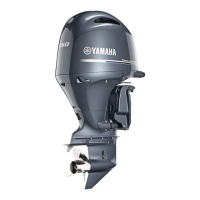

 To Next Page