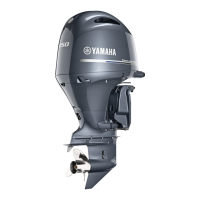
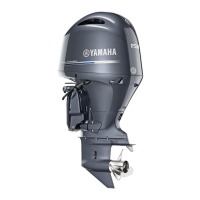
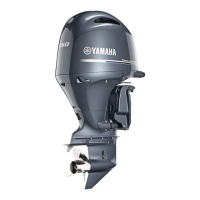
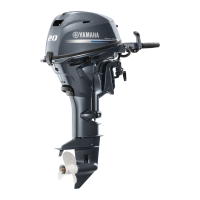
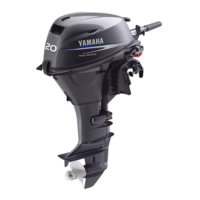
This document is the Owner's Manual for Yamaha F150G, FL150G, F175C, FL175C, F200G, and FL200G outboard motors. It provides essential information for proper operation, maintenance, and care of these engines.
Function Description:
The Yamaha F150G, FL150G, F175C, FL175C, F200G, and FL200G are 4-stroke DOHC L4 16-valve outboard motors designed for marine propulsion. They are equipped with an electric starter and fuel injection system. These models feature a digital electronic control system that manages shifting, throttle, and other electrical operations, including a start-in-gear protection device that prevents the engine from starting unless it is in neutral. The power trim and tilt system allows for adjustment of the outboard motor's angle relative to the transom, optimizing performance, fuel economy, and protecting the propeller and lower case from damage in shallow water. Some models may include a Yamaha Security System (Y-COP) for theft protection, consisting of a receiver and remote control transmitters. The engines are designed with a cooling water passage flushing device for easy maintenance.
Important Technical Specifications:
- Engine Type: 4-stroke DOHC L4 16 valves
- Total Displacement: 2785 cm³ (169.9 c.i.)
- Bore × Stroke: 96.0 × 96.2 mm (3.78 × 3.79 in)
- Ignition System: TCI
- Spark Plug (NGK): LFR6A-11
- Spark Plug Gap: 1.0–1.1 mm (0.039–0.043 in)
- Starting System: Electric starter
- Starting Carburetion System: Fuel injection
- Valve Clearance IN (cold engine): 0.17–0.24 mm (0.0067–0.0094 in)
- Valve Clearance EX (cold engine): 0.31–0.38 mm (0.0122–0.0150 in)
- Full Throttle Operating Range: 5000–6000 r/min
- Rated Power:
- F150GET, FL150GET: 110.3 kW (150 HP)
- F175CET, FL175CET: 128.7 kW (175 HP)
- F200GET, FL200GET: 147.1 kW (200 HP)
- Idle Speed (in neutral): 650–750 r/min
- Gear Shift Positions: Forward-neutral-reverse
- Gear Ratio:
- F175CET, F200GET, FL175CET, FL200GET: 1.86 (26/14)
- F150GET, FL150GET: 2.0 (28/14)
- Trim and Tilt System: Power trim and tilt
- Engine Oil (without filter replacement): 4.3 L (4.55 US qt, 3.78 Imp.qt)
- Engine Oil (with oil filter replacement): 4.5 L (4.76 US qt, 3.96 Imp.qt)
- Recommended Engine Oil: YAMALUBE 4 or 4-stroke outboard motor oil (SAE 10W-30/10W-40/5W-30 API SE/SF/SG/SH/SJ/SL or SAE 15W-40/20W-40/20W-50 API SH/SJ/SL)
- Recommended Gear Oil: YAMALUBE outboard gear oil or Hypoid gear oil (SAE 90 API GL-4 / SAE 80W API GL-5 / SAE 90 API GL-5)
- Gear Oil Quantity: 0.980 L (1.036 US qt, 0.862 Imp.qt)
- Battery Rating (CCA/SAE): 680–1150 A (U.S. insular areas)
- Battery Rating (CCA/EN): 640–1080 A (Europe)
- Maximum Generator Output: 50 A
- Dry Weight (SUS) L: 226 kg (498 lb) (F150GET, F175CET), 227 kg (500 lb) (F200GET)
- Dry Weight (SUS) X: 227 kg (500 lb) (F150GET, F175CET, FL150GET, FL175CET), 228 kg (503 lb) (F200GET, FL200GET)
- Overall Length: 920 mm (36.2 in)
- Overall Width: 548 mm (21.6 in)
- Overall Height L: 1742 mm (68.6 in) (F150GET, F175CET, F200GET)
- Overall Height X: 1869 mm (73.6 in)
- Motor Transom Height L: 516 mm (20.3 in) (F150GET, F175CET, F200GET)
- Motor Transom Height X: 643 mm (25.3 in)
Usage Features:
- Digital Electronic Control: Provides precise control over shifting and throttle. The control lever allows for engaging forward, neutral, and reverse gears, and adjusting throttle. A free throttle switch enables throttle operation in neutral without engaging gear.
- Start/Stop Switch Panel: Allows for starting and stopping the engine(s). For twin engine setups, individual or all engines can be controlled.
- Engine Shut-off Cord (Lanyard): A safety feature that stops the engine if the operator falls overboard or leaves the helm, preventing runaway boat incidents.
- Trolling Speed Adjustment: Allows for fine-tuning trolling speed between 600 r/min and 1000 r/min in 50 r/min increments when the control lever is in gear and throttle is fully closed.
- Multi-Display Gauges (6Y9 Multifunction Color Gauge, 6YC Multifunction meter, 6Y8 Multifunction meters): Provide comprehensive engine status and alert information, including engine warm-up, synchronization, overheat, low oil pressure, water separator, low battery voltage, and engine trouble alerts.
- Propeller Selection: Critical for optimal performance, fuel economy, and engine life. Yamaha offers propellers suitable for various applications, including those with the "Shift Dampener System (SDS)".
- Shallow Water Cruising: The power trim and tilt system allows for partial tilting of the outboard motor to navigate shallow waters, protecting the propeller and lower unit.
Maintenance Features:
- Periodic Maintenance Charts: Detailed schedules for inspections and replacements, categorized by operating hours (20, 100, 300, 500 hours) or time intervals (3 months, 1 year, 3 years, 5 years).
- Engine Oil Change: Procedures for filling, checking, and changing engine oil, either by draining or using an oil changer. Recommended oil types and quantities are specified.
- Gear Oil Change: Instructions for draining and refilling gear oil, with recommended types and quantities.
- Flushing Cooling Water Passage: A device and procedure for cleaning the cooling system with a garden hose and tap water to prevent clogging from salt, sand, or dirt.
- Anode Inspection and Replacement: Sacrificial anodes protect the engine from electrochemical corrosion. Regular inspection and replacement are recommended.
- Spark Plug Inspection and Replacement: Guidance on checking spark plug condition, gap, and replacement with specified plugs.
- Propeller Removal and Installation: Detailed steps for safely removing and installing the propeller, including tightening torques and cotter pin usage.
- Battery Maintenance: Instructions for checking electrolyte level, charge, and connections, as well as proper connection and disconnection procedures.
- Greasing Points: Identification of various points requiring lubrication with Yamaha grease A (water resistant) or Yamaha grease D (corrosion resistant).
- Fuel System Checks: Regular inspection for fuel leaks, fuel filter condition, and water in the fuel.
- Trouble Recovery Guide: A comprehensive section outlining likely causes and remedies for common problems such as engine not starting, irregular idling, power loss, and alert system activations.
- Storage Procedures: Recommendations for preparing the outboard motor for prolonged storage, including fuel drainage and fogging.

 Need help?
 General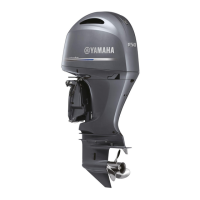

 To Next Page