*OTUSVNFOUBOEDPOUSPMGVODUJPOT
5-13
The ABS is monitored by an ECU,
which will revert the system to conven-
tional braking if a malfunction occurs.
5*1
The ABS performs a self-diagno-
sis test each time the vehicle rst
starts off after the main switch is
turned to “ON” and the vehicle has
traveled at a speed of 10 km/h (6
mi/h) or higher. During this test, a
“clicking” noise can be heard from
the front of the vehicle, and if ei-
ther brake lever is even slightly ap-
plied, a vibration can be felt at the
lever, but these do not indicate a
malfunction.
This ABS has a test mode which
allows the owner to experience
the pulsation at the brake levers
when the ABS is operating. How-
ever, special tools are required, so
please consult your Yamaha deal-
er.
NOTICE
ECA20100
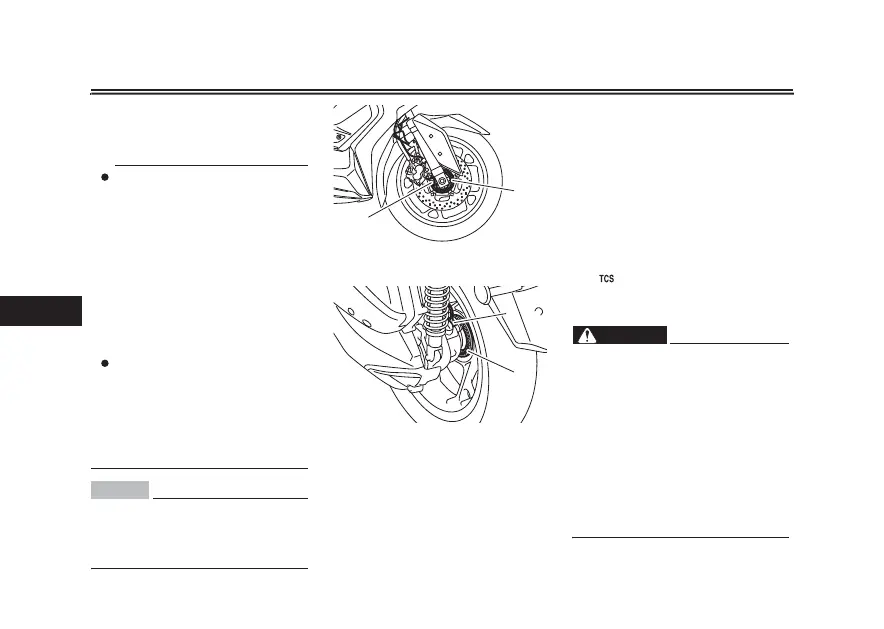
#FDBSFGVMOPUUPEBNBHFUIFXIFFM
TFOTPSPSXIFFMTFOTPSSPUPSPUIFS
XJTF JNQSPQFS QFSGPSNBODF PG UIF
"#4XJMMSFTVMU
EAU78611
5SBDUJPODPOUSPMTZTUFN
The traction control system (TCS)
helps maintain traction when acceler-
ating on slippery surfaces, such as un-
paved or wet roads. If sensors detect
that the rear wheel is starting to slip
(uncontrolled spinning), the traction
control system assists by regulating
engine power until traction is restored.
When traction control has engaged,
the “ ” indicator light will ash. You
may notice changes in engine re-
sponse or exhaust sound.
8"3/*/(
EWA18860
5IFUSBDUJPODPOUSPMTZTUFNJTOPUB
TVCTUJUVUF GPS SJEJOH BQQSPQSJBUFMZ
GPS UIF DPOEJUJPOT 5SBDUJPO DPOUSPM
DBOOPUQSFWFOU MPTTPGUSBDUJPOEVF
UP FYDFTTJWF TQFFE XIFO FOUFSJOH
UVSOT XIFO BDDFMFSBUJOH IBSE BU B
TIBSQ MFBO BOHMF PS XIJMF CSBLJOH
BOEDBOOPUQSFWFOUGSPOUXIFFMTMJQ
QJOH"TXJUIBOZWFIJDMFBQQSPBDI
TVSGBDFT UIBU NBZ CF TMJQQFSZ XJUI
DBVUJPO BOE BWPJE FTQFDJBMMZ TMJQ
QFSZTVSGBDFT
1. Front wheel sensor
2. Front wheel sensor rotor
1. Rear wheel sensor
2. Rear wheel sensor rotor
2
1
2
1



 To Next Page