1FSJPEJDNBJOUFOBODFBOEBEKVTUNFOU
8-9
EAU19623
$IFDLJOHUIFTQBSLQMVH
The spark plug is an important engine
component, which should be checked
periodically, preferably by a Yamaha
dealer. Since heat and deposits will
cause any spark plug to slowly erode,
it should be removed and checked in
accordance with the periodic mainte-
nance and lubrication chart. In addi-
tion, the condition of the spark plug
can reveal the condition of the engine.
The porcelain insulator around the
center electrode of the spark plug
should be a medium-to-light tan (the
ideal
color when the vehicle is ridden
normally). If the spark plug shows a
distinctly different color, the engine
could be operating improperly. Do not
attempt to diagnose such problems
yourself. Instead, have a Yamaha deal-
er check the vehicle.
If the spark plug shows signs of elec-
trode erosion and excessive carbon or
other deposits, it should be replaced.
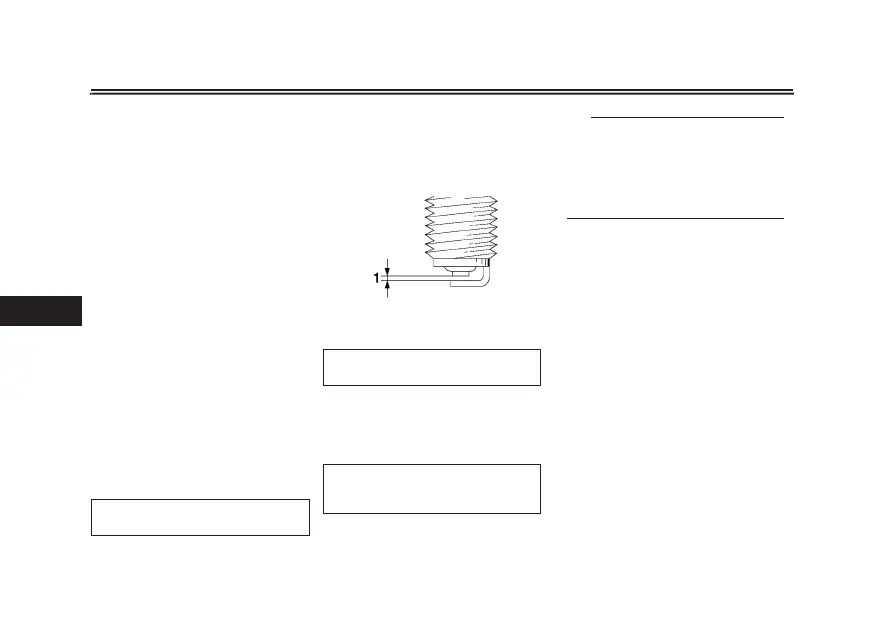
Before installing a spark plug, the
spark plug gap should be measured
with a wire thickness gauge and, if
necessary, adjusted to specication.
Clea
n the surface of the spark plug
gasket and its mating surface, and
then wipe off any grime from the spark
plug threads.
5*1
If a torque wrench is not available
when installing a spark plug, a good
estimate of the correct torque is 1/4–
1/2 turn past nger tight. However, the
spark plug should be tightened to the
specied torque as soon as possible.
4QFDJãFETQBSLQMVH
NGK/LMAR8A-9
1. Spark plug gap
4QBSLQMVHHBQ
0.8–0.9 mm (0.031–0.035 in)
5JHIUFOJOHUPSRVF
Spark plug:
13 N·m (1.3 kgf·m, 9.6 lb·ft)



 To Next Page