3-4. Determining Fish Freshness (Fish Status)
Fish AnalyzerTM PRO determines fish freshness by measuring the fish cell erosion electronically rather than
using the K-value index that is based on biochemical analysis.
This device uses a multi-frequency measurement method. The cell membrane has high electrical capacity and
insulation at low frequency bands and as electricity flows around/outside the cell without flowing through/inside
the cell, thus the impedance (electrical resistance) is high. Conversely, at the high frequency band, the cell
membrane is electrically shorted and electricity flows through/inside the cell, resulting in low impedance.
As the fish dies, the fish cells change with time. Right after the fish dies, there is high impedance that is in
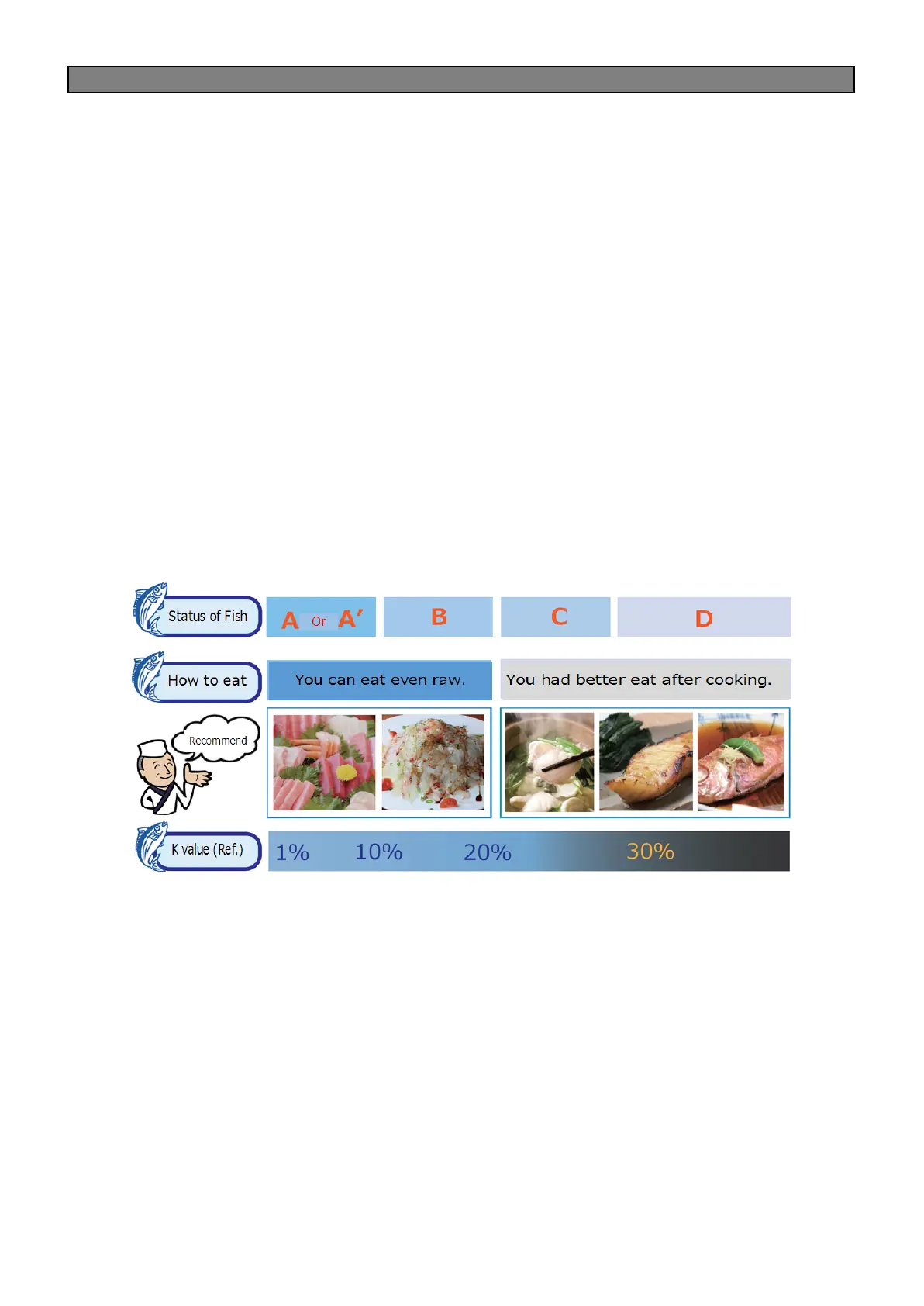
proportion to the tightness or the firmness of the fish. If the fish is “tight” or firm, it is graded at "A" or "A '" level.
After some time, the fish starts to soften and the impedance starts to decrease but the cell's electrical
characteristics are still maintained. This status is graded at "B" level.
If the fish is measured immediately after its death, the device may display “B” as the condition is similar to the
one before the fish starts to tighten and if blood remains in the body of the fish, it may display "C". When
freshness starts to decrease, the impedance from the lower frequency band drops significantly. This is because
the cell structure changes and the cell electrical characteristics deteriorates. Moreover, the water content of cells
decreases and the intracellular fluid flows out of the cells, which lowers the impedance at the lower frequency
band. The ability to retain water in cells is undoubtedly an important factor in fish freshness. The electrical
feature of the cells changes and the status of poor water content capacity is graded at “C” or “D”. The status of
fish or the fish freshness does have some common ties to the K value. The condition of the fish corresponding to
the K value of 1% to 20% is "A", "A '" or "B", and the K value that is 20% or more is equivalent to "C" or "D".
Note that grade “E” level is displayed when a measurement error occurs or “F” is displayed when the fish has
been previously frozen and thawed.
Remarks: It’s not possible to decide whether the fish can be eaten raw only by the freshness evaluation or the K value. Fish
such as salmon and mackerel, which are not eaten raw, should be cooked before eating even if the status of fish is
determined to be good.


 To Next Page