Chapter 5 Evaluation of measured result
5-1. Evaluation by impedance mode
The impedance mode is for actual measurement value for those who want to know:
1) Fish fat percentage of unregistered (not within the 20 supported) fish species listed in this document.
2) To make your own fish fat calibration. The impedance at 100 kHz is displayed instead of fat percentage
(unit: Ω). This device measures fish fat by applying small electricity into a fish body. This electricity flows
through the body easily when water is present but encounters high resistance when fat is present (no
water). It’s from these electrical characteristics that this device measures fat percentage. If it has high
impedance (resistance) at high frequency bands, this means there is more fat content present in the fish
body.
When using this impedance mode, it’s important to be consistent when measuring. We recommend having a
certain guideline of when to take measurements of the fish from time of catch (death). Once you have a
guideline to have consistent results, you can easily evaluate the fish fat percentage going forward.
5-2. Evaluating “Fish Status” (fish freshness) with actual measurement
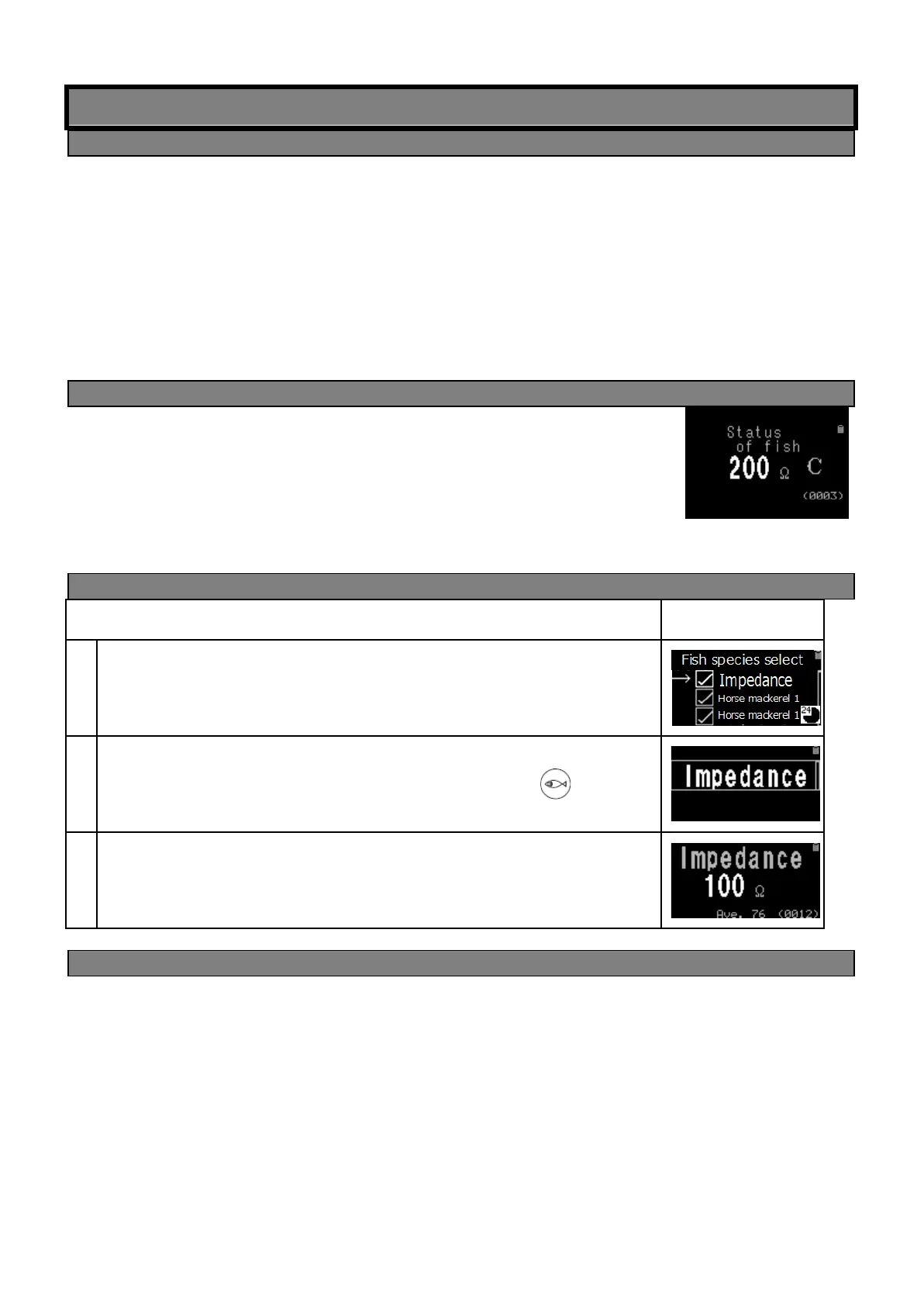
The status of fish (fish freshness) is a mode when you want to evaluate the fish
quality for fish freshness. The impedance of 5 kHz is displayed along with the 5-level
grading (unit: Ω). The measurement is carried out by applying small electric current to
the fish. The electrical characteristics of the cells change with decreasing freshness.
The water content of the cells decreases with time which makes the electricity easier
to flow through in low frequency bands, thus reducing impedance (resistance).
In the status of fish (fish freshness) mode, it’s necessary to keep track of the impedance at regular intervals.
From the measured results, you can monitor the fish quality for strict quality control.
5-3. Measuring in impedance mode
Make sure that the "Impedance mode" has a tick mark (レ) under " fish species
selection".
Start measuring after choosing “Impedance mode” by pressing key.
After measurement, the impedance value at 100kHz is displayed instead of the
fat percentage.
5-4. Custom Calibration: How to make an original algorithm
Fish Analyzer can be used to make custom calibrations mainly for research institutes use. It requires an
environment in which the actual fish fat mass can be measured and Soxhlet method or hydrometry can be used.
“Fish A", "Fish B" and "Fish C" are provided in the fish species selection. These are fish species for displaying
the percentage of fat in the original algorithm. First, measure the impedance value in the impedance mode and
then measure the fat percentage using the Soxhlet method or hydrometry. Finally, regression analysis with
impedance value is performed based on this fat percentage and by entering its slope and section, you can
create your own fat percentage formula.


 To Next Page