PERIODIC MAINTENANCE
5-22
3TNV88F Service Manual
Periodic Maintenance Procedures
Perform the following maintenance every 1500
hours of operation.
• Inspect, clean and test fuel injectors, if
necessary
• Inspect crankcase breather system
■ Inspect, clean and test fuel injectors
High-pressure Hazard!
• Avoid skin contact with the
high-pressure diesel fuel spray
caused by a fuel system leak such
as a broken fuel injection line.
High-pressure fuel can penetrate
your skin and result in serious
injury. If you are exposed to high-
pressure fuel spray, obtain
prompt medical treatment.
• Never check for a fuel leak with your hands.
Always use a piece of wood or cardboard.
Have your authorized YANMAR industrial
engine dealer or distributor repair the
damage.
• Failure to comply could result in death or
serious injury.
Proper operation of the fuel injectors is required to
obtain the optimum injection pattern for full engine
performance. The EPA/ARB requires that the fuel
injectors are inspected, cleaned and tested every
1500 hours. See Testing of Fuel Injectors on
page 7-27.
This procedure is considered normal maintenance
and is performed at the owner’s expense. This
procedure is not covered by the YANMAR Limited
Warranty.
■ Inspect crankcase breather system
Proper operation of the crankcase breather system
is required to maintain the emission requirements
of the engine. The EPA/ARB requires that the
crankcase breather system is inspected every 1500
hours.
There are three different crankcase breather
systems used on the TNV engines. Only the non-
turbo TNV engines crankcase breather system
requires periodic maintenance.
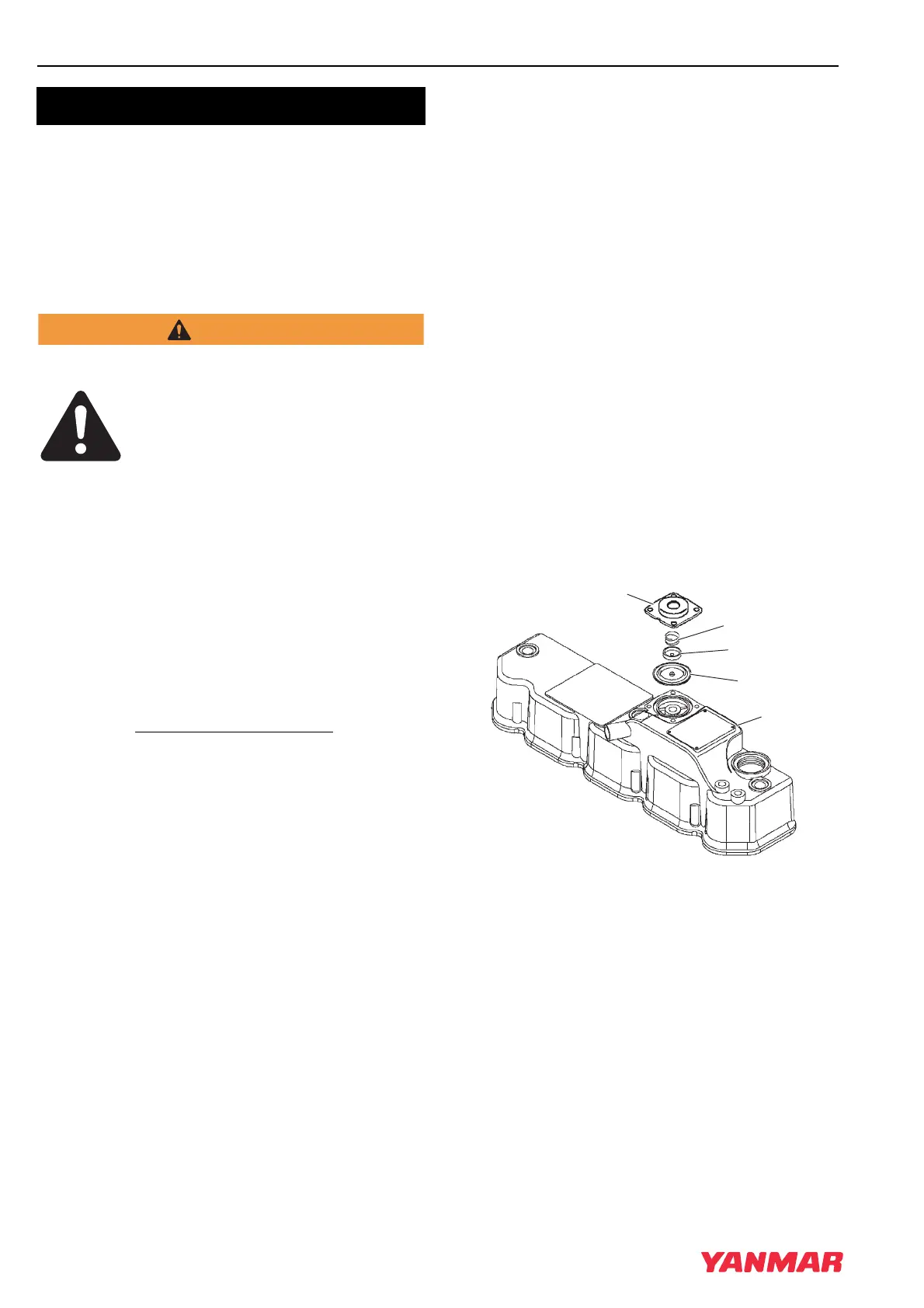
The non-turbo TNV engines use a crankcase
breather system that has a spring-backed
diaphragm (Figure 5-17, (1)) in the valve cover
(Figure 5-17, (2)). When the crankcase pressure
reaches a predetermined value, the diaphragm
opens a passage that allows crankcase fumes to
be routed to the intake manifold.
To inspect the diaphragm and spring
(Figure 5-17, (3)):
1. Remove the bolts retaining the diaphragm cover
(Figure 5-17, (4)).
Figure 5-17
2. Remove the diaphragm cover, spring,
diaphragm plate (Figure 5-17, (5)) and
diaphragm.
3. Inspect the diaphragm for tears. Inspect the
spring for distortion. Replace components if
necessary.
Every 1500 Hours of Operation
3TNV88F_SVM_A4.book 22 ページ 2012年7月26日 木曜日 午後6時4分


 To Next Page