Need help?
Do you have a question about the Zapi COMBI AC1 and is the answer not in the manual?
Details electrical and operational specs for AC traction and DC pump motors.
Visual schematics of master and slave controller configurations.
Specs for digital inputs, including voltage, impedance, and connection types.
Specifies switching threshold and input impedance for 24V systems.
Specifies switching threshold and input impedance for 48V systems.
Guidance on microswitch resistance and leakage current for reliable operation.
How to connect potentiometers or Hall effect devices for speed control.
Using analog inputs for proportional commands or braking functions.
Input for measuring traction motor winding temperature using analog sensors.
How the controller uses encoder feedback for motor speed control.
Required materials and warnings about incorrect part selection for installation.
Recommendations for cable cross-section and routing for power and auxiliary circuits.
Importance and function of the main contactor for battery connection and safety.
Recommended fuse ratings for protecting auxiliary circuits and the power unit.
Crucial safety steps and precautions before and during hardware installation.
Guidelines for mounting location and ensuring adequate heat dissipation for the controller.
Best practices for power cable length, torque, and connection to the battery.
Explains CAN bus, its applications, and how to route cables to minimize interference.
Procedures for crimping wires and ensuring correct insertion into connector cavities.
Detailed pin assignments and wiring diagrams for different encoder types.
Wiring schematics showing the main contactor and key switch integration.
Requirement to electrically isolate the truck frame from the controller's potential.
Overview of controller's internal protections and safety mechanisms.
Compliance with safety standards and dual microcontroller architecture for enhanced safety.
Discusses Electromagnetic Compatibility (EMC) and Electrostatic Discharge (ESD) considerations.
Recommendations on module compatibility and battery disconnection during charging.
Explains the system's self-diagnostic capabilities and error reporting methods.
Introduction to the logic connectors and details of the AmpSaab version.
Detailed pinout and function descriptions for the AmpSaab 42-pin connector.
Detailed pinout and function descriptions for the AmpSeal 35-pin connector.
Identifies and explains the function of the power connection terminals.
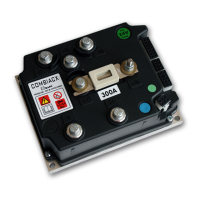
Shows physical dimensions and mounting details of the COMBI AC1 controller.
Wiring diagram illustrating the AmpSaab version connections.
Wiring diagram illustrating the AmpSeal version connections.
Connects a potentiometer to adjust the desired speed.
Connects FWD and REV travel demand switches for directional control.
Connects tiller or seat switch to enable/disable truck motion.
Details the connection of the motor shaft encoder for speed feedback.
Connects battery positive through a key switch to the controller's power input.
Connects the main contactor coil to the controller's output for battery connection.
Connects motor and negative battery terminal to the controller.
Connects the electromechanical brake for safety stopping.
Step-by-step guide for configuring the AC inverter for traction control.
How to modify inverter parameters and configuration using the digital console.
Details the functionality and physical connection of the Zapi hand-held console.
Console menu structure for configuring the Master unit with AmpSaab connectors.
Console menu structure for configuring the Master unit with AmpSeal connectors.
Console menu structure for configuring the Slave unit with AmpSaab connectors.
Console menu structure for configuring the Slave unit with AmpSeal connectors.
Lists configurable options like Tiller Switch, Hour Counter, Battery Check, and Stop on Ramp.
Details adjustable parameters including Battery Type, Throttle Zones, and set points.
Overview of parameters that can be modified, such as acceleration, speed, and current.
Access to factory-set parameters requiring expert adjustment.
Real-time monitoring of controller status, inputs, and motor variables.
Introduction to slave configuration menus and options.
Slave configurable options: Hour Counter, EVP/EV1 Type, motor temperature sensor.
Slave adjustments for throttle input and pump motor parameters.
Factory-adjusted parameters for the slave pump chopper.
Real-time monitoring of slave controller status and parameters.
How to save parameter values and configuration data to the console memory.
How to load saved parameter data from the console memory into the controller.
Procedure for calibrating potentiometer input signals for speed control.
Explains the non-linear speed control based on accelerator position.
How to configure battery voltage thresholds for charge level monitoring.
Classification of controller faults into ALARMS and WARNINGS.
Comprehensive list of master controller alarms, causes, effects, and recovery.
Overview of master controller warnings, their causes, effects, and restart procedures.
Summary of slave controller alarms, their causes, effects, and restart procedures.
Detailed steps for diagnosing and resolving slave controller alarms.


 To Next Page
 General