EasyManua.ls Logo

Zenith H-100 - Page 47

Zenith H-100
98 pages
Print Icon
To Next Page IconTo Next Page
To Previous Page IconTo Previous Page
Loading...
10-82
The
status
latch
still
can
not
be
read
until
the
status
port
select
line
(STPS)
is
asserted
at
pin
15
of
U31.
This
line
comes from
U17-14,
the
I/O
address
decoder.
The
I/O
address
decoder
activates
STPS
by
decoding
the
address
lines
AO,
A
1,
and
A2.
If
AO
and
A1
are
low
and
A2
is
high,
and
if
BDSEL
or
board
select
is
active,
then
U17's
Y1
line
goes
low.
This
causes
U31
to
place
the
status
word
onto
the
board's
internal
data
bus,
where
it
is
buffered
by
U36
to
the
S-100.bus.
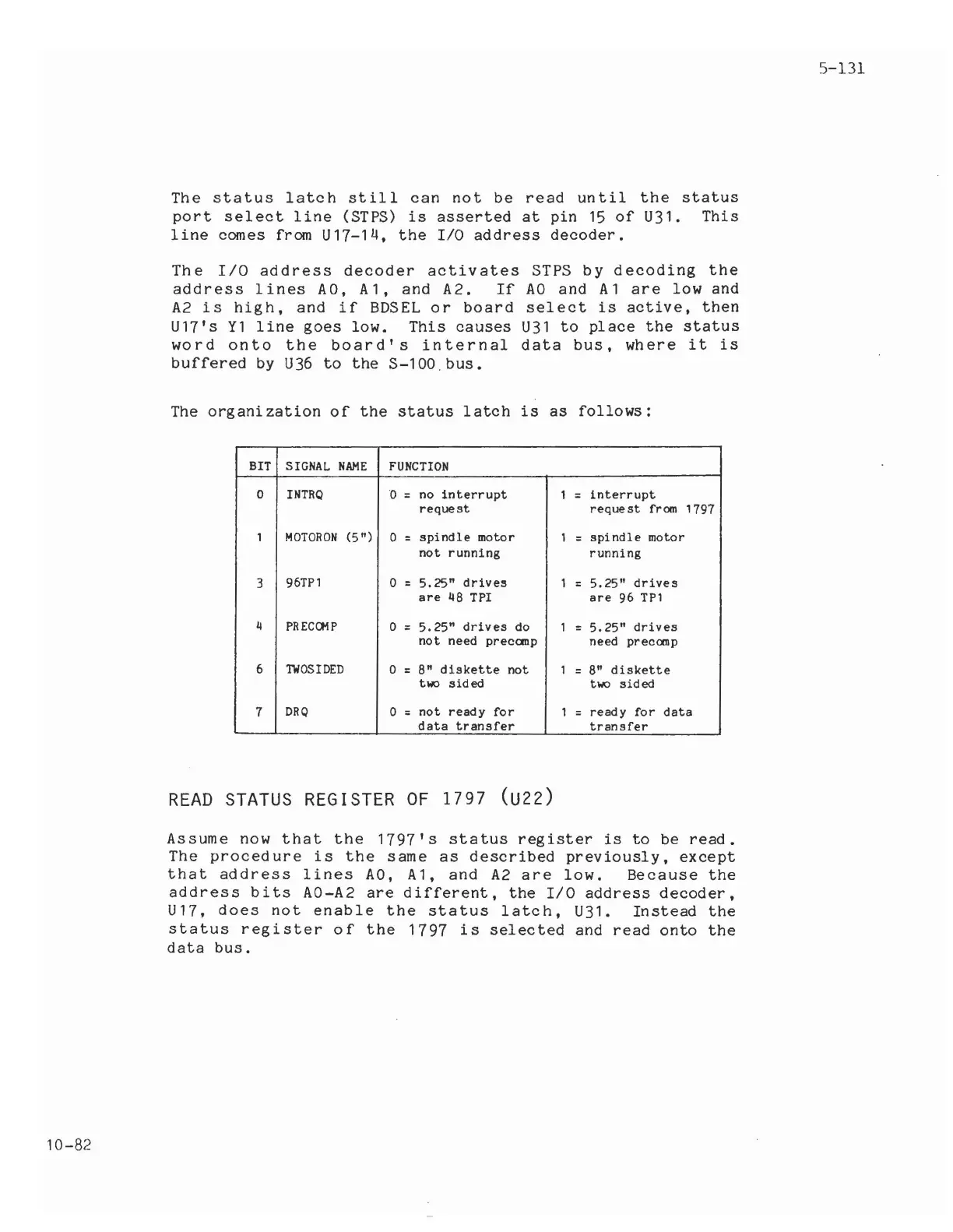
The
organization
of
the
status
latch
is
as
follows:
BIT
SIGNAL
NAME
FUNCTION
0
INTRQ
o =
no
interrupt
,
=
interrupt
request
request
from
1797
1
MOTORON
(5
")
0
=
spindle
motor
1
=
spindle
motor
not
running
running
3
96TPl
o =
5.25"
drives
1
=
5.25"
drives
are
48
TPI
are
96
TPl
4
PRECCl1P
o =
5.25"
drives
do
1
=
5.25"
drives
not
need
precanp
need
precomp
6
TWOS
I
DED
o =
8"
diskette
not
1
=
8"
diskette
t~
sided
t~
sided
7
DRQ
o =
not
ready
for
1
=
ready
for
data
data
transfer
transfer
READ
STATUS
REGISTER
OF
1797 (U22)
Assume
now
that
the
1797'
s
status
register
is
to
be
read.
The
procedure
is
the
same
as
described
previously,
except
that
address
lines
AO,
Al,
and
A2
are
low.
Because
the
address
bits
AO-A2
are
different,
the
I/O
address
decoder,
U17,
does
not
enable
the
status
latch,
U31.
Instead
the
status
register
of
the
1797
is
selected
and
read
onto
the
data
bus.
5-131

Related product manuals