Chapter 6. Description of Operation of Protection Subsystem
6-9
M7IRDA2003I
7IRD-A/J/M: Distribution Protection & Control Terminal
© ZIV APLICACIONES Y TECNOLOGÍA, S.L.U. 2020
6.1.5 Trip Blocking and Time Delay Disable
Trip Blocking inputs can be programmed into Time and Instantaneous Overcurrent elements,
which disable element trip if input is activated before trip is generated. If input is activated after
tripping, trip is reset. Trip blocking inputs must be programmed before this blocking logic can be
used.
Another programmable input exists that can turn a given Time Overcurrent element into
instantaneous. Said input is called Timer Disable and is available for all time-delayed elements.
6.2 Breaker Failure
The Breaker Failure function is designed to detect the failure of a circuit breakers response to
trip commands from protection elements. It also generates a trip signal to open adjacent
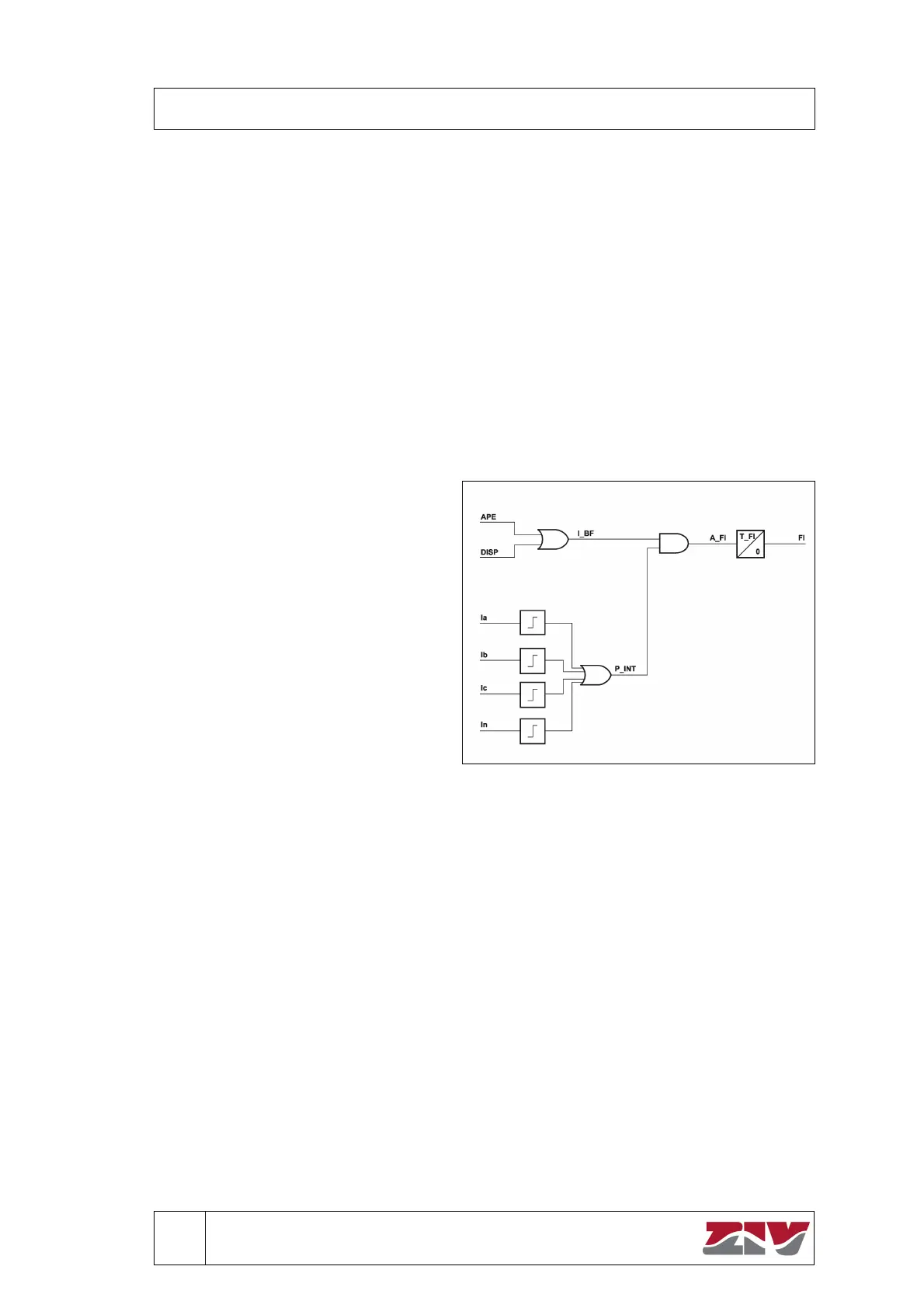
breakers capable of isolating the fault. The operation of this function is shown in the block
diagram of the following figure.
The Breaker Failure Initiate signal
(I_FI) is activated through a Trip
Command generated by the terminal
unit Internal Protection elements
(DISP) or an External Protection Trip
input (APE). Once the I_FI signal is
activated and current is still detected
by the terminal unit (P_INT signal),
the Breaker Failure signal (P_FI)
starts the counter for the Breaker
Failure Time Delay (T_FI). If T_FI
times out before either I_FI resets,
indicating that the conditions which
initiated Breaker Failure are no longer
present, or P_INT resets, indicating
that there is no current detected by
the terminal unit, the Breaker Failure
Output (FI) is activated.
Figure 6.6 Breaker Failure Element Block Diagram.
The reset of either the I_FI or P_INT signal causes the T_FI timer to reset and stop the Breaker
Failure process.
The P_INT signal, which indicates the presence of current, is active whenever any of the units
pickup levels are exceeded. These fast reset current level detectors are intended to stop the
timer as soon as the breaker is open and current has disappeared to insure that the FI signal is
not triggered inadvertently.
In order to activate the breaker failure element from an external protection trip input, one of the
terminal unit Status Contact Inputs must be configured as an External Protection Trip Input
(APE). If an input is not assigned as an External Protection Trip Input, the APE signal will
default to a logic “0”.
Additionally, one or more of the Auxiliary Contact Outputs must be configured as a Breaker
Failure Output (FI) to produce a contact output for initiating backup tripping.


 To Next Page